
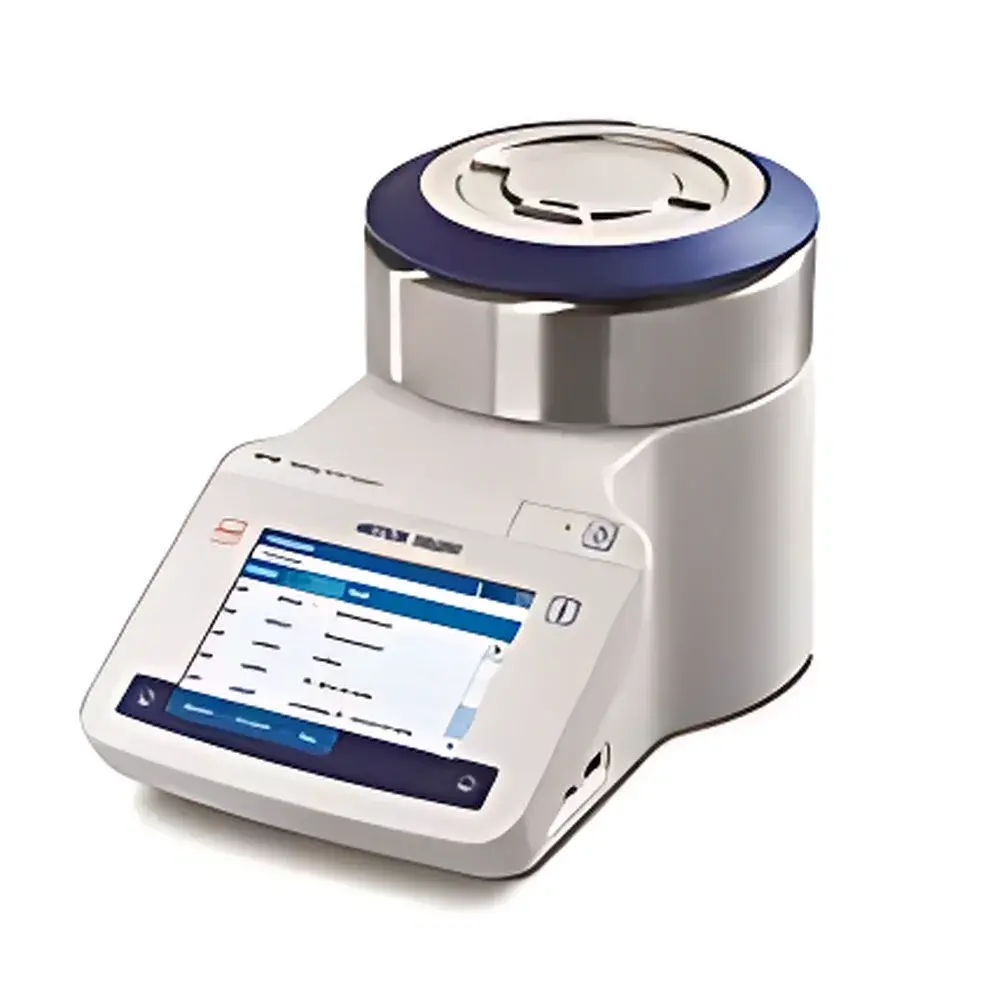
METTLER TOLEDO Excellence Series MP70 Melting Point Apparatus
| Brand | METTLER TOLEDO |
|---|---|
| Origin | Switzerland |
| Temperature Range | RT to 350 °C |
| Heating Rate | 0.1 to 20 °C/min |
| Temperature Accuracy | ±0.2 °C (30–200 °C), ±0.5 °C (200 °C to Tmax) |
| Sample Capacity | Up to 4 samples |
| Display | 5.7" VGA color touch screen |
| Video Resolution | Color AVI, >6× magnification |
| Data Export | PDF reports, GLP/GMP-compliant audit trail |
| Compliance | 21 CFR Part 11 ready (with LabX software) |
| Power Consumption | 120 W |
| Dimensions | 18 × 35 × 19 cm |
| Weight | 4.4 kg |
Overview
The METTLER TOLEDO Excellence Series MP70 Melting Point Apparatus is a fully automated, video-based thermal analysis instrument engineered for precise and reproducible determination of melting point, slip melting point, and other thermally induced phase transitions in solid organic compounds and pharmaceutical intermediates. Operating on the principle of real-time optical monitoring combined with programmable heating control, the MP70 employs high-resolution digital imaging to detect subtle changes in sample transparency, reflectivity, and morphology during controlled thermal ramping. This eliminates operator subjectivity inherent in manual capillary methods while delivering traceable, auditable results aligned with pharmacopeial standards including USP , Ph. Eur. 2.2.17, and JP 2.60. Designed for routine QC laboratories in pharmaceuticals, fine chemicals, and academia, the MP70 delivers regulatory-grade data integrity without compromising ease of use.
Key Features
- One Click™ operation: Initiate full measurement sequence—including heating, video capture, endpoint detection, and result calculation—with a single touchscreen tap.
- Integrated high-magnification optical system: Captures color AVI video at >6× magnification for real-time observation and post-run playback; enables visual verification of melt onset, clear point, and decomposition events.
- Calibration traceability: Supports dual-point calibration using certified reference standards (e.g., NIST-traceable melting point standards); stores calibration history with timestamps and operator ID.
- Robust thermal module: Platinum resistance thermometer (PRT) sensor with active temperature feedback control ensures stable ramping across the full range (RT to 350 °C) and repeatability better than ±0.1 °C under identical conditions.
- Multi-sample capability: Simultaneous loading of up to four capillaries allows parallel analysis—ideal for method validation, batch release testing, or comparative purity assessment.
- GLP/GMP-ready architecture: Built-in user management (12 customizable shortcuts per user), electronic signatures, and tamper-evident audit trails for all critical actions (method edits, calibrations, measurements).
Sample Compatibility & Compliance
The MP70 accepts standard 1-mm OD glass capillaries (1–3 mm sample height) and accommodates crystalline solids, polymorphs, hydrates, and semi-crystalline materials commonly encountered in API development and excipient qualification. It complies with ISO/IEC 17025 requirements for testing laboratories and supports IQ/OQ/PQ documentation frameworks. All measurement records—including raw video files, light intensity curves, temperature profiles, and metadata—are stored locally with time-stamped, user-locked entries. When integrated with METTLER TOLEDO LabX software, the system meets FDA 21 CFR Part 11 requirements for electronic records and signatures, including role-based access control, audit trail review functionality, and secure PDF report generation with embedded digital signatures.
Software & Data Management
Onboard firmware provides intuitive navigation via the 5.7″ VGA color touchscreen, supporting method storage (up to 20 predefined protocols), result archiving (last 50 measurements), and immediate PDF export with customizable templates. Raw video files and intensity-vs.-temperature curves are saved in standard AVI and CSV formats for external analysis. For enterprise-level integration, LabX software enables centralized instrument control, remote monitoring, automated report distribution, and seamless linkage to LIMS or ERP systems. All data transfers are encrypted, and LabX enforces strict password policies, session timeouts, and activity logging—fulfilling ALCOA+ principles (Attributable, Legible, Contemporaneous, Original, Accurate, Complete, Consistent, Enduring, Available).
Applications
- Pharmaceutical quality control: Identity confirmation and purity assessment of active pharmaceutical ingredients (APIs) per ICH Q5 and Q6 guidelines.
- Polymorph screening: Differentiation of solid-state forms based on distinct melting behavior and thermal hysteresis patterns.
- Stability studies: Monitoring thermal degradation onset during accelerated storage conditions.
- Regulatory submissions: Generating compliant datasets for ANDA, NDA, and CMC sections requiring documented thermal characterization.
- Academic research: Teaching fundamental concepts of phase transitions, eutectic behavior, and thermal purity estimation (e.g., van’t Hoff analysis).
FAQ
What temperature accuracy does the MP70 achieve across its operating range?
The MP70 guarantees ±0.2 °C accuracy between 30 °C and 200 °C, and ±0.5 °C from 200 °C to 350 °C, verified using NIST-traceable reference materials and documented in the calibration certificate.
Can the MP70 be validated for GMP environments?
Yes—the MP70 supports full qualification (IQ/OQ/PQ) with METTLER TOLEDO’s validated protocols and can be operated in compliance with Annex 11 and EU GMP guidelines when paired with LabX software.
Is video recording mandatory for every measurement?
No—video capture is configurable per method; users may enable or disable it depending on workflow needs, though it is recommended for audit readiness and troubleshooting.
How does the MP70 handle sample decomposition during heating?
The optical detection algorithm identifies darkening, bubbling, or charring events independently of melting endpoints, allowing simultaneous reporting of decomposition temperature alongside melt range.
What maintenance is required to ensure long-term performance?
Routine cleaning of the optical path and heating block with lint-free swabs and isopropanol is recommended weekly; annual recalibration by an authorized service technician is advised to maintain traceability.



