
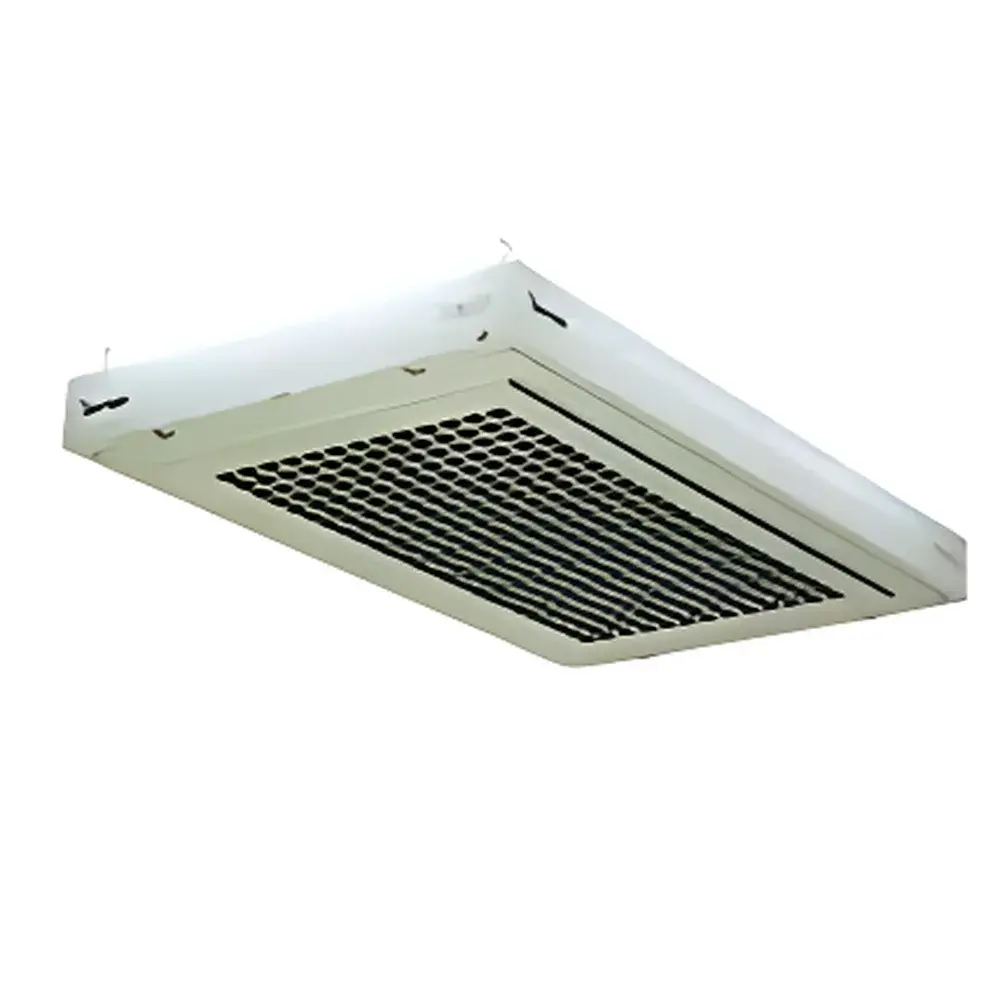
Erlab Halo Smart Laboratory Air Purifier
| Brand | Erlab |
|---|---|
| Origin | France |
| Model | Halo Smart Laboratory Air Purifier |
| Airflow Capacity | Up to 220 m³/h |
| Filtration Type | Multi-stage Filter-Based System |
| Power Supply | 100–240 V, 50/60 Hz |
| Power Consumption | 50 W |
| Weight (incl. filters) | 31 kg |
| Mounting | Ceiling-suspended via four wire ropes or bracket-mounted |
| Compliance | Designed for ISO 14644-1 Class 5–8 laboratory environments |
| Sensor Types | Semiconductor (VOCs), Electrochemical (acids, formaldehyde) |
| Control Interface | Visual status indicators (LED light patterns), e-Guard remote monitoring software via Ethernet port |
| Operating Modes | Continuous 7×24, Day/Night, Pollution-triggered Auto-Start, Adjustable Fan Speed (Min/Max) |
Overview
The Erlab Halo Smart Laboratory Air Purifier is an engineered solution for continuous, real-time removal of hazardous airborne contaminants in analytical, synthetic, and biological laboratories. Unlike general-purpose HVAC-integrated air cleaners, the Halo Smart operates as a standalone, ceiling-mounted recirculation unit that employs a dual-stage filtration architecture grounded in adsorption kinetics and particulate interception principles. Its core function is to mitigate exposure risks associated with volatile organic compounds (VOCs), acidic vapors (e.g., HCl, HF, NOx), aldehydes (notably formaldehyde), and submicron aerosols generated during routine lab operations—including fume hood sash adjustments, reagent transfers, and instrument venting. The system draws ambient air through a side intake, passes it sequentially through a pre-filter (capturing dust, fibers, and coarse particulates ≥1 µm) and a high-capacity activated carbon matrix (impregnated for both organic and inorganic gas-phase adsorption), then returns purified air via a lateral discharge grille. With a certified maximum airflow of 220 m³/h and low-energy consumption (50 W), it is validated for uninterrupted operation under ISO 14644-1 cleanroom-compatible conditions and meets fundamental requirements for occupational hygiene per ACGIH TLV® and OSHA PEL guidelines.
Key Features
- Real-time multi-sensor air quality monitoring: Integrated semiconductor sensor for broad-spectrum VOC detection and dual electrochemical sensors calibrated for acid gases and formaldehyde—enabling dynamic response to chemical-specific concentration thresholds.
- Intelligent operational modes: Configurable 7×24 continuous cycling, energy-optimized day/night scheduling, and pollution-triggered auto-activation based on real-time sensor input.
- Visual status feedback system: LED indicator patterns provide immediate, intuitive recognition of operational state (e.g., normal operation, filter saturation warning, sensor fault, airflow deviation).
- Modular ceiling installation: Supports flexible deployment via four-point suspension using stainless steel cables or rigid bracket mounting—no ductwork, HVAC integration, or structural modification required.
- Scalable coverage: Multiple units can be networked within a single lab space to maintain uniform air exchange rates and contaminant removal efficiency across variable floor plans and ceiling heights.
- e-Guard remote management platform: Enables centralized monitoring, historical data logging, alarm notifications, and firmware updates via standard Ethernet (RJ45) interface—fully compatible with institutional IT infrastructure and audit-ready for GLP/GMP environments.
Sample Compatibility & Compliance
The Halo Smart is designed for use in laboratories handling common research and QC chemicals, including but not limited to acetone, methanol, chloroform, toluene, hydrochloric acid, nitric acid, formaldehyde solutions, and ammonia. Its filtration matrix is validated against ASTM D5157-19 (Standard Guide for Indoor Air Quality Investigations) for sorption capacity and breakthrough time under controlled challenge testing. Units comply with CE marking requirements (EMC Directive 2014/30/EU, Low Voltage Directive 2014/35/EU), RoHS 2011/65/EU, and meet IEC 61000-6-3 emission limits. While not classified as medical devices, its performance aligns with ISO 15223-1 labeling conventions and supports adherence to ISO/IEC 17025:2017 clause 6.4.2 (environmental conditions for testing). Filter replacement intervals are tracked automatically and logged within e-Guard for maintenance traceability.
Software & Data Management
The embedded e-Guard software provides secure, role-based web access for system configuration, event history review, and predictive maintenance alerts. All sensor readings, fan speed settings, runtime logs, and alarm triggers are timestamped and stored locally with optional cloud synchronization (via customer-managed server). Audit trails include user login records, parameter changes, and filter life-cycle events—supporting compliance with FDA 21 CFR Part 11 where electronic records are subject to regulatory review. Data export is available in CSV format for integration into laboratory information management systems (LIMS) or environmental health and safety (EHS) dashboards. No proprietary drivers or client-side installations are required; interface operates natively in modern HTML5-compliant browsers.
Applications
- Supplemental air cleaning adjacent to fume hoods where residual vapor leakage occurs during sash movement or equipment venting.
- Continuous decontamination in open-bench chemistry labs lacking full HVAC recirculation or dedicated exhaust pathways.
- Protection of sensitive instrumentation (e.g., mass spectrometers, FTIR, XRD) from ambient VOC-induced baseline drift or detector contamination.
- Occupational exposure control in teaching labs, pharmaceutical development suites, and polymer synthesis facilities where intermittent high-emission procedures are performed.
- Air quality assurance in biosafety level 2 (BSL-2) containment areas where odorous disinfectants (e.g., glutaraldehyde, hydrogen peroxide vapor residues) require rapid clearance between experiments.
FAQ
What types of gases does the Halo Smart effectively remove?
It targets volatile organic compounds (e.g., acetone, ethanol, xylene), acidic gases (HCl, HF, SO2), formaldehyde, ammonia, and ozone—using tailored carbon impregnation and electrochemical sensor specificity.
How often must the filters be replaced?
Filter service life depends on ambient contaminant load and runtime; typical replacement intervals range from 6–12 months under standard academic lab usage, with automatic alerts issued via LED and e-Guard when saturation thresholds are approached.
Can the Halo Smart integrate with existing building management systems (BMS)?
Yes—via Modbus TCP over Ethernet or HTTP API endpoints provided in the e-Guard platform, enabling interoperability with third-party BMS and centralized facility monitoring tools.
Is the unit suitable for use in explosion-proof or hazardous area classified zones?
No—the Halo Smart is rated for general laboratory use only (non-classified environments) and is not certified for Class I Div 1 or ATEX Zone 0/1 applications.
Does it generate ozone or other secondary pollutants during operation?
No—it employs passive adsorption and mechanical filtration only; no UV-C, photocatalytic oxidation, or ionization technologies are used, eliminating risk of ozone generation or reactive byproduct formation.



