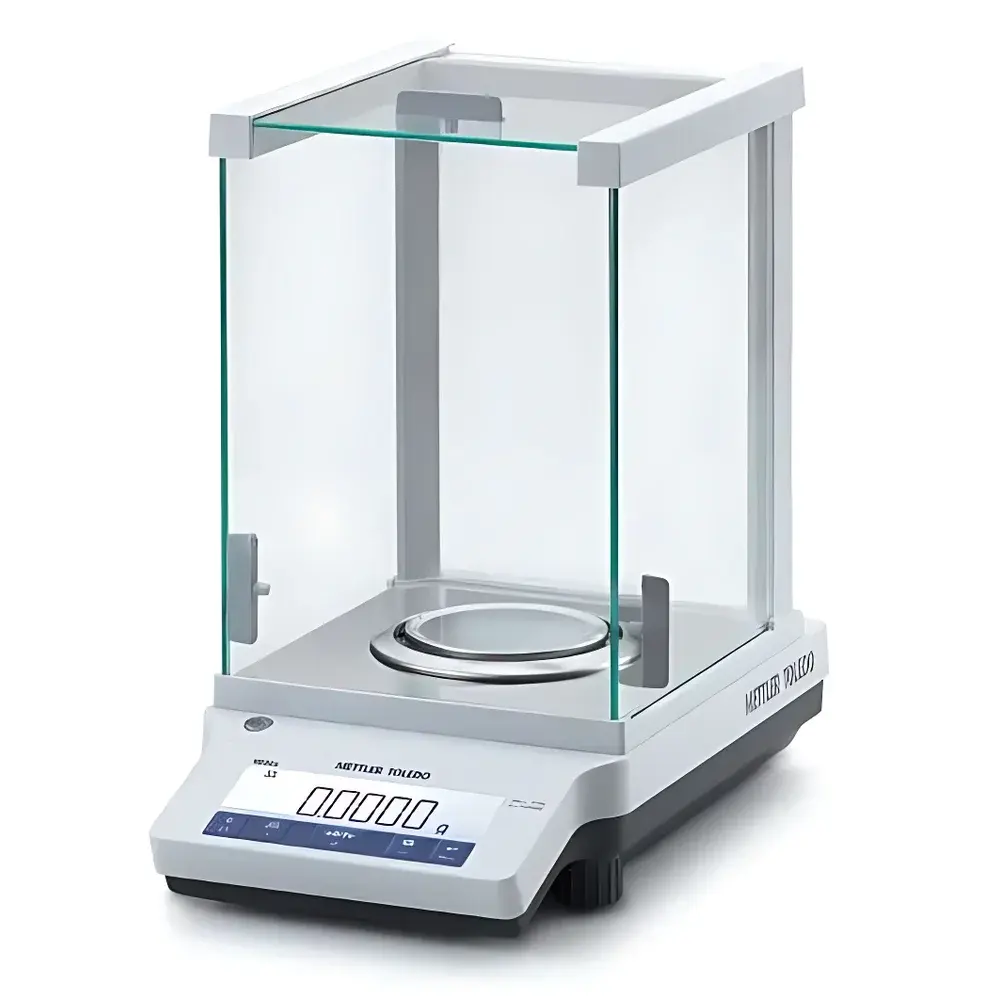
METTLER TOLEDO ME Series Analytical Balance
| Brand | METTLER TOLEDO |
|---|---|
| Origin | Switzerland |
| Model Variants | ME54 / ME104 / ME204 / ME54E / ME104E / ME204E |
| Maximum Capacity | 52 g / 120 g / 220 g |
| Readability | 0.1 mg |
| Repeatability | ≤ ±0.1 mg |
| Linearity Error | 0.2 mg |
| Stabilization Time | 2 s |
| Sensitivity Drift | 2.0 ppm/°C |
| Pan Diameter | Ø 90 mm |
| Net Weight | 4.7 kg (ME) / 4.5 kg (ME E) |
| Calibration | Internal (ME series) or External (ME E series) |
| Compliance | ISO/IEC 17025, GLP, GMP, USP <41>, ASTM E898 |
| Power Consumption | Reduced by up to 50% vs. prior generation |
Overview
The METTLER TOLEDO ME Series Analytical Balance is an entry-level precision weighing instrument engineered for routine laboratory applications requiring high reproducibility and regulatory traceability. Built upon METTLER TOLEDO’s legacy of Swiss manufacturing excellence, the ME Series employs electromagnetic force compensation (EMFC) technology — a core principle in modern analytical balances — to deliver stable, drift-resistant measurements under variable environmental conditions. Each unit features a robust metal frame with reinforced housing designed to withstand mechanical overload and minimize vibration-induced noise. The balance operates within ambient temperature ranges of 10–30 °C and relative humidity up to 80% non-condensing, ensuring consistent performance across standard QC labs, academic teaching environments, and pharmaceutical pre-formulation workflows. Its compact footprint (210 × 320 × 310 mm) and ergonomic front-panel layout support seamless integration into fume hoods, glove boxes, and benchtop workstations.
Key Features
- Electromagnetic force compensation (EMFC) sensor architecture delivering 0.1 mg readability with ≤ ±0.1 mg repeatability across all models (ME54, ME104, ME204 and their external-calibration counterparts)
- Internal calibration system (standard on ME models) with motor-driven weight deployment; external calibration option (ME E models) supports user-defined traceable standards compliant with ISO/IEC 17025 requirements
- GLP- and ISO-compliant data logging: automatic timestamping (date/time stamp) for every weighing, calibration, and adjustment event — fully auditable for regulatory submissions
- Backlit LCD display with large-digit formatting (15 mm height) optimized for visibility under low-light or high-glare conditions
- Energy-efficient design: power consumption reduced by up to 50% compared to previous-generation analytical balances; RoHS-compliant materials and eco-conscious packaging align with corporate sustainability mandates
- Smooth, rounded edges and seamless stainless-steel pan surface (Ø 90 mm) facilitate rapid cleaning and reduce particle retention — critical for ISO 14644-1 Class 5–7 cleanroom environments
- Stabilization time of ≤ 2 seconds enables throughput optimization in high-volume sample preparation protocols
Sample Compatibility & Compliance
The ME Series accommodates standard analytical samples including powders, granules, liquids in tared containers, and small solid components. Its draft shield compatibility (optional accessory) ensures measurement integrity for volatile or low-density substances. All models comply with international metrological and quality assurance frameworks: ISO 9001 calibration traceability pathways, USP requirements for accuracy and repeatability testing, ASTM E898 for balance performance verification, and FDA 21 CFR Part 11 readiness when paired with METTLER TOLEDO LabX Lite software (via optional RS232/USB interface). The built-in audit trail functionality satisfies GLP and GMP documentation expectations for raw material receipt, in-process checks, and stability study weighings.
Software & Data Management
While standalone operation requires no software, the ME Series supports bidirectional data transfer via RS232 or USB interfaces. When connected to METTLER TOLEDO LabX Lite (freely downloadable), users gain automated report generation, electronic signature capability, and structured data export to CSV, PDF, or LIMS-compatible formats. All timestamps adhere to NIST-traceable UTC synchronization. The balance firmware includes configurable user access levels and password-protected method locking — essential for multi-user laboratories operating under controlled document systems. Raw data files retain immutable metadata: operator ID, balance serial number, environmental conditions (if external sensors are integrated), and full calibration history.
Applications
- Pharmaceutical quality control: active pharmaceutical ingredient (API) dispensing, excipient ratio verification, and tablet weight uniformity testing per USP
- Chemical synthesis: stoichiometric reagent weighing, catalyst loading, and reaction mixture preparation
- Food and beverage testing: moisture content determination (via loss-on-drying protocols), nutritional labeling compliance, and allergen threshold verification
- Academic instruction: foundational gravimetric analysis, titration standardization, and density calculation experiments
- Materials science: powder blend homogeneity assessment, coating thickness validation via mass-thickness correlation, and nanomaterial dispersion quantification
FAQ
What is the difference between ME and ME E model designations?
The “ME” suffix indicates internal calibration capability with an integrated motorized weight; “ME E” denotes external calibration only — requiring manual placement of certified weights for periodic verification.
Does the ME Series support connectivity to LIMS or ERP systems?
Yes — via ASCII-based RS232 or virtual COM port over USB, enabling direct integration with laboratory information management systems (LIMS), enterprise resource planning (ERP) platforms, or custom data acquisition scripts.
Is the balance compliant with 21 CFR Part 11 for electronic records?
Out-of-the-box, the ME Series provides ALCOA+ data integrity attributes (Attributable, Legible, Contemporaneous, Original, Accurate); full 21 CFR Part 11 compliance requires LabX Lite configuration with electronic signatures and audit trail activation.
How often should internal calibration be performed?
METTLER TOLEDO recommends automatic internal calibration at user-defined intervals (e.g., at startup, after temperature shifts >2 °C, or every 2 hours), configurable via the intuitive menu interface.
Can the balance be used in a laminar flow hood?
Yes — provided the draft shield is installed and airflow velocity remains below 0.5 m/s at the weighing chamber entrance, per manufacturer specifications.