
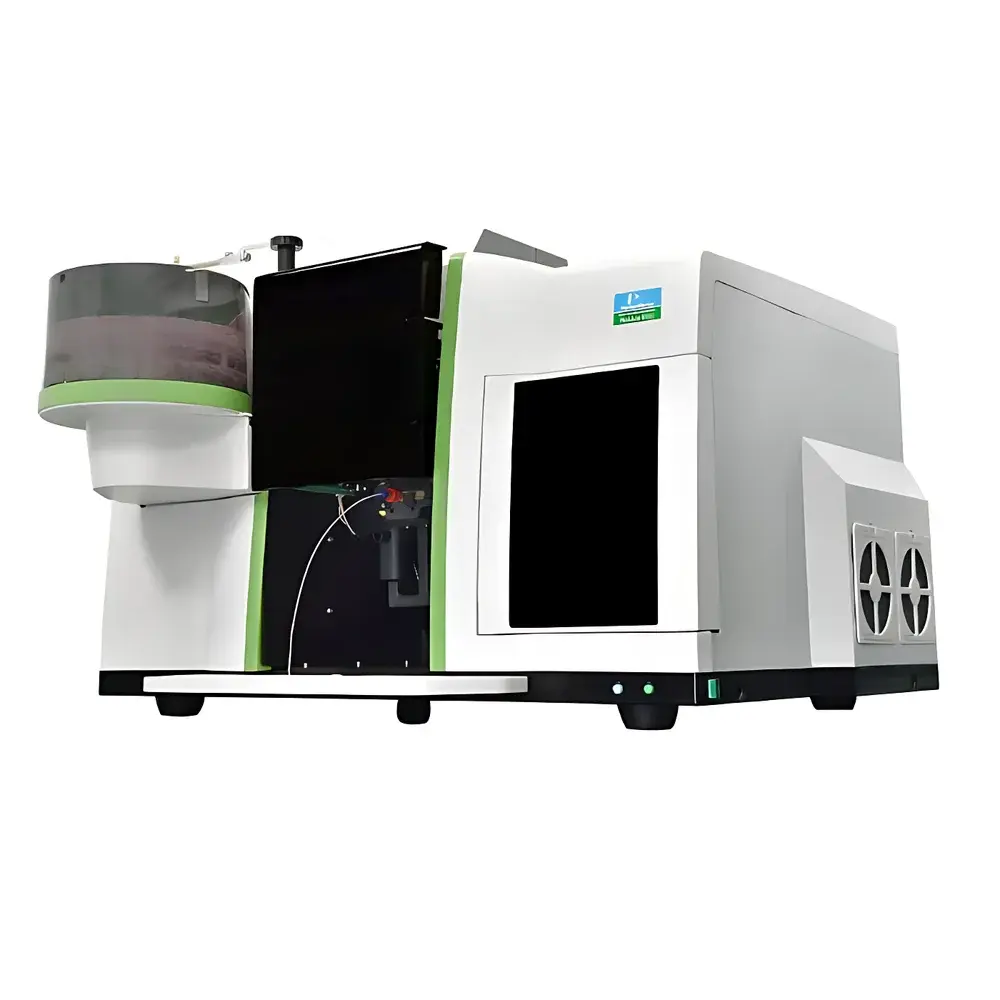
PerkinElmer PinAAcle™ 950D Atomic Absorption Spectrometer
| Brand | PerkinElmer |
|---|---|
| Origin | Jiangsu, China |
| Manufacturer Type | Original Equipment Manufacturer (OEM) |
| Regional Classification | Domestic (China-manufactured) |
| Model | PinAAcle™ 950D |
| Pricing | Available upon request |
Overview
The PerkinElmer PinAAcle™ 950D Atomic Absorption Spectrometer is a dual-mode analytical platform engineered for high-precision elemental quantification in routine and demanding laboratory environments. It integrates flame atomic absorption spectroscopy (FAAS) and graphite furnace atomic absorption spectroscopy (GFAAS) into a single, unified instrument architecture—eliminating the need for separate dedicated systems. The core measurement principle relies on Beer-Lambert law-based absorption of element-specific hollow cathode lamp (HCL) radiation by ground-state atoms atomized in either an air-acetylene or nitrous oxide-acetylene flame (FAAS), or within a temperature-programmed pyrolytic graphite tube (GFAAS). Designed with regional operational requirements in mind—including robustness under variable power supply conditions and simplified maintenance workflows—the PinAAcle 950D maintains full compliance with internationally recognized AA performance benchmarks while delivering trace-level detection sensitivity (sub-pg absolute for GFAAS; low µg/L for FAAS) and long-term signal stability.
Key Features
- Dual-Mode Atomization System: Fully integrated flame and graphite furnace modules share a common optical path, monochromator, and detector—ensuring consistent calibration and minimizing inter-method variability.
- Automatic Sample Introduction: Integrated autosampler supports both flame and furnace modes without hardware reconfiguration; accommodates up to 148 samples per rack with programmable dilution, standard addition, and replicate analysis routines.
- Enhanced Background Correction: Deuterium Arc Background (DAB) correction system with real-time lamp intensity balancing, coupled with optimized slit width/height selection, delivers superior spectral discrimination versus conventional transverse Zeeman systems—particularly critical for complex matrices such as soil digests, biological fluids, and industrial effluents.
- STPF Graphite Furnace Platform: Implements Strictly Temperature-Controlled Platform (STPF) methodology—achieving true isothermal atomization across the entire graphite surface. This ensures reproducible vaporization kinetics for refractory elements (e.g., Al, Ba, V) and minimizes matrix-induced interferences in high-salt or organic-rich samples.
- Comprehensive Flame Safety Architecture: Multi-layered interlock system monitors gas pressure, flame status, burner head alignment, and nebulizer flow in real time—preventing ignition under unsafe conditions and automatically extinguishing the flame during anomalies.
Sample Compatibility & Compliance
The PinAAcle 950D accepts liquid samples in aqueous or diluted acid media (e.g., HNO₃, HCl), including those prepared via microwave-assisted digestion (EPA Method 3051A/3052) or hotplate digestion (ASTM D5683). Solid suspensions ≤5% w/v may be introduced directly using stabilized platform GFAAS protocols. Instrument design adheres to IEC 61010-1 (Safety Requirements for Electrical Equipment for Measurement, Control, and Laboratory Use) and meets essential requirements of the EU Machinery Directive 2006/42/EC. Software operation supports audit trail generation and electronic signature functionality aligned with FDA 21 CFR Part 11 and GLP/GMP documentation standards when deployed with Syngistix for AA Express in validated configurations.
Software & Data Management
Syngistix for AA Express provides a streamlined, icon-driven interface built on a modular workflow engine. Method setup follows a three-step sequence: (1) Select element and lamp, (2) Define atomization mode and parameters (flame gas ratios, furnace temperature ramps), and (3) Configure calibration strategy (single-point, multi-point, standard addition). All acquisition, processing, and reporting functions are accessible via context-sensitive toolbars. Real-time spectral visualization, peak integration with baseline correction options (linear, curved, derivative), and automatic interference flagging are embedded. Reports are exportable in PDF, CSV, and XML formats—with customizable templates compliant with ISO/IEC 17025 reporting clauses. Raw data files retain full metadata (lamp current, slit width, integration time, furnace temperature profile timestamps) for retrospective analysis and regulatory review.
Applications
The PinAAcle 950D serves laboratories engaged in environmental monitoring (EPA 7000B, ISO 11885), food safety testing (AOAC 972.32, ISO 11171), clinical toxicology (blood Pb, urinary Cd), geological resource assessment (rock/soil metal content per ASTM D4292), and pharmaceutical excipient purity verification (USP ). Its STPF furnace enables reliable determination of ultra-trace elements in challenging sample types—such as seawater (NaCl matrix), plant tissue digests (high K/Ca), and catalyst residues—without requiring extensive chemical modification or matrix-matched calibration.
FAQ
Does the PinAAcle 950D support hydride generation or cold vapor techniques?
No—this model is configured exclusively for flame and graphite furnace AAS. Hydride generation (HG-AAS) and cold vapor (CV-AAS) require dedicated accessories not included in the base configuration.
Is remote instrument control possible via LAN or USB?
Yes—Syngistix for AA Express supports Ethernet-based remote operation, including method transfer, real-time data streaming, and instrument status monitoring from networked workstations.
What maintenance intervals are recommended for the graphite furnace components?
Pyrolytic graphite tubes should be replaced after 200–300 firings depending on sample matrix; platform inserts require replacement every 500–800 firings. Auto-calibration of lamp alignment and wavelength accuracy is performed daily during startup.
Can the software generate IQ/OQ/PQ documentation templates?
Syngistix includes configurable validation protocol wizards supporting installation qualification (IQ), operational qualification (OQ), and performance qualification (PQ) activities per ISO/IEC 17025 and GxP requirements.
Is third-party LIMS integration supported?
Yes—via ASTM E1384-compliant ASCII or HL7 message export, enabling bidirectional data exchange with major laboratory information management systems (LIMS).





