
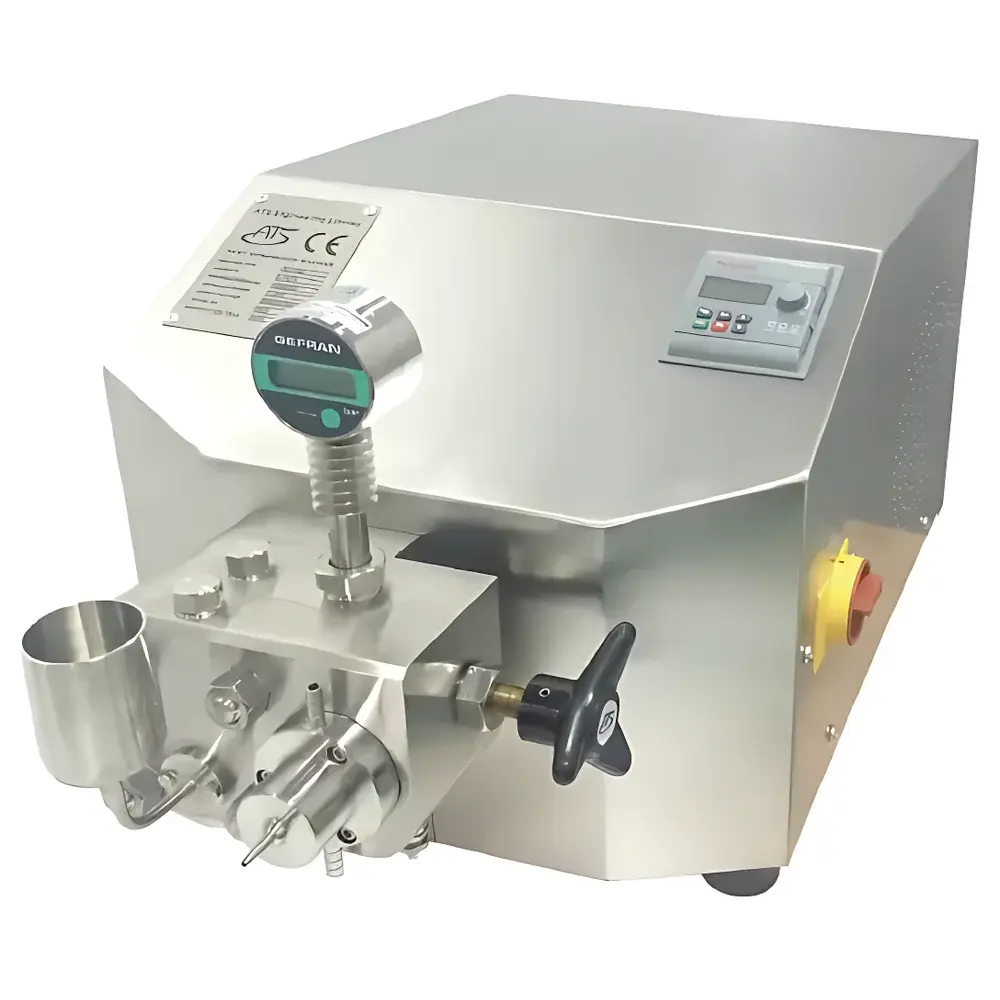
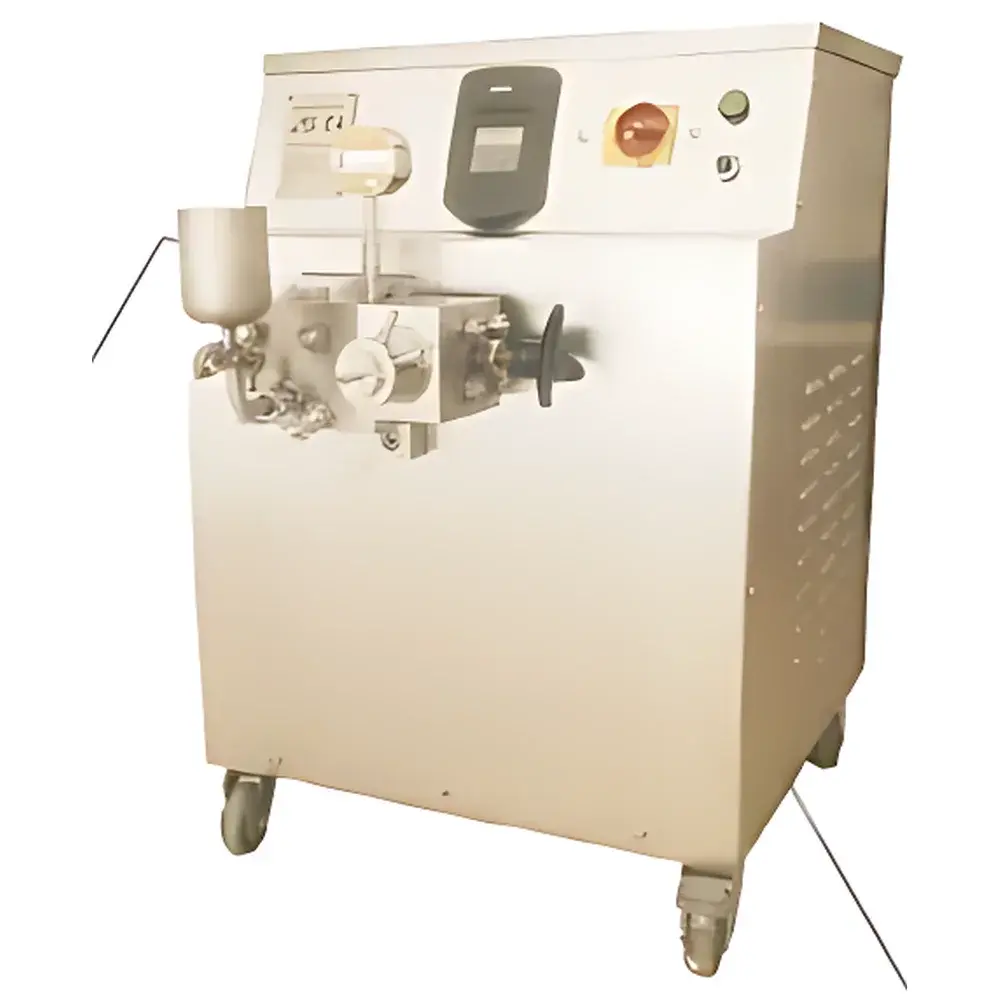
ATS AH-D150 High-Pressure Homogenizer
| Brand | ATS |
|---|---|
| Origin | Canada |
| Model | AH-D150 |
| Instrument Type | High-Pressure Homogenizer |
| Dimensions (W×D×H) | 440 × 800 × 410 mm |
| Processing Capacity | 5–15 L/h |
| Minimum Sample Volume | 15 mL |
| Maximum Design Pressure | 2000 bar |
| Maximum Operating Pressure | 1500 bar |
| Flow Control | Variable-Frequency Drive (VFD) with Adjustable Flow Rate |
| Pressure Sensing | Digital Pressure Transducer, 0–2000 bar Range, ±10 bar Accuracy |
| Integrated Cooling System | Yes |
| Overpressure Protection | Programmable Safety Cut-off |
| Residual Volume | Near-Zero via Integrated Exhaust Valve |
| Power Supply | 220 V AC, 1.5 kW |
| Certification | CE Compliant (EU Machinery Directive 2006/42/EC & EMC Directive 2014/30/EU) |
Overview
The ATS AH-D150 High-Pressure Homogenizer is an industrial-grade, benchtop homogenization system engineered for reproducible cell disruption, nanoemulsion formation, and colloidal dispersion under precisely controlled high-pressure conditions. Based on the principle of microfluidic shear and cavitation-induced lysis—where samples are forced through a narrow interaction chamber at pressures up to 1500 bar—the AH-D150 delivers consistent mechanical energy input essential for applications requiring sub-micron particle size reduction and uniform dispersion. Designed and assembled in Canada, the system complies with EU CE directives for machinery safety and electromagnetic compatibility, ensuring operational integrity in regulated laboratory environments including GLP-compliant R&D labs and early-stage process development facilities.
Key Features
- Robust stainless-steel construction with precision-machined homogenizing valve and integrated heat exchanger for real-time thermal management during extended operation.
- Variable-frequency drive (VFD) flow control enabling precise adjustment of throughput between 5 and 15 L/h, supporting scalable process optimization from screening to pilot-scale batch preparation.
- Digital pressure monitoring via a calibrated transducer (0–2000 bar range, ±10 bar accuracy), displayed on an intuitive front-panel interface with programmable overpressure cut-off logic.
- Near-zero residual volume architecture achieved through a pneumatically actuated exhaust valve and optimized fluid path geometry—critical for precious biological samples and cross-contamination-sensitive workflows.
- Soft-start motor control minimizes mechanical stress during startup, reduces acoustic emissions (<72 dB(A)), and extends service life of pump components and seals.
- Comprehensive safety suite including thermal overload protection, phase-loss detection, and emergency stop circuitry compliant with IEC 60204-1.
Sample Compatibility & Compliance
The AH-D150 accommodates a broad spectrum of sample matrices, including microbial cultures (e.g., E. coli, yeast), suspension-adapted mammalian cells (CHO, HEK293, Vero, SF9), lipid-based formulations (liposomes, fat emulsions, nanostructured lipid carriers), protein-rich food matrices (whey isolates, casein micelles), and nanomaterial dispersions (graphene oxide, carbon nanotubes). Its pressure stability and low dead-volume design support protocols aligned with ISO 13320 (laser diffraction particle sizing), USP (liposomal particle size distribution), and ASTM E2456 (cell disruption efficiency assessment). All wetted parts meet FDA-compliant material standards (316L SS, EPDM/PFA seals), and documentation supports audit readiness for ISO 9001 and 21 CFR Part 11–enabled data integrity frameworks when paired with validated software interfaces.
Software & Data Management
While the AH-D150 operates as a standalone instrument with local digital control, it features analog and RS-485 communication ports for integration into centralized lab automation systems. Optional firmware upgrades enable timestamped pressure/flow logging (CSV export), user-level access control (admin/operator modes), and configurable alarm thresholds—all traceable via internal audit trail. When deployed in GMP-aligned environments, third-party SCADA or LIMS connectors may be configured to satisfy ALCOA+ principles (Attributable, Legible, Contemporaneous, Original, Accurate, Complete, Consistent, Enduring, Available) for critical process parameters.
Applications
- Biopharmaceutical R&D: Lysis of gram-negative bacteria and suspension-grown mammalian cells for intracellular protein recovery; preparation of viral vector suspensions and mRNA-LNP formulations.
- Nanomedicine Development: Production of sterility-compatible nanoemulsions, polymeric nanoparticles, and liposomal drug carriers with narrow PDI (<0.15) and repeatable Z-average diameters.
- Functional Food Science: Homogenization of high-viscosity dairy and plant-based protein emulsions to improve physical stability and mouthfeel consistency.
- Advanced Materials Research: Exfoliation and de-agglomeration of 2D materials and conductive nanofillers in aqueous/organic media for ink formulation and thin-film deposition.
- Quality Control Laboratories: Standardized disruption protocols for reference material generation in microbiological assay validation and enzyme activity profiling.
FAQ
What is the maximum allowable operating pressure for routine use?
The AH-D150 is rated for continuous operation at up to 1500 bar; the 2000 bar value represents its certified structural safety margin per ASME B31.3 process piping standards.
Can the system process viscous or particulate-laden samples?
Yes—provided inlet viscosity remains ≤500 cP and suspended particles are <50 µm in diameter. Pre-filtration through a 100 µm mesh is recommended for crude lysates.
Is the cooling system sufficient for extended runs at 1200+ bar?
The integrated heat exchanger maintains sample temperature rise within ±3 °C over 60-minute continuous operation at 1300 bar and 10 L/h flow, assuming ambient lab temperature ≤25 °C.
Does the AH-D150 support regulatory compliance for pharmaceutical manufacturing?
The base unit meets CE requirements for safety and EMC; full 21 CFR Part 11 compliance requires optional software validation packages and documented IQ/OQ protocols executed by qualified personnel.
What maintenance intervals are recommended?
Valve seat inspection every 200 hours of cumulative operation; O-ring replacement every 500 hours; full hydraulic system flush and calibration annually or after 1000 operating hours—whichever occurs first.



