
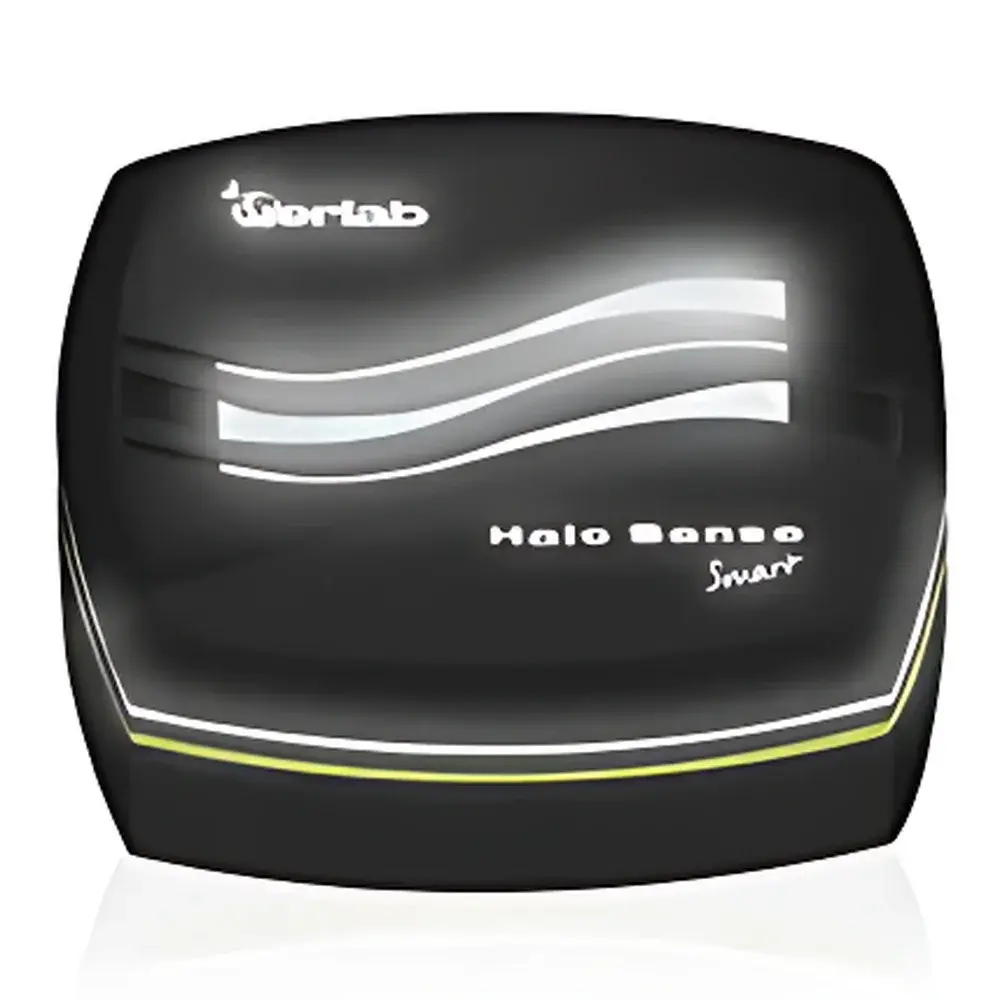
Erlab Halo Sense Laboratory Air Quality Sensor
| Brand | Erlab |
|---|---|
| Origin | France |
| Model | Halo Sense Laboratory Air Quality Sensor |
| Detection Targets | VOCs, Acids, Formaldehyde |
| Connectivity | Ethernet + USB + Bluetooth (via eGuard app) |
| Alert Mechanism | Dual-mode visual (RGB status ring) + audible alarm |
| Software Platform | eGuard Cloud & Desktop Application |
| Compliance | CE, RoHS, EN 61000-6-3, EN 61000-6-1 |
| Power Supply | 100–240 VAC, 50/60 Hz |
| Mounting | Wall-mounted with IP20 enclosure |
| Operating Environment | 5–40 °C, 20–80% RH non-condensing |
Overview
The Erlab Halo Sense Laboratory Air Quality Sensor is an engineered environmental monitoring solution designed for continuous, real-time detection of hazardous airborne contaminants in analytical, synthetic, and teaching laboratories. Built upon multi-sensor electrochemical and photoionization detection principles, the Halo Sense platform delivers selective, stable response to three critical chemical hazard classes: volatile organic compounds (VOCs), acidic gases (e.g., HCl, HF, NO₂, SO₂), and formaldehyde—each addressed by a dedicated, field-replaceable sensor module. Unlike single-gas point monitors, Halo Sense integrates cross-interference compensation algorithms and temperature/humidity compensation to maintain measurement integrity across dynamic lab environments. Its architecture supports both local presence awareness—via a calibrated RGB status ring and Class I audible alert—and remote situational awareness through encrypted cloud telemetry. The system operates as a fixed-installation node within a broader laboratory safety infrastructure, intended to complement—not replace—engineering controls such as fume hoods, gas scrubbers, and local exhaust ventilation.
Key Features
- Dedicated sensor variants: Halo Sense-VOC (PID-based, 1–5000 ppm range), Halo Sense-Acid (electrochemical, sub-ppm detection for corrosive gases), Halo Sense-Formaldehyde (high-selectivity metal oxide semiconductor with <50 ppb LOD)
- Real-time dual-mode alerting: Programmable RGB annular indicator (green = normal, amber = threshold warning, red = alarm), plus adjustable 85 dB(A) audible tone compliant with ISO 7731 for hazard signaling
- eGuard software integration: Desktop application (Windows/macOS) and mobile app (iOS/Android) providing live concentration graphs, historical trend logging, event tagging, and customizable notification thresholds via email/SMS/push
- Network resilience: Dual communication paths—wired Ethernet (TCP/IP) for primary data streaming and Bluetooth Low Energy (BLE) for local commissioning and firmware updates
- Regulatory-ready data handling: Audit-trail enabled logging (ISO/IEC 17025 traceable timestamps), user access levels (admin/operator), and optional 21 CFR Part 11-compliant electronic signature module for GLP/GMP environments
- Installation flexibility: Wall-mount bracket included; operates continuously with AC power; no consumables or recalibration required within first 12 months per manufacturer specification
Sample Compatibility & Compliance
Halo Sense is validated for use in ISO 14644-1 Class 7–8 cleanroom-adjacent labs, university chemistry teaching facilities, and industrial R&D laboratories handling moderate-hazard reagents. It complies with European electromagnetic compatibility (EN 61000-6-3) and immunity (EN 61000-6-1) standards, carries CE marking under the Low Voltage Directive 2014/35/EU, and meets RoHS 2011/65/EU material restrictions. Sensor modules are calibrated against NIST-traceable reference gases prior to shipment. While not certified as a life-safety device under EN 50545 or UL 2075, Halo Sense is explicitly designed and documented for occupational exposure monitoring per OSHA PEL and ACGIH TLV guidelines. Deployment must follow Erlab’s Site Assessment Protocol (SAP-LS-002), which defines optimal placement relative to potential emission sources, airflow patterns, and occupancy zones.
Software & Data Management
The eGuard platform provides secure, role-based access to sensor data via TLS 1.2–encrypted web interface or locally installed client. All measurements are timestamped with microsecond precision using internal RTC synchronized to NTP servers. Raw data (concentration, temperature, humidity, signal stability index) are stored in CSV and SQLite formats, with optional export to LIMS via RESTful API. Event logs include operator-initiated actions (e.g., “alarm acknowledged”, “sensor zeroed”), automatic diagnostics (e.g., “baseline drift >5%”, “humidity out-of-spec”), and configurable retention policies (default: 90 days on-device, 365 days in cloud). For regulated environments, eGuard supports ALCOA+ principles: attributable, legible, contemporaneous, original, accurate, complete, consistent, enduring, and available—with full audit trail export capability.
Applications
- Continuous verification of fume hood containment integrity during active use or standby mode
- Early-warning monitoring near solvent storage cabinets, acid stockrooms, and formaldehyde-releasing equipment (e.g., histology processors)
- Post-maintenance validation of local exhaust systems following filter replacement or ductwork inspection
- Occupational hygiene surveys supporting ISO 45001 compliance and exposure recordkeeping
- Teaching lab safety demonstrations: real-time visualization of vapor dispersion during open-vessel procedures
- Integration into building management systems (BMS) via Modbus TCP gateway for automated ventilation ramp-up on alarm condition
FAQ
Does Halo Sense require periodic calibration in the field?
Yes—annual sensor verification using certified span gas is recommended; Erlab provides factory-certified calibration kits and remote support for bump testing.
Can multiple Halo Sense units be managed from a single eGuard instance?
Yes—eGuard Desktop supports up to 64 networked sensors; eGuard Cloud offers unlimited scalability with site-level dashboards and group permissions.
Is formaldehyde detection specific to HCHO only, or does it respond to other aldehydes?
The Halo Sense-Formaldehyde module exhibits >100× selectivity for HCHO over acetaldehyde and propionaldehyde per IEC 60751 validation reports.
What happens if network connectivity is lost?
All measurements continue locally with 72-hour onboard data buffering; synchronization resumes automatically upon connection restoration without data loss.
Can Halo Sense trigger external devices (e.g., hood sash alarms or HVAC relays)?
Yes—via optional digital output module (Halo IO-1) supporting dry-contact closure or 0–10 V analog output, configurable per alarm severity level.



