
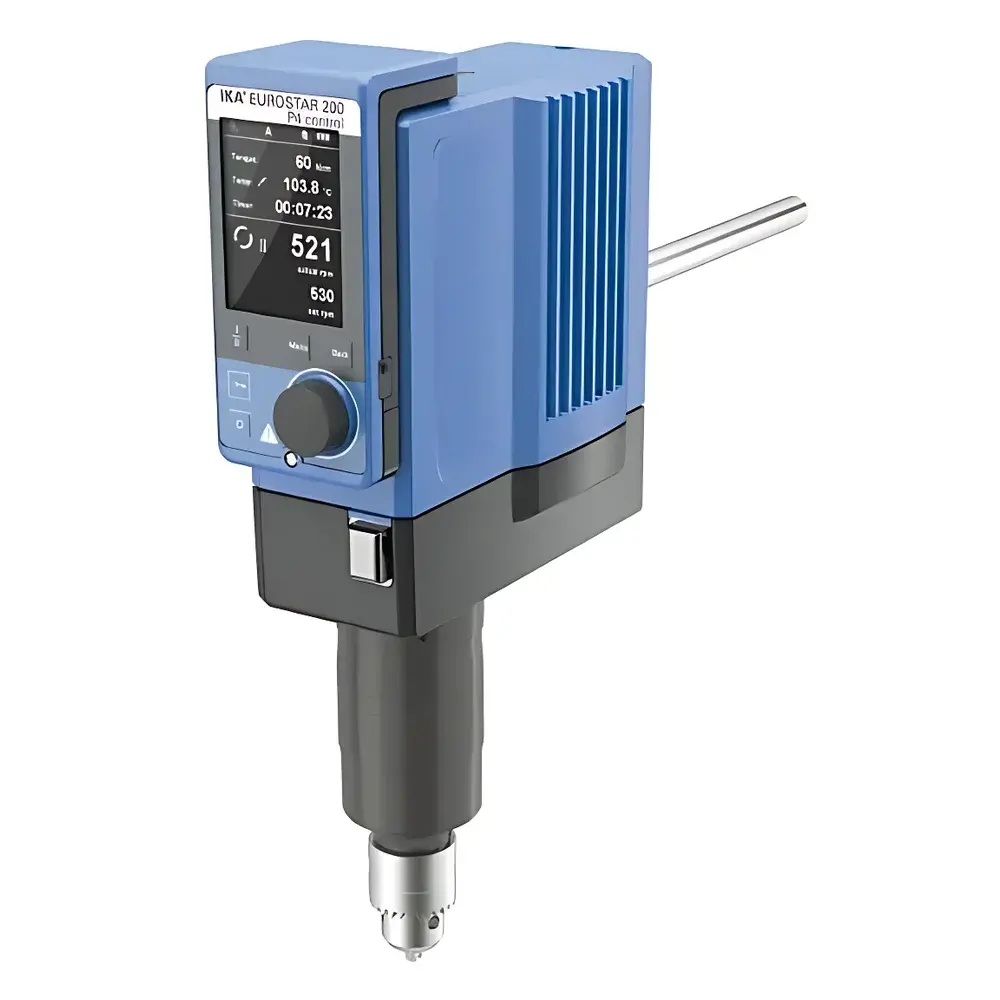
IKA Eurostar 200 P4 Control Stirrer
| Brand | IKA |
|---|---|
| Origin | Germany |
| Model | Eurostar 200 P4 Control |
| Max. Viscosity | 150,000 mPa·s |
| Max. Volume (H₂O) | 100 L |
| Speed Range | 0/4–530 rpm (two ranges: I: 4–108 rpm |
| II | 16–530 rpm) |
| Torque | 660 N·cm (Range I), 130 N·cm (Range II) |
| Motor | Brushless DC |
| Power Input | 134 W |
| Power Output | 99 W |
| Stirring Shaft Output Power | 76 W |
| Temp. Measurement | PT1000 interface, –10 to +350 °C, ±0.5 K (DIN IEC 751 Class A) |
| Display | TFT touchscreen |
| Interfaces | RS 232, USB |
| IP Rating | IP 40 |
| Dimensions | 91 × 379 × 231 mm |
| Weight | 5.8 kg |
| Ambient Operating Conditions | 5–40 °C, ≤80% RH |
Overview
The IKA Eurostar 200 P4 Control Stirrer is a high-performance, microprocessor-driven laboratory stirrer engineered for precision mixing and dispersion of demanding samples—including highly viscous, shear-sensitive, or temperature-dependent formulations. Built on a robust brushless DC motor architecture, it delivers exceptional torque stability and speed fidelity across its dual-range operation (4–108 rpm and 16–530 rpm), enabling reliable handling of volumes up to 100 L (water-equivalent) and viscosities up to 150,000 mPa·s. Unlike conventional stirrers with fixed-speed feedback loops, the Eurostar 200 P4 implements real-time closed-loop speed regulation: it continuously compares actual shaft rotation against the setpoint and dynamically adjusts power delivery to maintain constant rotational velocity—even during significant viscosity shifts or transient load changes. This capability ensures reproducible hydrodynamic conditions critical for process development, QC batch validation, and formulation consistency studies in pharmaceutical, chemical, and materials science laboratories.
Key Features
- Brushless DC motor with 99 W continuous output power and 76 W shaft-delivered power—eliminates carbon wear, extends service life, and enables silent, low-maintenance operation
- Dual-speed-range architecture (I: 4–108 rpm; II: 16–530 rpm) optimized for both high-torque low-speed dispersion and high-shear mixing applications
- Real-time torque trend display for indirect viscosity profiling—enables detection of structural transitions (e.g., gelation, polymer crosslinking, crystallization onset)
- TFT color touchscreen with multilingual UI (English, German, French, Spanish, Chinese, Japanese), programmable protocols, and integrated timer (1–6000 min)
- Active thermal monitoring via optional PT1000 probe (–10 to +350 °C; ±0.5 K accuracy per DIN IEC 751 Class A) with on-screen temperature overlay during stirring
- Comprehensive safety system: automatic shutdown on motor stall, overtorque, or thermal overload; adjustable torque limit; mechanical and electronic interlocks
- Wireless remote control (up to 150 m line-of-sight range) with full parameter access—supports hands-free operation in fume hoods or gloveboxes
- RS 232 and USB interfaces for bidirectional communication with PC-based lab software (e.g., LabWorldSoft); supports automated data logging of speed, torque, temperature, time, and error codes
Sample Compatibility & Compliance
The Eurostar 200 P4 accommodates a broad spectrum of sample types—from Newtonian liquids and pseudoplastic suspensions to thixotropic gels and particle-laden slurries—thanks to its high starting torque (660 N·cm in Range I) and adaptive speed stabilization. Its 0.5–10 mm chuck accepts standard ISO 8687-compliant stirring elements (propellers, anchors, dissolvers, helical ribbons). While not certified for explosion-proof (ATEX) or cleanroom (ISO 14644) environments, the unit complies with key international safety and EMC standards: EN 61000-6-3 (emissions), EN 61000-6-2 (immunity), and EN 61010-1 (electrical safety for laboratory equipment). Its firmware architecture supports audit-ready operation under GLP and GMP frameworks when paired with compliant data acquisition software meeting FDA 21 CFR Part 11 requirements for electronic records and signatures.
Software & Data Management
Data integrity and traceability are ensured through native RS 232 and USB connectivity, allowing seamless integration with IKA’s LabWorldSoft platform or third-party LIMS/ELN systems. All operational parameters—including setpoints, real-time speed/torque/temperature values, timestamped events, and diagnostic codes—are logged at user-defined intervals (down to 1 s resolution). The system generates CSV-exportable reports compatible with statistical process control (SPC) tools. Critical functions such as protocol locking, user-level access control (admin/operator modes), and electronic signature prompts align with ALCOA+ principles (Attributable, Legible, Contemporaneous, Original, Accurate, Complete, Consistent, Enduring, Available). Firmware updates are delivered via USB stick with cryptographic checksum verification.
Applications
- Pharmaceutical: Homogenization of ointments, suspensions, and emulsions; dissolution testing support; API crystallization kinetics under controlled shear
- Chemical R&D: Polymerization reaction mixing; catalyst slurry dispersion; multi-phase reaction optimization
- Food & Cosmetics: Stabilizer hydration, thickener activation, and rheological conditioning of creams and sauces
- Materials Science: Carbon nanotube dispersion in solvents; ceramic slurry deagglomeration; battery electrode slurry homogenization
- Academic Research: Teaching labs requiring robust, repeatable stirring for fluid dynamics or mass transfer experiments
FAQ
Does the Eurostar 200 P4 support bidirectional rotation?
No—it operates in clockwise rotation only, optimized for compatibility with standard anchor, paddle, and turbine impellers.
Can external temperature probes other than PT1000 be used?
Only PT1000 sensors compliant with DIN IEC 751 Class A are supported; third-party probes may yield inaccurate readings due to calibration mismatch.
Is continuous 100% duty cycle operation permitted?
Yes—the motor and electronics are thermally rated for uninterrupted operation at any speed within specification, provided ambient conditions remain within 5–40 °C and ≤80% RH.
What is the maximum allowable radial load on the stirring shaft?
The chuck and bearing assembly are designed for axial loading typical of vertical immersion; lateral loads exceeding 5 N at the tip are not recommended and may accelerate wear.
How is calibration traceability maintained for torque and speed measurements?
Speed is calibrated against internal quartz-referenced timing circuits (±1 rpm accuracy above 300 rpm); torque calibration is factory-performed using NIST-traceable load cells and documented in the device’s CoC (Certificate of Conformance).



