
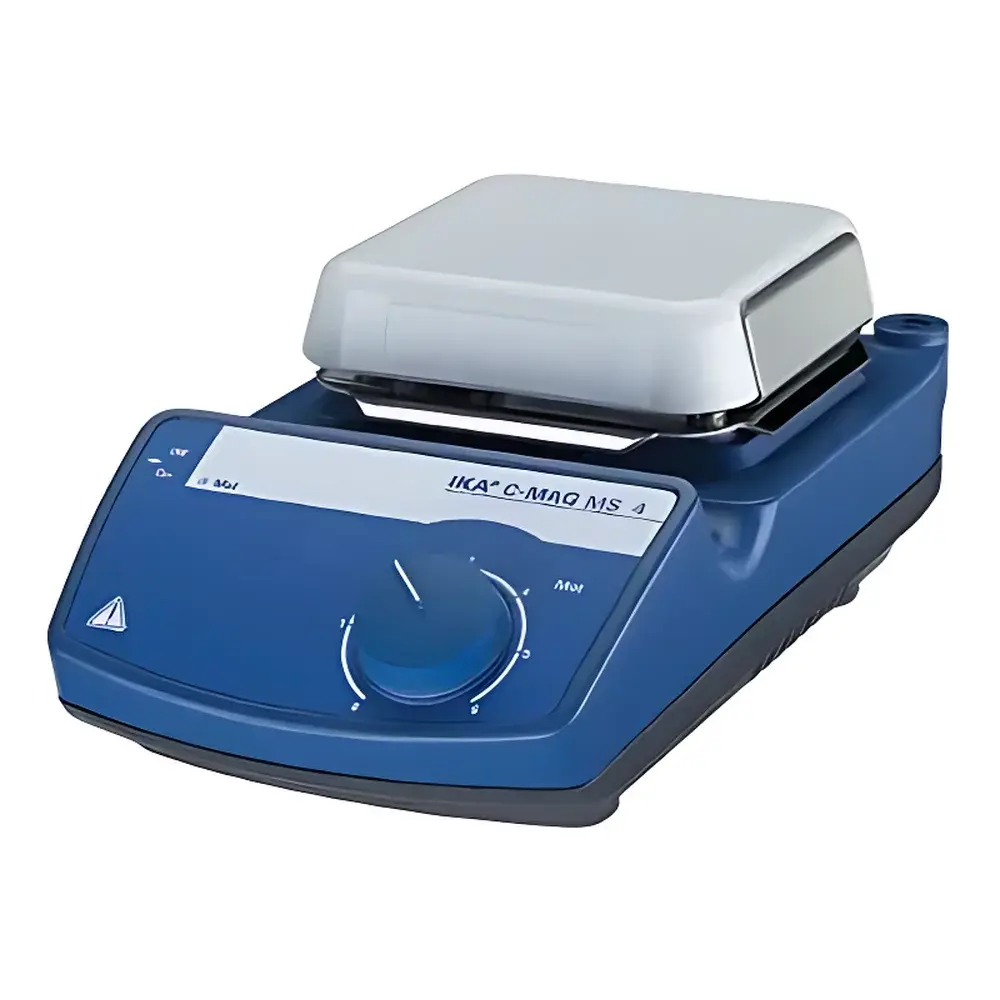
IKA C-MAG MS 4/710 Digital Magnetic Stirrer
| Brand | IKA |
|---|---|
| Origin | Germany |
| Model | C-MAG MS 4/710 |
| Stirring Points | 1 |
| Max. Stirring Volume (H₂O) | 5 L |
| Speed Range | 100–1500 rpm |
| Speed Control | 0–6 scale (analog) |
| Speed Display | Analog scale |
| Motor Input Power | 15 W |
| Motor Output Power | 1.5 W |
| Heater Power | None |
| Workplate Material | Ceramic |
| Workplate Dimensions | 100 × 100 mm |
| Overall Dimensions | 150 × 105 × 260 mm |
| Weight | 3 kg |
| Ambient Temperature Range | 5–40 °C |
| Relative Humidity Limit | 80 % |
| Protection Class | IP21 (per DIN EN 60529) |
| Voltage | 230 / 120 / 100 V |
| Frequency | 50/60 Hz |
| Total Input Power | 30 W |
Overview
The IKA C-MAG MS 4/710 is a compact, single-position digital magnetic stirrer engineered for precision and reliability in routine laboratory mixing applications. Designed without integrated heating functionality, this unit operates exclusively via permanent magnet coupling—leveraging high-strength neodymium magnets embedded beneath a seamless ceramic workplate to drive PTFE- or glass-coated stirring bars within vessels. Its core principle relies on rotational torque transfer through magnetic fields, ensuring consistent agitation across low- to medium-viscosity aqueous and organic solutions. The device is optimized for applications requiring stable speed maintenance under variable load conditions, such as reagent homogenization, buffer preparation, dissolution testing, and sample equilibration prior to analytical workflows. Its robust mechanical architecture, combined with microprocessor-based motor feedback control, delivers high reproducibility in speed-dependent protocols—particularly critical in QC/QA environments where inter-batch consistency must be documented and validated.
Key Features
- High-torque DC motor with closed-loop speed feedback ensures constant rotational velocity across the full 100–1500 rpm range—even when viscosity or vessel geometry introduces load fluctuations.
- One-piece, chemically inert ceramic workplate (100 × 100 mm) resists corrosion from strong acids, bases, and organic solvents; surface integrity eliminates crevices where residue accumulation or microbial growth could occur.
- Elevated control panel minimizes risk of liquid ingress during splashing events and improves ergonomics for visual confirmation of analog speed setting and operational status.
- IP21-rated enclosure provides protection against vertically falling drops of water and solid objects >12.5 mm, meeting standard safety requirements for general laboratory use per DIN EN 60529.
- Multi-voltage compatibility (100 / 120 / 230 V, 50/60 Hz) enables seamless deployment across global laboratory infrastructures without external transformers or voltage converters.
- Low thermal footprint (30 W total input power) reduces ambient heat buildup in enclosed hoods or densely packed benchtop configurations.
Sample Compatibility & Compliance
The C-MAG MS 4/710 supports standard laboratory glassware—including beakers, Erlenmeyer flasks, and cylindrical vessels—up to 5 L capacity with water-equivalent viscosity. Compatibility extends to common solvent systems (e.g., ethanol, acetone, dichloromethane) and mildly aggressive reagents (e.g., diluted HCl, NaOH up to 1 mol/L), provided appropriate stirring bar coating (e.g., PTFE, glass, or PEEK) is selected. While not certified for hazardous area operation, its non-sparking motor design and absence of exposed electrical contacts make it suitable for use in general-purpose chemical laboratories compliant with ISO/IEC 17025 and GLP frameworks. It does not incorporate temperature sensing or data logging hardware; therefore, it is not intended for applications requiring traceable thermal or kinetic parameter recording per FDA 21 CFR Part 11 or ASTM E2500.
Software & Data Management
This model operates as a standalone analog-controlled instrument with no embedded firmware, USB interface, or software connectivity. All operational parameters—including speed selection via the 0–6 analog dial—are manually configured and visually verified using the engraved scale. As such, it generates no electronic audit trail, does not support remote monitoring, and requires manual documentation of operating conditions in lab notebooks or LIMS entries. Its simplicity aligns with lean laboratory practices where minimal validation overhead is preferred—for example, in teaching labs, preliminary screening setups, or GMP-compliant facilities where only basic mixing functionality is required and electronic records are not mandated for the process step.
Applications
- Preparation of standardized buffers and calibration standards in analytical chemistry laboratories.
- Homogenization of cell culture media and dilution series in life science workflows.
- Stirring of reaction mixtures during synthetic chemistry procedures where exothermicity or gas evolution precludes heating integration.
- Equilibration of environmental water samples prior to pH, conductivity, or dissolved oxygen measurement.
- Supporting dissolution testing per USP when used in conjunction with non-heated vessel assemblies.
- Routine mixing in pharmaceutical quality control labs performing identification tests or assay preparations under compendial methods.
FAQ
Does the C-MAG MS 4/710 include a heating function?
No. This model is a non-heated magnetic stirrer. For combined stirring and heating, consider IKA’s RCT or HS series hotplates.
What is the maximum recommended viscosity for reliable operation?
It is rated for aqueous solutions up to 5 L; for higher-viscosity fluids (e.g., glycerol, polymer solutions), performance depends on stir bar geometry and vessel shape—empirical optimization is advised.
Is the ceramic plate resistant to hydrofluoric acid (HF)?
No. Standard alumina-based ceramic plates are etched by HF; alternative containment strategies or specialized equipment must be used for HF-containing systems.
Can this unit be mounted in a fume hood with limited vertical clearance?
Yes. At 260 mm height and 3 kg mass, it fits standard hood sashes and remains stable on level surfaces without anchoring.
Does IKA provide calibration certificates for this instrument?
No. As an analog, non-data-logging device, it falls outside formal metrological calibration scope per ISO/IEC 17025; users may perform in-house speed verification using a tachometer.



