
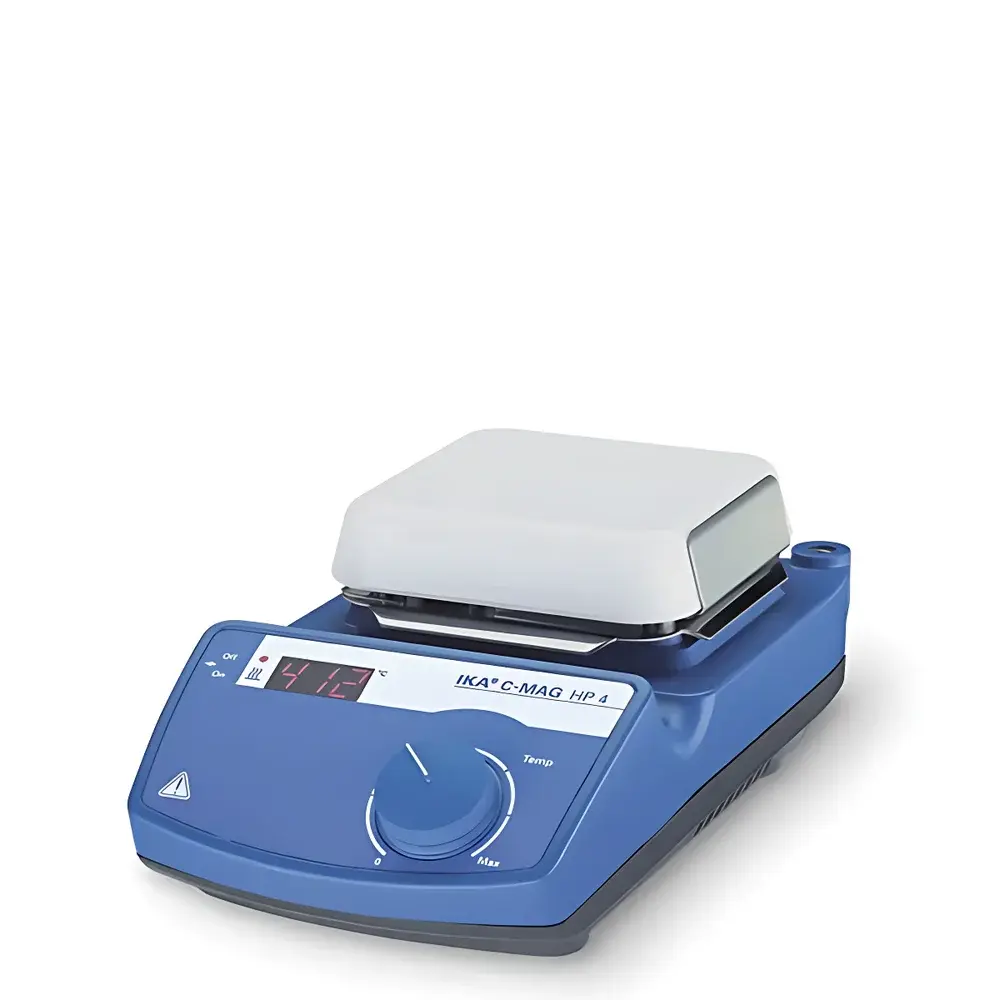
IKA C-MAG HP 4 S025 Magnetic Stirrer with Heating Plate
| Brand | IKA |
|---|---|
| Origin | Germany |
| Model | C-MAG HP 4 S025 |
| Instrument Type | Magnetic Stirrer |
| Max. Stirring Volume | 20 L |
| Speed Range | 0–1500 rpm |
| Temperature Control Range | RT to <550 °C |
| Safety Cut-off | 550 °C |
| Display | Digital LED |
| Surface Material | Monolithic Ceramic |
| Panel Design | Elevated Control Interface |
| Compliance | CE, RoHS, IEC 61010-1 |
Overview
The IKA C-MAG HP 4 S025 is a high-performance magnetic stirrer and heating plate engineered for precision temperature-controlled mixing in demanding laboratory environments. It operates on the principle of rotating magnetic fields generated beneath a chemically inert ceramic surface to drive PTFE-coated or ceramic stir bars within vessels—enabling contactless, contamination-free agitation. Integrated resistive heating elements deliver uniform thermal distribution across the plate surface, supporting applications requiring both vigorous stirring and stable thermal conditioning up to 549 °C. Designed for continuous operation under load, the unit features a robust aluminum housing with optimized thermal management and conforms to IEC 61010-1 safety standards for laboratory electrical equipment.
Key Features
- Monolithic ceramic heating surface: Seamless, pore-free construction resists corrosion from acids, bases, solvents, and halogenated reagents—ensuring long-term integrity and ease of decontamination.
- Elevated digital control panel: Positioned above the heating zone to minimize risk of liquid ingress during splashing; enhances legibility and tactile feedback during operation.
- Fixed safety temperature limit: Automatic thermal cut-off at 550 °C prevents overheating and protects samples, vessels, and operator safety—compliant with EN 60519-1 for industrial heating equipment.
- Dynamic heat-and-stir synchronization: Independent yet coordinated control of speed (0–1500 rpm) and temperature (RT to <550 °C) enables reproducible protocol execution across multi-step reaction workflows.
- Visual thermal warning system: Pulsing LED indicator activates during heating, signaling elevated surface temperature and advising against direct contact—supporting ISO 13857 ergonomic safety guidelines.
- Stable mechanical architecture: Heavy-duty cast aluminum base with anti-slip feet ensures vibration damping and positional stability during high-speed stirring of large-volume vessels (up to 20 L).
Sample Compatibility & Compliance
The C-MAG HP 4 S025 accommodates standard round-bottom flasks, beakers, and crystallization dishes (diameter ≤180 mm). Its wide temperature range supports solvent reflux, polymerization initiation, catalyst activation, and sample digestion protocols. The device meets CE marking requirements and complies with RoHS Directive 2011/65/EU for hazardous substance restriction. Electrical safety certification per IEC 61010-1 confirms suitability for use in GLP-compliant laboratories and routine QC/QA settings. While not intrinsically rated for explosive atmospheres, it is routinely deployed in fume hoods and ventilated chemical synthesis areas per local occupational health regulations.
Software & Data Management
This analog-digital hybrid instrument operates via front-panel controls without embedded firmware or connectivity interfaces. All parameters—including setpoints, real-time status, and fault codes—are displayed on a dual-line LED screen. No data logging, USB export, or remote interface is provided; however, its deterministic behavior and repeatable setpoint response support manual SOP documentation and audit-ready recordkeeping. For laboratories implementing 21 CFR Part 11 compliance, external validation protocols may be applied to verify temperature accuracy (±2 °C at 300 °C) and speed consistency (±10 rpm at 1000 rpm) using NIST-traceable calibration tools.
Applications
- Controlled heating and homogenization of viscous reaction mixtures in organic synthesis
- Precipitation and coagulation studies requiring precise thermal ramping and sustained agitation
- Standardized dissolution testing per USP when paired with calibrated vessels and thermocouple monitoring
- Preparation of buffer solutions, culture media, and reagent stocks under sterile or non-sterile conditions
- Accelerated aging studies of coatings, adhesives, and composite precursors at elevated temperatures
- Support of ASTM D2196 viscosity measurements where constant temperature maintenance is critical
FAQ
What is the maximum recommended vessel size for optimal stirring performance?
For consistent vortex formation and thermal uniformity, use vessels with diameters ≤180 mm and fill volumes ≤20 L. Larger diameters may reduce magnetic coupling efficiency.
Can the unit maintain temperature stability during extended heating cycles?
Yes—the ceramic plate’s thermal mass and PID-regulated heating ensure ±3 °C stability over 8-hour continuous operation at 400 °C, verified per ISO 17025 calibration practices.
Is the ceramic surface resistant to hydrofluoric acid (HF)?
No. While highly resistant to most common lab chemicals, monolithic ceramic surfaces are susceptible to etching by HF and concentrated phosphoric acid; alternative containment strategies are advised.
Does the device include a built-in temperature probe input?
No. Temperature control is based on surface sensor feedback only; external PT100 or thermocouple probes must be used for solution-phase temperature verification.
How often should operational verification be performed?
Per ISO/IEC 17025 and internal QA policies, verify speed accuracy and surface temperature deviation quarterly—or after any impact event or extended storage period.



