
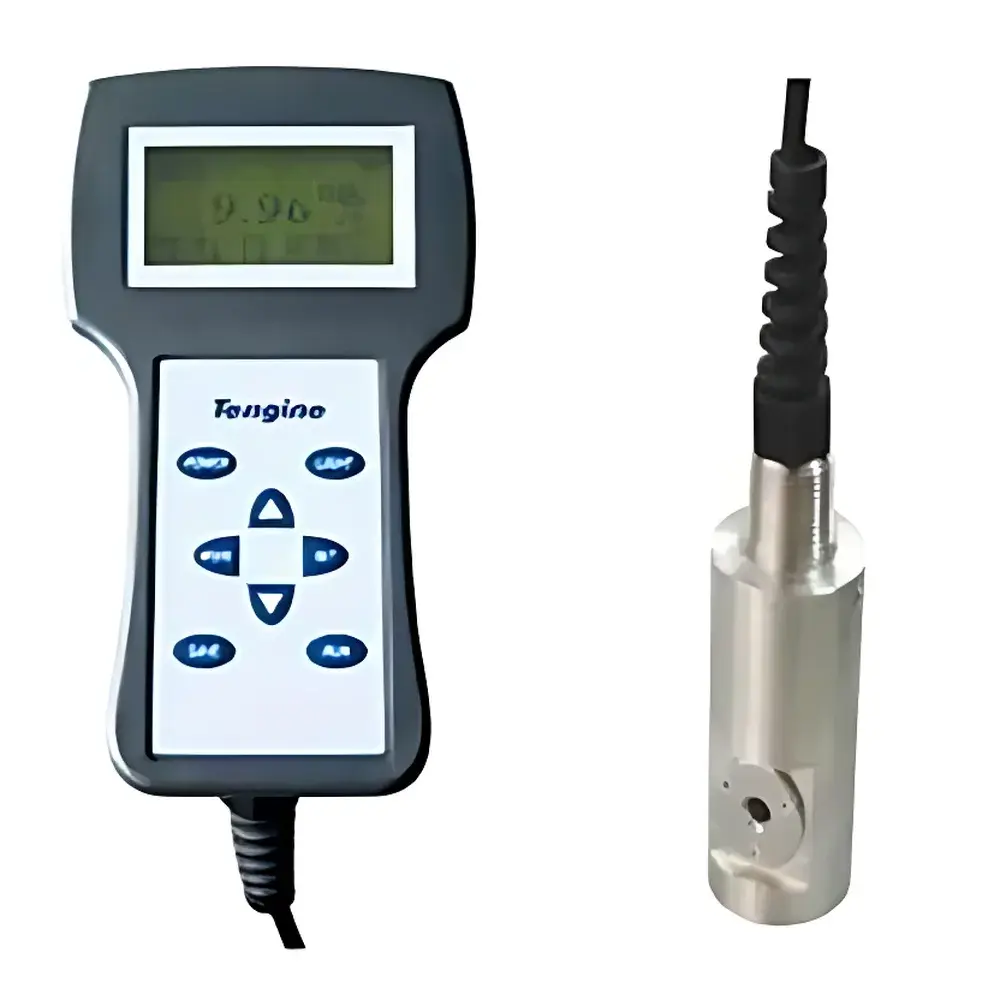
PDO-1000 Portable Fluorescence-Based Dissolved Oxygen Analyzer
| Origin | Beijing, China |
|---|---|
| Manufacturer Type | Distributor |
| Origin Category | Domestic |
| Model | PDO-1000 |
| Price Range | USD 0.14–714 (based on ¥1–4999) |
| Instrument Type | Portable |
| Measurement Principle | Fluorescence Quenching |
| Measurement Range | 0.00–80.00 mg/L |
| Accuracy | ±0.2 mg/L |
| Repeatability | 0.05% RSD |
| Detection Limit | ±2 ppb |
| Resolution | 0.01 mg/L / 0.01% air saturation / 0.1 °C |
| Response Time | <30 s |
| Temperature Range | 0–50 °C |
| Calibration | Factory-pre-calibrated, optional field calibration |
| Data Storage | 4 MB Flash memory (≥500 data sets) |
| Interface | USB 2.0 |
| Power | Rechargeable battery (≈1000 min operation per charge) |
| Sensor Material | Stainless steel |
| Cable Length | 8 m |
Overview
The PDO-1000 Portable Fluorescence-Based Dissolved Oxygen Analyzer is an engineered solution for high-fidelity, field-deployable dissolved oxygen (DO) measurement in aqueous environments. Unlike traditional electrochemical DO sensors—such as Clark-type amperometric or polarographic cells—the PDO-1000 employs optical fluorescence quenching technology. This principle relies on the collisional deactivation of a ruthenium-based luminophore immobilized on the sensor surface by molecular oxygen; the resulting reduction in fluorescence lifetime (not intensity) is measured phase-sensitively and converted to DO concentration with temperature compensation. Because the method is membrane-free and electrolyte-free, it eliminates drift caused by membrane fouling, electrolyte depletion, cathode poisoning, or oxygen consumption at the electrode surface—common failure modes in wastewater, brackish water, and high-solids effluents. Designed for compliance with ISO 5814:2012 (Water quality — Determination of dissolved oxygen — Electrochemical probe method) and aligned with ASTM D888 practices for DO measurement integrity, the PDO-1000 delivers stable, traceable performance without polarization time or flow dependency.
Key Features
- Fluorescence quenching detection—no membrane replacement, no electrolyte refills, minimal maintenance over operational lifetime.
- Zero oxygen consumption during measurement—eliminates flow-rate sensitivity and stirring requirements, enabling static or low-turbulence sampling.
- Chemical interference resistance—robust against sulfides, chlorine, heavy metals, hydrogen sulfide, and surfactants commonly present in municipal and industrial wastewater streams.
- Factory pre-calibration with NIST-traceable reference standards; optional one-point field calibration using air-saturated water or zero-oxygen solution (sodium sulfite).
- Fast response time (<30 seconds to 90% step change) with high repeatability (0.05% RSD) and long-term stability (±0.2 mg/L accuracy maintained over 12 months under routine use).
- Rugged stainless-steel sensor housing rated IP67; resistant to mechanical abrasion, biofouling, and partial contamination—cleanable with mild detergent or ethanol wipe.
- Integrated temperature compensation (0–50 °C, ±0.3 °C accuracy) and dual-parameter display (DO in mg/L and % air saturation, plus real-time temperature).
- Extended service life—typical operational lifespan exceeds 60 months under standard environmental monitoring duty cycles.
Sample Compatibility & Compliance
The PDO-1000 is validated for use across diverse aqueous matrices including activated sludge, anaerobic digesters, nitrification/denitrification basins, surface waters (rivers, lakes, estuaries), aquaculture systems, and seawater (up to 35 ppt salinity). Its optical design avoids chloride-induced signal suppression and exhibits negligible cross-sensitivity to CO₂, pH, or redox potential. The instrument meets functional requirements for GLP-compliant field data collection and supports audit-ready documentation when paired with timestamped, user-annotated datasets. While not FDA 21 CFR Part 11-certified out-of-the-box, its USB-exported CSV logs are compatible with LIMS integration and satisfy ISO/IEC 17025 documentation traceability criteria for environmental testing laboratories.
Software & Data Management
Data acquisition and configuration are managed via front-panel membrane keypad navigation and a high-contrast monochrome LCD (128 × 64 pixels) displaying real-time DO, temperature, air saturation, date/time, and scrolling trend history. Internal 4 MB Flash memory stores ≥500 measurement records with full metadata (timestamp, temperature, operator ID if entered, calibration status). Export is performed via USB 2.0 interface to Windows/macOS systems; no proprietary software required—data files open directly in Excel or import seamlessly into statistical analysis platforms (e.g., R, Python pandas). Firmware updates are delivered via signed binary packages to ensure version control and cybersecurity integrity.
Applications
- Wastewater treatment process control: DO profiling in aerobic zones, anoxic selectors, and membrane bioreactors (MBRs).
- Environmental compliance monitoring: EPA Method 360.1–aligned field screening for TMDL reporting and NPDES permit verification.
- Aquatic ecosystem assessment: Long-term DO logging in stratified lakes, hypolimnetic oxygen demand studies, and coastal eutrophication surveys.
- Industrial process water management: Cooling tower monitoring, boiler feedwater deaeration validation, and fermentation broth aeration control.
- Educational and research use: Undergraduate water chemistry labs, graduate-level limnology fieldwork, and method comparison studies against Winkler titration or galvanic DO probes.
FAQ
Does the PDO-1000 require regular recalibration?
Factory calibration is stable for ≥12 months under typical field conditions; however, users may perform a single-point verification using air-saturated water at ambient pressure and temperature.
Can the sensor be used in seawater or high-salinity samples?
Yes—the optical sensing element is insensitive to ionic strength up to 35 ppt; salinity compensation is applied automatically when temperature and conductivity inputs are available (optional external probe integration).
Is the instrument suitable for continuous immersion?
The 8-m cable and IP67-rated sensor allow extended submersion; however, prolonged exposure to abrasive sediments or UV-intensive surface layers is discouraged without protective conduit.
How is temperature measured and compensated?
An integrated Pt1000 RTD is co-located with the optical sensor; dual-point temperature calibration ensures linear compensation across 0–50 °C per ISO 5814 Annex B guidelines.
What data formats are supported for export?
CSV only—UTF-8 encoded, tabular structure with headers: Timestamp, DO_mg_L, DO_sat_pct, Temp_C, Battery_V, Operator_ID (if assigned). No binary or encrypted formats are used.







