
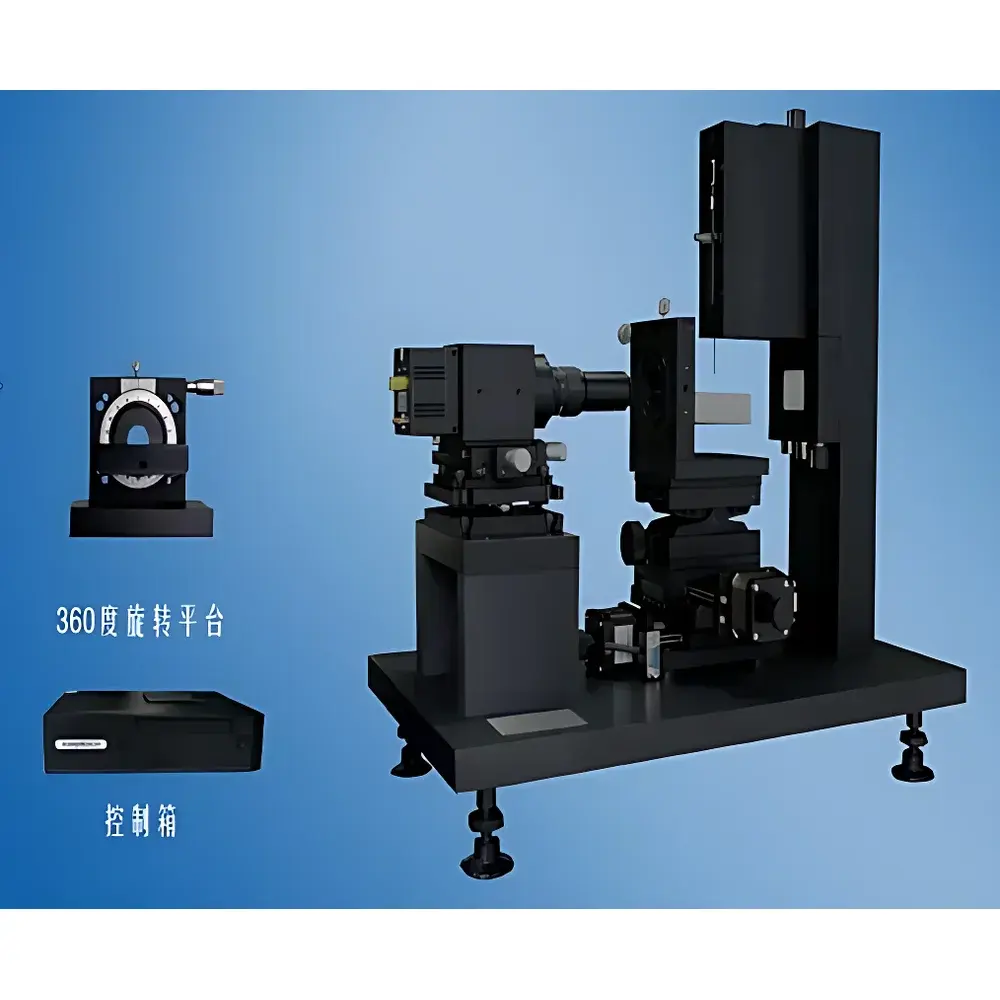
JC2000D3M Automated Dynamic Contact Angle Goniometer
| [Origin | Beijing, China |
|---|---|
| Manufacturer Type | Authorized Distributor |
| Origin Category | Domestic (PRC) |
| Model | JC2000D3M |
| Instrument Type | Benchtop Laboratory Goniometer |
| Contact Angle Measurement Range | 0–180° |
| Contact Angle Accuracy | ±0.1° (θ/2 method) |
| Sample Stage Dimensions | 70 × 70 mm |
| Optical Magnification | 0.7–5× (55–320 pixels/mm) |
| Surface/Interfacial Tension Range | 0–1000 mN/m] |
Overview
The JC2000D3M Automated Dynamic Contact Angle Goniometer is a precision benchtop instrument engineered for quantitative characterization of solid–liquid–gas interfacial behavior under static and dynamic conditions. Based on high-resolution optical goniometry and digital image analysis, the system captures real-time droplet profiles using an industrial-grade low-light CCD camera and a continuously variable magnification lens. It employs multiple validated analytical algorithms—including θ/2, tangent fitting, conic section fitting, and pendant drop shape analysis—to determine contact angles with traceable accuracy. The instrument supports all standard measurement modes: sessile drop (advancing/receding), captive bubble, tilting plate (roll-off/tilt angle), and dynamic advancing–receding cycles—enabling rigorous assessment of wettability hysteresis, surface heterogeneity, and kinetic wetting behavior. Designed for compliance with fundamental surface science protocols, it serves as a foundational tool in R&D labs where interfacial thermodynamics, surface energy estimation, and functional coating development demand metrologically sound data.
Key Features
- Automated microdispensing system with programmable syringe drivers offering 0.01 µL minimum dispensing resolution and repeatable positioning (XY ±12.5 mm, Z ±25 mm, 0.01 mm step resolution)
- Motorized 360° rotating sample stage with angular positioning accuracy ≤0.2°, enabling precise tilt-angle and roll-off angle measurements
- Continuously variable optical zoom lens (0.7–5×) coupled with a 1.3 MP industrial CCD camera (25 fps, 0.0005 lux sensitivity) and adjustable LED cold backlighting
- Dual-axis manual sample stage (X/Y ±50 mm, Z +45 mm) with independent fine-leveling mechanisms for sample platform and lens assembly
- Integrated software suite supporting six primary contact angle calculation methods, automatic edge detection, asymmetric droplet correction, and curvature-based surface roughness compensation
- Comprehensive surface energy analysis module implementing nine established models (e.g., Owens–Wendt, Fowkes, Wu, van Oss–Chaudhury–Good) for both low- and high-energy solids
- Full video capture capability (AVI format) and time-lapse imaging (1–3600 s interval), synchronized with automated image acquisition and batch analysis workflows
Sample Compatibility & Compliance
The JC2000D3M accommodates a broad spectrum of sample geometries and material classes—including flat substrates (metals, polymers, ceramics), fibers, textiles, pressed powders, and micro-patterned surfaces—within its 70 × 70 mm stage. Its modular design permits optional accessories such as hydrophobic needle sets, temperature-controlled stages (–20 to 80 °C), and environmental chambers for humidity-controlled testing. While not certified to ISO/IEC 17025 or ASTM D7334/D7490 by default, the instrument’s measurement traceability aligns with widely accepted interfacial characterization practices referenced in ASTM D5946 (corona treatment), ISO 19403 (contact angle for surface energy), and USP (analytical instrument qualification). Data integrity is supported through audit-trail-enabled software logging, timestamped image metadata, and exportable EXCEL reports containing raw pixel coordinates, fitted curves, and statistical summaries—facilitating GLP/GMP-aligned documentation.
Software & Data Management
The proprietary image analysis software provides a unified interface for acquisition, processing, and reporting. It implements dual-mode operation: fully automated sequence-driven measurement (e.g., multi-point deposition → auto-focus → frame capture → angle calculation → database entry) and manual intervention mode for edge refinement or outlier rejection. All results—including contact angle values, surface tension (via pendant drop analysis), droplet volume/height/diameter, and surface free energy components—are stored in a relational database with versioned backups and compression support. Export options include annotated PNG/JPEG images embedding measurement overlays, CSV/EXCEL datasets with full parameter metadata, and AVI video clips for presentation or method validation. Software licensing includes lifetime updates and remote technical support; local installation packages are provided with electronic user manuals and SOP templates compliant with laboratory quality management systems.
Applications
This goniometer is routinely deployed across academic and industrial laboratories engaged in surface modification, thin-film deposition, biomaterial evaluation, and formulation science. Typical use cases include: quantifying plasma or corona treatment efficacy on polymer films; assessing hydrophobicity/hydrophilicity gradients in gradient surfaces; evaluating inkjet printability and droplet spreading kinetics on porous media; characterizing anti-fouling coatings via advancing–receding hysteresis analysis; determining critical micelle concentration (CMC) of surfactants using pendant drop tensiometry; and estimating dispersive/polar surface energy components of pharmaceutical excipients or battery electrode materials. Its adaptability to fiber and textile samples further supports R&D in smart fabrics, filtration membranes, and medical textiles where capillary wicking and liquid retention are performance-critical parameters.
FAQ
What measurement methods does the JC2000D3M support?
It supports sessile drop (static, advancing, receding), captive bubble, tilting plate (roll-off and tilt angle), and pendant drop methods—all accessible via software-selectable protocols.
Can the system measure surface tension independently of contact angle?
Yes—using the pendant drop method, it calculates surface/interfacial tension over a range of 0–1000 mN/m with resolution down to 0.01 mN/m based on Laplace equation fitting.
Is the software compatible with Windows 10/11 and 64-bit architecture?
Yes—the application is natively compiled for modern Windows OS versions and supports high-DPI displays and multi-monitor configurations.
Does the instrument meet regulatory requirements for pharmaceutical or medical device testing?
While not pre-validated for FDA 21 CFR Part 11, the software supports user-defined electronic signatures, audit trails, and data export formats suitable for IQ/OQ/PQ documentation and internal QA review.
What maintenance is required during routine operation?
Routine calibration involves verification of stage leveling, lens focus consistency, and syringe driver linearity using NIST-traceable reference standards; no consumables beyond disposable needles and calibration slides are required.



