
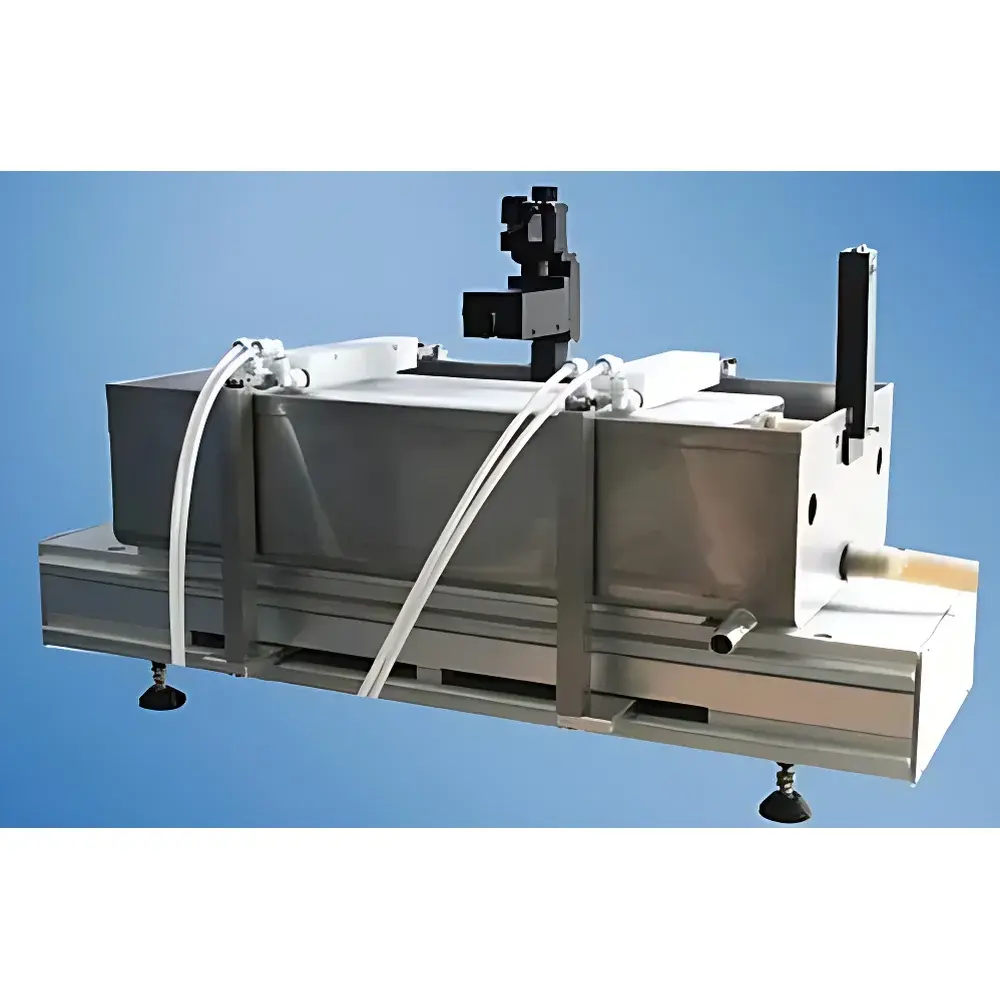
SCI-016 Langmuir-Blodgett Trough with Wilhelmy Plate Surface Tensiometer
| Brand | ZYKX |
|---|---|
| Origin | Beijing, China |
| Model | SCI-016 |
| Surface Tension Range | 0–150 mN/m |
| Resolution | < 0.05 mN/m |
| Measurement Method | Wilhelmy Plate (Du Noüy–Wilhelmy) |
| Trough Dimensions | 700 mm × 140 mm |
| Barrier Speed | 10–100 mm/min (infinitely variable) |
| Temperature Control | Dual independent water jackets (30 L pure water tank + 10 L trough jacket), both settable to 35 ± 0.5 °C |
| Power Supply | AC 220 V ± 10 V, 50 Hz, < 150 W |
| Compliance | ASTM D971, ISO 6295, ISO 1409, USP <721>, GLP-ready data logging |
Overview
The SCI-016 Langmuir-Blodgett Trough with integrated Wilhelmy plate surface tensiometer is a precision instrument engineered for quantitative monolayer characterization at the air–water interface. It operates on the fundamental principle of Langmuir film physics: amphiphilic molecules—such as fatty acids, phospholipids, or industrial lubricants—spontaneously form condensed, oriented monolayers when spread on an aqueous subphase. By measuring surface pressure (π) as a function of molecular area (A), the system generates π–A isotherms that reveal phase transitions, collapse pressure, compressibility modulus, and molecular packing density. Coupled with high-resolution Wilhelmy plate tensiometry, the instrument simultaneously quantifies dynamic surface tension during barrier compression/expansion cycles. This dual-mode capability makes it indispensable for R&D and QC laboratories evaluating surfactant performance, thin-film stability, and surface coverage—particularly in metallurgical coating processes where precise oil dosage control directly impacts corrosion resistance and downstream processing.
Key Features
- Fully automated Langmuir trough operation via embedded PLC and PC-based controller, minimizing operator-induced variability in barrier positioning, dipping speed, and data acquisition timing.
- High-stability Wilhelmy plate sensor (NMB, full-scale 98 mN/m) with < 0.05 mN/m resolution, calibrated traceably to NIST-traceable standards.
- Large-area PTFE-coated Langmuir trough (700 mm × 140 mm) with integrated thermal insulation, leveling feet, and anti-surge bottom design for hydrodynamic stability during compression.
- Dual independent temperature-controlled water jackets: a 30 L purified water reservoir (setpoint 35 ± 0.5 °C) feeds the subphase; a separate 10 L jacket maintains uniform trough wall temperature—critical for thermodynamic reproducibility in π–A measurements.
- Motorized barrier with optical encoder feedback, enabling precise, repeatable compression speeds from 10 to 100 mm/min (infinitely adjustable) and programmable ramp profiles.
- Automated cleaning sequence: solenoid-actuated spray nozzles, timed waste drainage via φ90 mm deep-cleaning port (75 mm depth), and programmable rinse-dry cycles for plate and trough surfaces.
- Hydrofluoric acid-etched glass Wilhelmy plates (3 supplied) ensure consistent wetting geometry and long-term calibration stability.
- Comprehensive software suite supporting real-time π–A and γ–A curve plotting, hysteresis analysis, compressibility modulus (Cs⁻¹) calculation, and user-defined collapse threshold triggering.
Sample Compatibility & Compliance
The SCI-016 accommodates a broad range of spreadable amphiphiles—including mineral oils, synthetic esters, fatty alcohols, fluorosurfactants, and biological lipids—provided they exhibit sufficient insolubility and spreading coefficient on ultrapure water (resistivity ≥ 18.2 MΩ·cm). Its design conforms to standard methodologies referenced in ASTM D971 (surface tension of petroleum products), ISO 6295 (determination of interfacial tension), and ISO 1409 (plastics—determination of surface tension of polymer films). The system supports GLP-compliant workflows through timestamped, user-annotated data export (CSV, TXT), audit-trail-enabled parameter logging, and password-protected method storage. While not FDA 21 CFR Part 11 certified out-of-the-box, its deterministic control architecture and immutable raw-data recording enable validation for regulated environments under internal SOPs.
Software & Data Management
The Windows-native application provides intuitive graphical configuration of experimental protocols—including multi-step compression ramps, constant-pressure or constant-area modes, and cyclic expansion–compression sequences. All raw sensor outputs (voltage, position, time) are logged at ≥ 10 Hz and stored in structured ASCII format for third-party analysis (e.g., MATLAB, Python, Origin). Curve fitting tools support Langmuir equation regression, Gibbs adsorption isotherm derivation, and transition point identification. Export options include vector-based SVG/PDF plots, annotated measurement reports, and batch-processed summary tables. Firmware updates and calibration utilities are accessible via secure USB interface; no cloud dependency or telemetry is implemented.
Applications
- Quantitative oil dosing verification on tinplate and aluminum foil production lines—transferring surface oil to water subphase and correlating measured monolayer area to mass per unit area (mg/m²).
- Formulation screening of metalworking fluids and rolling lubricants via monolayer collapse pressure and compressibility analysis.
- Quality control of LB-deposited functional coatings (e.g., biosensors, organic photovoltaics) by assessing monolayer homogeneity and transfer ratio consistency.
- Interfacial rheology studies of mixed surfactant systems using dynamic surface tension tracking during barrier motion.
- Educational use in physical chemistry and soft matter labs for teaching thermodynamics of 2D phases and Gibbs adsorption theory.
FAQ
What subphase purity requirements apply for reliable π–A isotherms?
Ultrapure water (≥ 18.2 MΩ·cm resistivity, TOC < 5 ppb) is mandatory; electrolyte contamination shifts collapse pressure and distorts phase behavior. Conductivity monitoring is recommended during extended runs.
Can the system operate without external thermostatic control?
Yes—the integrated dual-jacket system maintains stable subphase and trough wall temperatures at 35 ± 0.5 °C. For experiments requiring non-standard temperatures (e.g., 20–45 °C), connection to an external recirculating chiller/heater is supported via standard PT100 inputs.
Is the Wilhelmy plate interchangeable with other geometries (e.g., du Noüy ring)?
No—the system is optimized exclusively for Wilhelmy plate geometry to ensure accurate contact angle correction (assumed 0° for properly cleaned plates) and direct force-to-pressure conversion. Ring-based methods are incompatible with Langmuir trough kinematics.
How is calibration traceability documented?
Each instrument ships with a factory calibration certificate referencing NIST SRM 8491 (standard reference material for surface tension) and includes step-by-step user calibration procedures validated against certified aqueous ethanol solutions.
What maintenance intervals are recommended for long-term accuracy?
Monthly verification of zero-force baseline and plate cleanliness; annual recalibration of load cell and encoder positioning; biannual inspection of PTFE trough integrity and barrier seal condition. All service procedures are detailed in the bilingual technical manual.



