
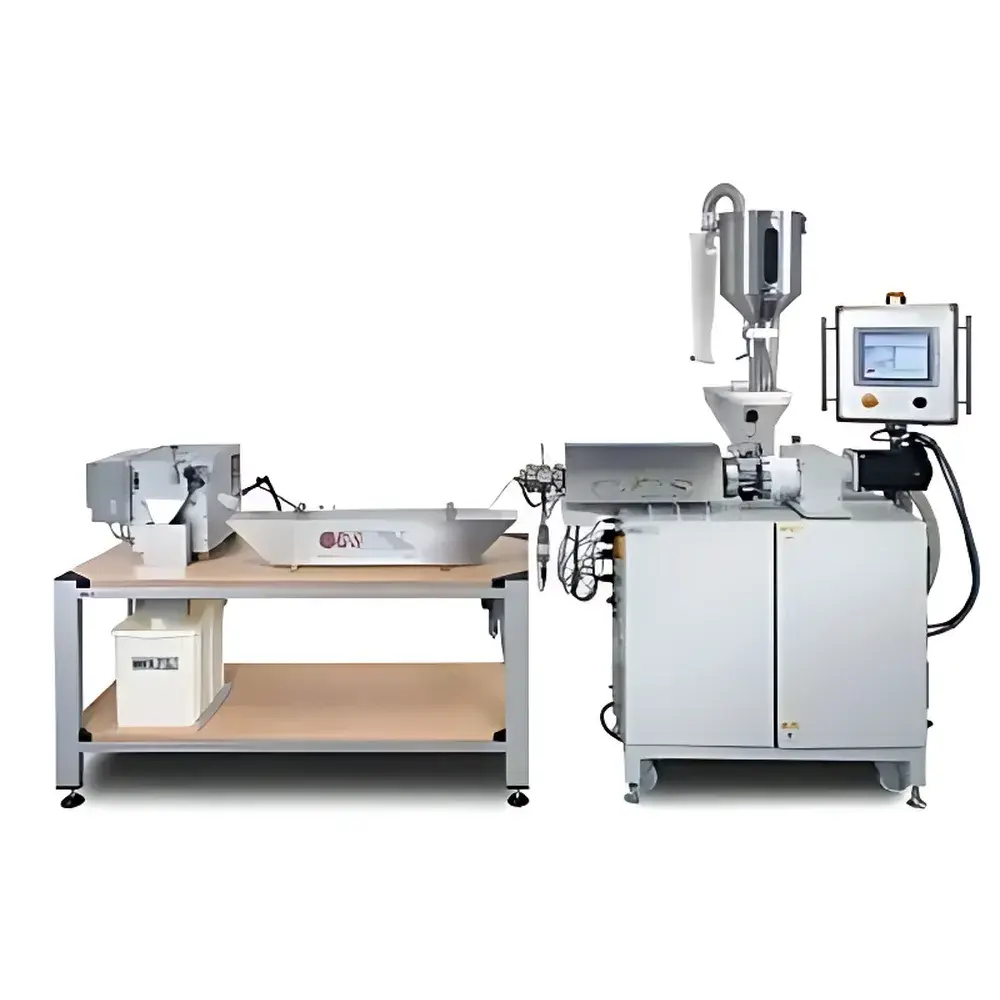
Pelletizing-20D Laboratory-Scale Extrusion and Pelletizing System by EUROTECH
| Brand | EUROTECH |
|---|---|
| Origin | Germany |
| Model | Pelletizing-20D |
| Screw Diameter | 20 mm |
| L/D Ratio | 25:1 |
| Max. Screw Speed | 150 rpm |
| Heating Zones | 4 (independent microprocessor-controlled) |
| Temperature Range | Ambient to 350 °C per zone |
| Strand Cooling | Water bath + forced-air cooling |
| Die Options | 3 mm and 4 mm round orifices |
| Feed Hopper | Equipped with material-level sensor and empty-feed alarm |
| Torque Monitoring | Real-time display with overload shutdown |
| Control Interface | TFT touchscreen panel with dedicated soft-keys for each heating zone |
| Screw Configuration | Three-zone design with dedicated mixing section (mixing length ratio: 4:1) |
| Safety Features | High/low temperature alarm, torque limit lockout, emergency stop |
Overview
The Pelletizing-20D is a fully integrated, benchtop-scale extrusion and pelletizing system engineered for formulation development, polymer compounding validation, masterbatch optimization, and post-consumer polymer recycling research. Designed and assembled in Germany by EUROTECH, this modular system implements co-rotating twin-screw extrusion technology — a standard platform for controlled melt homogenization, dispersion, devolatilization, and reactive processing. The system operates on the principle of volumetric feeding, shear-induced melting, precise thermal profiling across four independently regulated barrel zones, and strand-based pelletization via water-bath quenching followed by adjustable-speed rotary cutter. Its compact footprint (≤1.8 m length) and closed-loop thermal management make it suitable for ISO 17025-accredited laboratories, R&D centers conducting ASTM D3835-compliant compound characterization, and QC labs supporting ISO 9001:2015-certified production lines.
Key Features
- Modular architecture integrating extruder (20 mm screw diameter, 25:1 L/D), precision die head, temperature-stabilized water bath (±0.5 °C), and variable-speed strand pelletizer with interchangeable cutting blades.
- TFT touchscreen HMI with dedicated soft-keys for each of the four microprocessor-based PID temperature controllers; real-time visualization of setpoint, actual temperature, and deviation per zone.
- Three-section screw configuration featuring conveying, melting, and high-intensity mixing sections — the latter engineered at a 4:1 length-to-diameter ratio to ensure uniform filler dispersion in filled thermoplastics (e.g., CaCO₃, talc, carbon black) and polymer blends.
- Integrated safety interlocks: over-temperature cut-off (±5 °C deviation threshold), torque overload shutdown (programmable limit), feed hopper level monitoring with audible/visual empty-feed alarm, and emergency stop compliant with EN 60204-1.
- Strand cooling subsystem comprising thermostatically controlled water bath (stainless steel, 30 L capacity) and downstream forced-air cooler — enabling consistent pellet sphericity, crystallinity control, and minimal thermal history variation across batches.
- Die plate options include 3 mm and 4 mm circular orifices (standard); custom multi-orifice or flat-die configurations available upon request for specialty morphologies (e.g., cylindrical, rectangular, or segmented strands).
Sample Compatibility & Compliance
The Pelletizing-20D accommodates a broad spectrum of thermoplastic polymers including polyolefins (PP, PE), engineering resins (PA6, PC, PBT), biopolymers (PLA, PHA), and filled composites (glass fiber-reinforced PP, mineral-filled ABS). It supports solvent-free processing and is compatible with volatile additives (e.g., peroxides, blowing agents) under vacuum venting (optional add-on). All wetted components comply with FDA 21 CFR §177.1520 for food-contact polymer processing. System documentation includes full traceability of calibration certificates for temperature sensors (PT100 Class A), torque transducers (±0.5% FS), and rotational encoders (±0.1 rpm resolution), satisfying GLP audit requirements per OECD Series on Principles of Good Laboratory Practice.
Software & Data Management
Data acquisition is managed via embedded firmware with timestamped logging of all process parameters — screw speed, torque %, melt pressure (if equipped), zone temperatures, and motor current — at 1 Hz sampling rate. Export formats include CSV and XML for direct import into LIMS platforms or statistical analysis tools (e.g., JMP, Minitab). Audit trail functionality meets FDA 21 CFR Part 11 requirements: user authentication, electronic signatures, immutable record retention, and change history tracking. Optional Ethernet/IP interface enables integration with MES systems for batch record synchronization and OEE calculation.
Applications
- R&D of color masterbatches and additive concentrates requiring narrow particle size distribution (PSD) and high pigment dispersion uniformity (measured per ISO 18453).
- Recycling process development for post-industrial and post-consumer plastic streams, including compatibilization trials for mixed-polymer feeds (e.g., PET/PE blends).
- Pre-validation of commercial-scale extrusion recipes prior to pilot-line trials — reducing scale-up risk per CIPAC MT 186 guidelines.
- Thermal stability assessment of flame-retardant formulations using TGA-coupled extrusion protocols.
- Functional testing of biodegradable polymer blends under controlled shear and residence time conditions (residence time distribution measured via pulse-response tracer studies).
FAQ
What is the maximum throughput capacity for polypropylene under standard operating conditions?
Typical throughput ranges from 1.2–3.5 kg/h depending on formulation viscosity, screw speed (60–120 rpm), and die configuration — validated per ISO 1133-1 melt flow rate correlation protocols.
Is vacuum venting available as a factory-installed option?
Yes — a dual-stage vacuum venting module (10⁻² mbar ultimate pressure) can be integrated upstream of the die head for moisture removal or monomer extraction.
Can the system be configured for reactive extrusion (e.g., grafting or polymerization)?
With optional liquid injection ports, static mixers, and inert gas purging capability, the Pelletizing-20D supports limited-scope reactive extrusion studies under controlled stoichiometry and residence time.
Does the system support automated recipe recall and execution?
Yes — up to 99 user-defined process profiles can be stored and recalled with one-touch activation, including linked temperature ramps, speed profiles, and alarm thresholds.
What maintenance intervals are recommended for the gearmotor and barrel heating elements?
Gearmotor oil replacement every 2,000 operational hours; barrel heater calibration verification annually or after 500 thermal cycles — documented in the included Maintenance Logbook per ISO 55001 asset management standards.






