
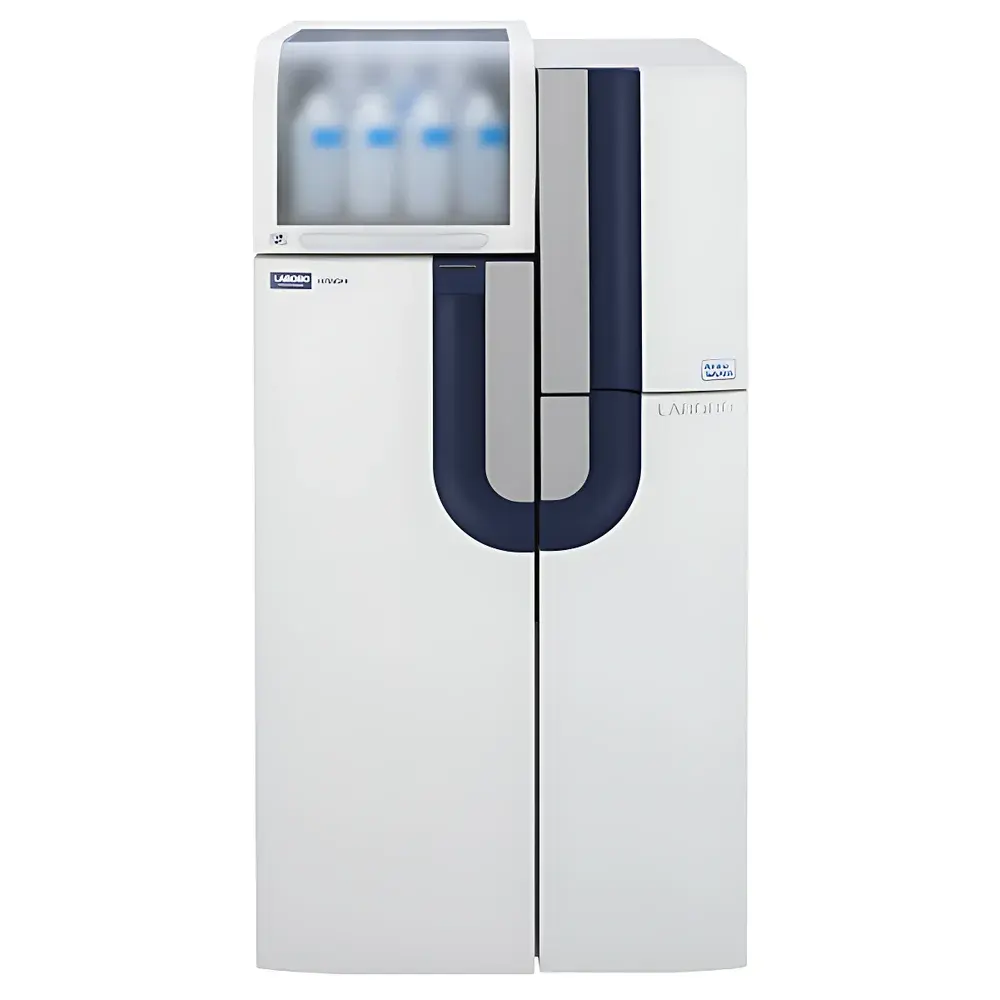
Hitachi LA8080 Amino Acid Analyzer
| Brand | Hitachi |
|---|---|
| Origin | Japan |
| Manufacturer | Hitachi High-Tech Corporation |
| Instrument Type | Post-Column Derivatization Amino Acid Analyzer |
| Model | LA8080 |
| Pump Flow Rate | 0.000–1.000 mL/min |
| Maximum Pump Pressure | 34 MPa |
| Autosampler Injection Volume | 0–100 µL |
| Autosampler Temperature Control | 4 °C and 10 °C |
| Post-Column Reactor Temperature Range | 50–140 °C |
| Detection Wavelengths | 570 nm and 440 nm |
| Flow Cell Volume | 8 µL |
Overview
The Hitachi LA8080 Amino Acid Analyzer is a seventh-generation, high-throughput post-column derivatization (PCD) system engineered for precision, reproducibility, and regulatory compliance in quantitative amino acid analysis. Based on ion-exchange chromatography coupled with ortho-phthalaldehyde (OPA) and ninhydrin derivatization, the LA8080 delivers robust separation of proteinogenic and non-proteinogenic amino acids—including cysteine, methionine, taurine, and hydroxyproline—under fully automated, thermally controlled reaction conditions. Introduced in 2018, it represents over five decades of continuous innovation since Hitachi’s first KLA-series analyzer (1962), incorporating advances in fluidic architecture, optical detection, and software-driven workflow governance. Designed for routine QC laboratories, clinical diagnostics, food & feed testing, and pharmaceutical development, the LA8080 operates under validated analytical methods aligned with ISO 13022, AOAC Official Method 994.12, and USP <421>, supporting both research-grade method development and GLP/GMP-regulated environments.
Key Features
- Third-generation TDE³ (Thermo-Derivatization Engine) technology: Solid-phase reactor with extended service life (>25× longer than conventional coiled reactors), delivering consistent derivatization efficiency and 400% improved sensitivity at low pmol-level detection.
- High-resolution separation: Achieves baseline resolution (Rs > 1.2) for 18–23 standard amino acids within ≤30 minutes; optional 6-minute rapid protocol available for sulfur-containing amino acids (cystine, methionine) without compromising peak symmetry or quantitation accuracy.
- Dual-wavelength photometric detection: Simultaneous monitoring at 570 nm (OPA derivatives) and 440 nm (ninhydrin derivatives) using a fixed-grating monochromator with optimized optical path—delivering ~30% higher photon throughput versus prior-generation detectors.
- Integrated six-solvent gradient pumping system: Capable of precise isocratic and multi-step gradient elution; maximum pressure-to-flow ratio of 34 MPa / 1.0 mL/min ensures stable operation across viscous mobile phases and elevated column backpressures.
- Temperature-controlled autosampler: Dual-zone cooling (4 °C and 10 °C) minimizes sample degradation during extended batch runs; injection volume programmable from 0 to 100 µL with ≤0.5% RSD precision.
- Post-column reactor with wide thermal range (50–140 °C): Enables optimization of derivatization kinetics for challenging analytes such as proline, hydroxyproline, and imino acids.
Sample Compatibility & Compliance
The LA8080 accommodates hydrolyzed protein samples (acid or enzymatic), biological fluids (serum, urine, CSF), plant/animal tissue extracts, fermentation broths, and nutritional supplements. Sample preparation follows standardized protocols per AOAC, ISO, and USP guidelines. The system supports full audit trail functionality, electronic signatures, and data integrity controls compliant with FDA 21 CFR Part 11, EU Annex 11, and China’s CFDA GMP Annexes. All hardware modules—including pump, reactor, detector, and autosampler—are CE-marked and designed for long-term stability in ISO 17025-accredited laboratories.
Software & Data Management
Controlled by OpenLAB CDS 2 (Chemical Data System), the LA8080 integrates seamlessly into enterprise laboratory informatics environments. The software provides method editor with real-time gradient simulation, peak integration with customizable baselines and retention time windows, calibration curve generation (linear/non-linear), and automated report export in PDF, CSV, and XML formats. Audit trail logs capture all user actions, parameter changes, and instrument events with timestamp and operator ID. Raw data files are stored in vendor-neutral format with embedded metadata, facilitating third-party reprocessing and regulatory submission readiness.
Applications
- Quality control of infant formula, sports nutrition products, and dietary supplements per Codex Alimentarius standards.
- Stability-indicating assays for biopharmaceuticals and recombinant proteins (e.g., monitoring deamidation, oxidation, and fragmentation).
- Clinical assessment of inborn errors of metabolism (e.g., phenylketonuria, maple syrup urine disease) using plasma/urine amino acid profiling.
- Feed formulation validation in aquaculture and livestock industries, including lysine/methionine balance evaluation.
- Research applications in proteomics, metabolomics, and fermentation process monitoring where absolute amino acid quantitation is required.
FAQ
What derivatization chemistry does the LA8080 support?
The system is optimized for OPA (primary amines) and ninhydrin (secondary amines, proline) post-column reactions, with pre-installed reagent delivery lines and temperature-controlled mixing zones.
Is method transfer possible from older Hitachi models (e.g., L-8900)?
Yes—retention time alignment and calibration curve portability are supported via OpenLAB CDS 2 migration tools; column dimensions and mobile phase compositions remain compatible across L-series and LA-series platforms.
Can the LA8080 be integrated into a LIMS environment?
Absolutely—the system supports ASTM E1578-compliant data export and HL7-compatible reporting modules for direct LIMS ingestion.
What maintenance intervals are recommended for the TDE³ reactor?
Under typical usage (≤200 injections/day), the TDE³ module requires no routine replacement for ≥12 months; performance verification is conducted via daily system suitability tests per USP <621>.
Does the LA8080 offer remote monitoring capabilities?
Yes—OpenLAB CDS 2 includes secure web-based dashboard access with real-time status alerts, run queue management, and instrument health diagnostics via TLS-encrypted connection.






