
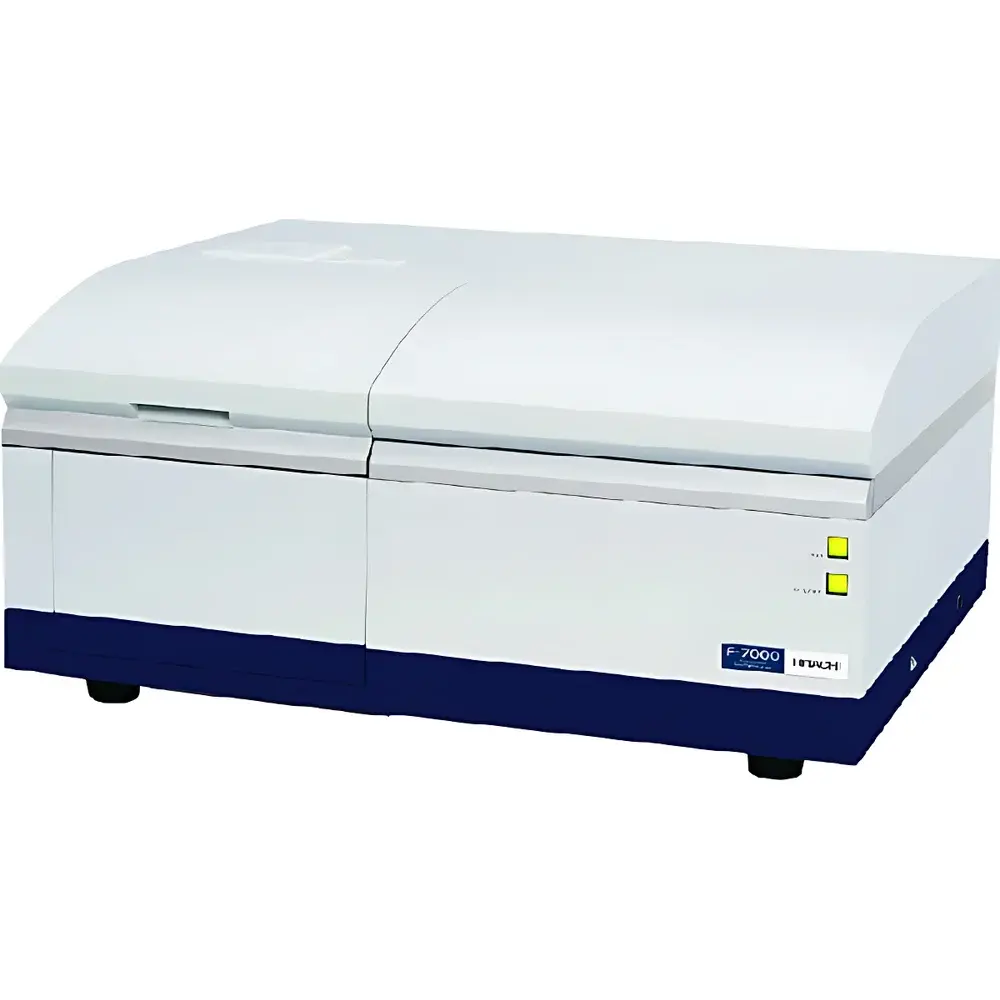
Hitachi F-7000 Molecular Fluorescence Spectrometer
| Brand | Hitachi |
|---|---|
| Origin | Japan |
| Manufacturer Type | Original Equipment Manufacturer (OEM) |
| Instrument Type | Steady-State Fluorescence Spectrometer |
| Wavelength Scanning Speed | Up to 60,000 nm/min |
| Slit Width (Spectral Bandpass) | 1–20 nm |
| Excitation Source | Xenon Arc Lamp |
| Monochromator Type | Dual Grating |
| Detection Mode | Photon Counting with PMT |
| Dimensions & Weight | Approx. 2/3 volume and 30% less mass vs. F-4500 model |
| Software Compliance | FDA 21 CFR Part 11 (Audit Trail, Electronic Signature, User Access Control) |
| Linear Dynamic Range | 6 decades for calibration curve generation |
| Phosphorescence Measurement Capability | Extended time-gated detection up to seconds scale |
| Optional Module Support | Report Generator, Temperature-Controlled Cell Holder, Polarization Accessories, Microvolume Adapters |
Overview
The Hitachi F-7000 Molecular Fluorescence Spectrometer is a high-performance steady-state fluorometer engineered for precision quantitative and qualitative analysis of fluorescent and phosphorescent species across research, quality control, and regulatory environments. Based on the principle of photoluminescence spectroscopy—where samples are excited by monochromatic light (typically from a high-intensity xenon arc lamp) and the resulting emission is dispersed via dual-grating monochromators—the F-7000 delivers exceptional signal-to-noise ratio and spectral fidelity. Its optical architecture minimizes stray light and ensures high wavelength accuracy (< ±0.5 nm) and repeatability (±0.1 nm), critical for method transfer and multi-laboratory comparability. Designed for operational efficiency without compromising analytical rigor, the instrument integrates compact mechanical layout with advanced photon detection electronics, enabling reliable measurement of weakly fluorescent analytes—including proteins, nucleic acids, quantum dots, and organic electroluminescent materials—even at sub-nanomolar concentrations.
Key Features
- Ultra-high scanning speed of up to 60,000 nm/min, facilitating rapid spectral acquisition and high-throughput screening workflows.
- Dual-grating monochromator system with continuously variable slit width (1–20 nm), offering precise control over spectral resolution and photometric sensitivity.
- High-sensitivity photomultiplier tube (PMT) detector with photon-counting mode, optimized for low-light applications such as trace-level environmental monitoring or single-cell fluorescence assays.
- Extended time-domain capability supporting phosphorescence lifetime measurements via time-gated detection—enabling discrimination between short-lived fluorescence and long-lived phosphorescence in complex matrices.
- Compact footprint (≈67% of F-4500 dimensions) and reduced mass (30% lighter), improving laboratory space utilization and benchtop integration without sacrificing optical path stability.
- FDA 21 CFR Part 11-compliant software platform with full audit trail logging, role-based user authentication, electronic signatures, and secure data archiving—meeting GLP/GMP documentation requirements for pharmaceutical and clinical laboratories.
Sample Compatibility & Compliance
The F-7000 accommodates standard 10 mm quartz cuvettes, microvolume cells (down to 50 µL), and optional temperature-controlled holders (−10 °C to +100 °C). It supports solid, liquid, and powder samples using accessory modules including front-face reflectance adapters and fiber-optic probes. Regulatory alignment includes compliance with ISO/IEC 17025 for testing laboratories, ASTM E1358–22 for fluorescence intensity calibration, and USP <1032>, <1033>, and <1034> for validation of fluorescence-based analytical procedures. All firmware and software revisions undergo formal change control per ICH Q9 principles, ensuring traceability during method validation and routine operation.
Software & Data Management
The bundled FL Solutions software provides intuitive workflow-driven operation: automated wavelength scanning, synchronous fluorescence mapping, excitation-emission matrix (EEM) acquisition, kinetic time-scan profiling, and ratiometric quantitation. Calibration curves support linear, quadratic, and cubic regression models across six orders of magnitude—eliminating sample dilution steps for unknowns. Raw and processed data are stored in vendor-neutral HDF5 format with embedded metadata (instrument parameters, operator ID, timestamp, environmental conditions). The optional Report Generator module allows customizable PDF/Excel report templates compliant with internal SOPs and external audit expectations—including header/footer branding, automatic pass/fail flagging, and signature fields.
Applications
- Pharmaceutical development: Quantification of APIs, impurity profiling, stability-indicating assays, and excipient interaction studies.
- Environmental analysis: Detection of polycyclic aromatic hydrocarbons (PAHs), humic substances, and metal-chelating fluorophores in water and soil extracts.
- Materials science: Characterization of OLED emitters, quantum yield determination of nanomaterials, and aggregation-induced emission (AIE) behavior.
- Life sciences: Intracellular Ca2+ dynamics using Fluo-4 or Fura-2 dyes, protein folding/unfolding monitored by intrinsic tryptophan fluorescence, and DNA intercalation assays.
- Industrial QC: Batch consistency verification of fluorescent brighteners, ink formulations, and polymer additives.
FAQ
What types of samples can be measured with the F-7000?
Liquid solutions in standard cuvettes, microvolume samples (≥50 µL), temperature-sensitive biological specimens, and solid films using reflection accessories.
Does the F-7000 support phosphorescence measurements?
Yes—via programmable time-gated detection with adjustable delay and integration windows, enabling separation of phosphorescent decay from prompt fluorescence.
Is method validation support available?
Yes—the instrument meets USP <1032>–<1034> and ICH Q2(R2) guidelines; full validation packages (IQ/OQ/PQ protocols) are provided upon request.
Can the software generate regulatory-compliant reports?
Yes—FL Solutions with Report Generator produces auditable, template-customizable reports meeting FDA, EMA, and PMDA submission standards.
What maintenance is required for long-term performance stability?
Annual optical alignment verification, xenon lamp replacement every 1,000 hours (typical), and routine PMT dark-current calibration using built-in diagnostics.
Related Products




