
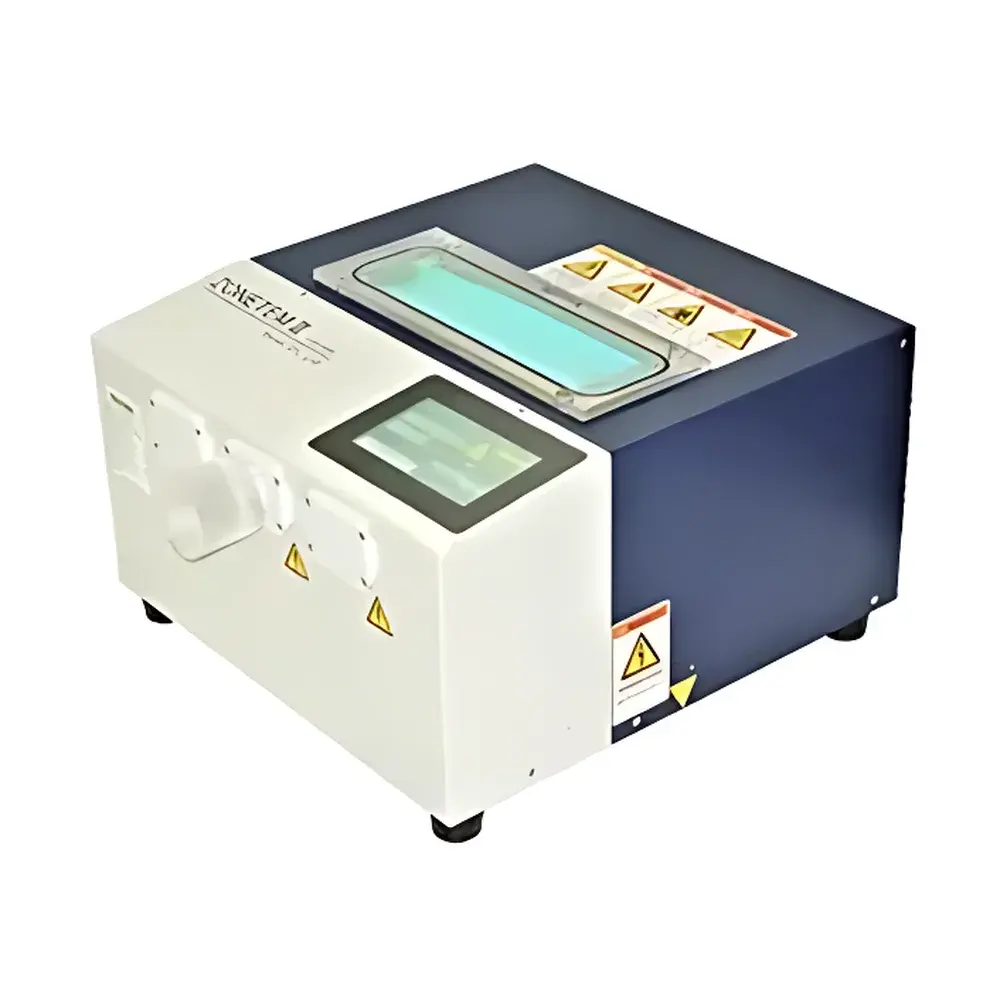
SUNYOU ZONETEM II Ozone-Based UV Cleaning System for TEM Sample Preparation
| Brand | SUNYOU |
|---|---|
| Origin | Japan |
| Model | ZONETEM II |
| Cleaning Principle | Vacuum-Enhanced 185/254 nm UV-Ozone Oxidation |
| Vacuum Range | 100–500 Torr (100-step adjustable) |
| Pump Type | Oil-Free Dry Scroll Vacuum Pump (3.8 L/min) |
| Pump-Down Time | ≤3 min to operational vacuum |
| Cleaning Duration | 1–30 min (1-min increments) |
| Sample Holder Compatibility | 3-hole or 5-hole TEM specimen holders |
| Effective Cleaning Area | Ø3 mm per position |
| Regulatory Compliance | Designed for ISO/IEC 17025-compliant labs |
Overview
The SUNYOU ZONETEM II is a dedicated ultraviolet-ozone (UV-O3) cleaning system engineered for high-precision surface decontamination of transmission electron microscopy (TEM) specimens prior to imaging or analysis. It operates on the well-established photochemical oxidation principle: short-wavelength ultraviolet light (185 nm) photolyzes ambient oxygen (O2) within a controlled low-pressure environment to generate atomic oxygen (O), which rapidly combines with molecular oxygen to form ozone (O3). Concurrent irradiation at 254 nm directly dissociates organic contaminants and enhances ozone decomposition into highly reactive singlet oxygen and hydroxyl radicals. This dual-wavelength, vacuum-assisted mechanism enables efficient removal of hydrocarbon monolayers, adventitious carbon, and trace organosilicon residues—without ion bombardment, thermal stress, or plasma-induced surface modification. Unlike RF or microwave plasma cleaners, the ZONETEM II delivers non-destructive, isotropic cleaning ideal for beam-sensitive materials including graphene, MOFs, biological thin sections, and catalytic nanoparticles.
Key Features
- Vacuum-enhanced UV-O3 chamber with precise pressure control (100–500 Torr in 100 discrete steps), ensuring reproducible radical density and reaction kinetics across diverse sample geometries.
- Oil-free dry scroll vacuum pump (3.8 L/min) achieves stable process vacuum in ≤3 minutes—eliminating oil backstreaming risk and enabling rapid turnaround between samples.
- Two operational modes: (1) Vacuum UV-O3 cleaning and (2) Vacuum storage post-cleaning, minimizing recontamination during handling and transfer.
- Programmable cleaning duration from 1 to 30 minutes (1-minute resolution), supporting method optimization for varied contamination loads and material sensitivities.
- Dual-lamp UV source with calibrated 185 nm (ozone generation) and 254 nm (direct photolysis & ozone activation) emission bands, each independently monitored for intensity stability.
- Modular specimen holder interface accommodating standard 3-hole or 5-hole TEM sample rods—ensuring compatibility with JEOL, Thermo Fisher Scientific (FEI), Hitachi, and Zeiss TEM platforms.
- Effective cleaning zone diameter of 3 mm per position—optimized for high-resolution TEM grid areas while maintaining uniform photon flux and radical exposure.
Sample Compatibility & Compliance
The ZONETEM II is validated for use with carbon-coated Cu/Ni/Au TEM grids, silicon nitride windows, amorphous carbon films, and cryo-EM specimen supports. Its non-thermal, non-sputtering mechanism preserves delicate crystalline structures, surface terminations, and functional group integrity—critical for EELS, EDX, and high-angle annular dark-field (HAADF) imaging. The system conforms to ASTM E2933-21 (Standard Practice for Cleaning Electron Microscopy Specimens) and supports adherence to ISO 14644-1 (cleanroom classification) when integrated into Class 1000 or better preparation environments. Vacuum and timing parameters are fully loggable and exportable, facilitating compliance with FDA 21 CFR Part 11 requirements when paired with validated third-party data management software.
Software & Data Management
The embedded microcontroller provides local parameter setting and real-time vacuum monitoring via analog pressure sensor feedback. All process parameters—including start time, vacuum setpoint, duration, lamp status, and final pressure—are timestamped and stored in non-volatile memory for ≥10,000 cycles. Optional USB-to-PC interface enables CSV export of full session logs for integration into laboratory information management systems (LIMS). When deployed in regulated environments, the system supports electronic signatures and audit trails via compatible GLP/GMP-compliant software extensions—ensuring full traceability from cleaning protocol execution to final TEM acquisition.
Applications
- Removal of hydrocarbon contamination from TEM grids prior to high-resolution lattice imaging.
- Pre-cleaning of graphene and 2D material transfer substrates to minimize folding artifacts and improve monolayer yield.
- Surface activation of SiNx membranes for improved vitrified ice adhesion in cryo-TEM workflows.
- Decontamination of FIB-prepared lamellae to reduce amorphous carbon deposition during serial sectioning.
- Restoration of electron transparency in reused TEM grids without altering mesh geometry or carbon film thickness.
- Validation of cleaning efficacy using XPS or EELS carbon C1s peak quantification (post-ZONETEM II reduction ≥92% typical).
FAQ
What vacuum level is optimal for routine TEM grid cleaning?
A setpoint of 250–300 Torr balances ozone generation efficiency with sufficient mean free path for radical transport—recommended as the default for most carbon-contaminated grids.
Can the ZONETEM II be used with liquid-nitrogen-cooled specimen holders?
No—the chamber is not cryo-compatible; cooling must occur downstream in the TEM column after transfer.
How often should the UV lamps be replaced?
Lamp lifetime is rated at ≥1,500 hours under nominal operation; output decay is monitored via integrated photodiode feedback, triggering maintenance alerts at 85% initial intensity.
Is ozone exhaust treatment required?
Yes—integrated ozone destruct catalyst or external scrubber is mandatory per OSHA PEL (0.1 ppm 8-hr TWA); exhaust must vent to a fume hood or dedicated abatement system.
Does the system support automated batch processing?
Not natively; sequential cleaning requires manual rod insertion, but programmable timers enable unattended single-sample runs up to 30 minutes.



