
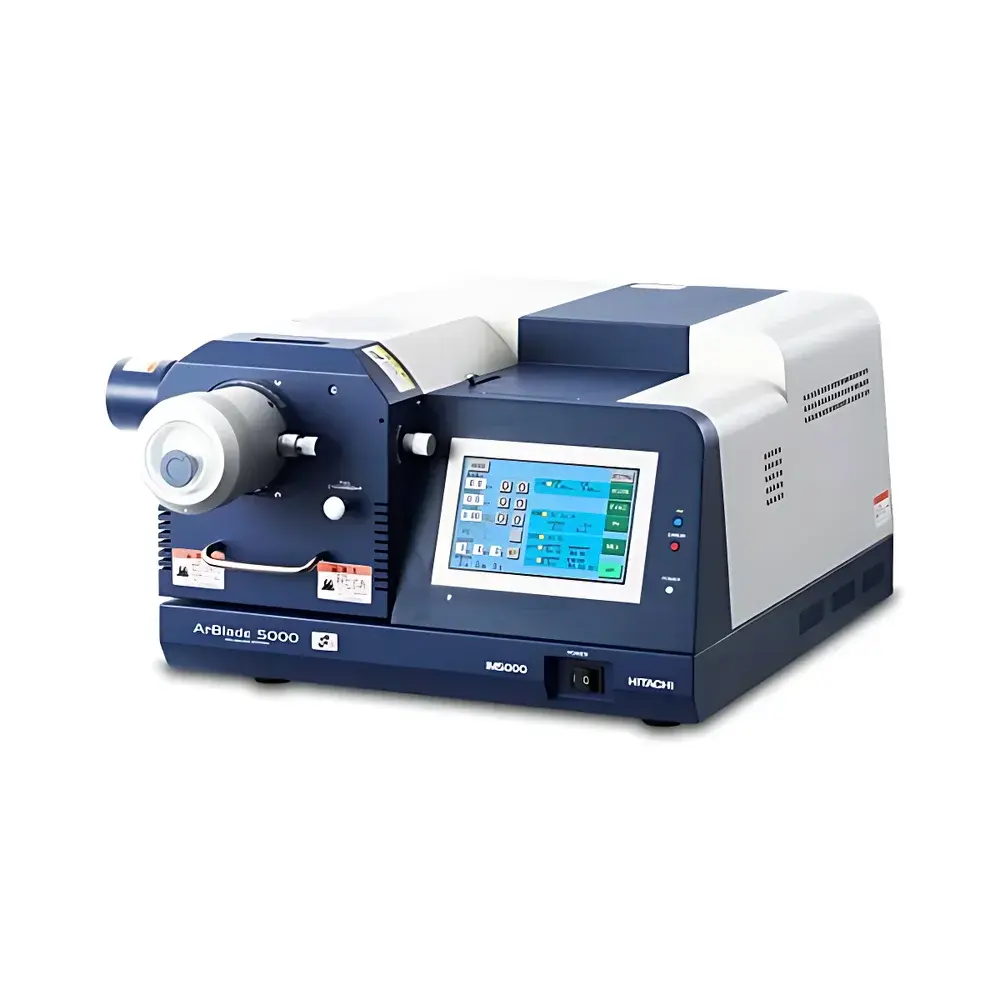
Hitachi ArBlade5000 Ion Milling System
| Brand | Hitachi |
|---|---|
| Origin | Japan |
| Manufacturer | Hitachi High-Tech Corporation |
| Type | Imported Equipment |
| Model | ArBlade5000 |
| Price Range | USD 135,000 – 270,000 (FOB Japan) |
Overview
The Hitachi ArBlade5000 Ion Milling System is a high-precision, vacuum-based sample preparation instrument engineered for cross-sectional and planar surface polishing of solid-state materials without mechanical deformation or thermal damage. It operates on the principle of physical sputtering—where a focused beam of accelerated argon ions bombards the sample surface at controlled angles, progressively removing material atom-by-atom via momentum transfer. This non-contact, stress-free process preserves microstructural integrity, making it indispensable for failure analysis, interface characterization, and nanoscale metrology in advanced materials science, semiconductor R&D, metallurgy, and ceramic engineering. Unlike mechanical polishing—which introduces subsurface deformation, smearing, or preferential phase removal—the ArBlade5000 delivers artifact-free surfaces suitable for high-resolution imaging in scanning electron microscopy (SEM), transmission electron microscopy (TEM), atomic force microscopy (AFM), and scanning probe microscopy (SPM). Its design reflects over two decades of iterative user feedback from global academic labs, semiconductor fabs, and industrial QA/QC facilities, culminating in a platform optimized for reproducibility, throughput, and operator ergonomics.
Key Features
- Mixed-mode milling architecture: Simultaneous or sequential cross-section and planar polishing within a single vacuum cycle—enabling versatile specimen preparation for layered structures, thin-film stacks, and heterogeneous composites.
- PLUS II ion gun technology: A next-generation broad-beam argon ion source delivering stable, uniform ion flux up to 1 mm/hr cross-sectional milling rate on hard materials (e.g., Al2O3, SiC, tungsten carbide), doubling the throughput of its predecessor (IM4000Plus).
- Ultra-wide-area cross-section milling: Engineered stage kinematics and collimated ion optics support maximum milling width of 8 mm—ideal for large-die IC packages, multi-layer PCBs, and bulk ceramic components requiring statistically representative cross-sectional views.
- Intuitive LCD touch-panel control system: Fully integrated graphical interface with real-time parameter monitoring (ion current, chamber pressure, stage tilt/rotation, elapsed time), programmable multi-step recipes, and password-protected user profiles compliant with GLP documentation requirements.
- Robust vacuum architecture: Dual-stage pumping system (turbo-molecular + dry scroll) achieving base pressure ≤5×10⁻⁶ Pa, ensuring low contamination and stable ion beam performance across extended runs (>24 h continuous operation).
Sample Compatibility & Compliance
The ArBlade5000 accommodates conductive and non-conductive specimens up to Ø100 mm × 30 mm height—including metals, alloys, oxides, nitrides, polymers, geological thin sections, and packaged electronic devices. Conductive coatings (e.g., carbon or Pt sputtering) are optional for insulating samples. The system meets ISO 9001 manufacturing standards and supports audit-ready documentation workflows aligned with FDA 21 CFR Part 11 (electronic records/signatures) when paired with Hitachi’s optional DataLogger Pro software. All ion gun components are RoHS-compliant; vacuum chamber materials conform to ASTM E1557 specifications for ultra-high-vacuum compatibility.
Software & Data Management
Control firmware includes built-in recipe management with version history, timestamped operation logs, and exportable CSV reports containing ion energy, current, angle, duration, and chamber pressure traces. Optional DataLogger Pro adds secure user authentication, electronic signature capture, and automated PDF report generation per sample—fully traceable for ISO/IEC 17025-accredited laboratories. Raw log files are compatible with third-party LIMS integration via standard OPC UA protocols.
Applications
- Failure analysis of solder joints, wire bonds, and flip-chip interconnects in microelectronics
- Interface characterization of ALD/CVD-grown dielectric stacks in memory devices
- Grain boundary and precipitate analysis in aerospace superalloys
- Porosity and phase distribution mapping in solid oxide fuel cell (SOFC) electrolytes
- Preparation of TEM lamellae from FIB-thinned regions for correlative SEM–TEM studies
- Surface relief profiling of lithographically patterned photomasks and EUV masks
FAQ
What vacuum level is required for optimal ion beam stability?
Base pressure ≤5×10⁻⁶ Pa is recommended; achieved using the integrated dual-pump system.
Can the ArBlade5000 prepare TEM-ready specimens directly?
It produces high-quality cross-sections for SEM/EDS and AFM; for TEM, it serves as a critical pre-thinning step prior to final FIB lift-out.
Is the PLUS II ion gun field-replaceable?
Yes—modular design enables tool-less replacement with full calibration retention via embedded EEPROM.
Does the system support automated batch processing?
Up to six samples can be loaded sequentially using the optional multi-sample holder; each processed under independent recipe parameters.
What safety certifications does the ArBlade5000 hold?
CE marking (EMC Directive 2014/30/EU, Machinery Directive 2006/42/EC), UL 61010-1, and IEC 61000-6-2/6-3 compliance.





