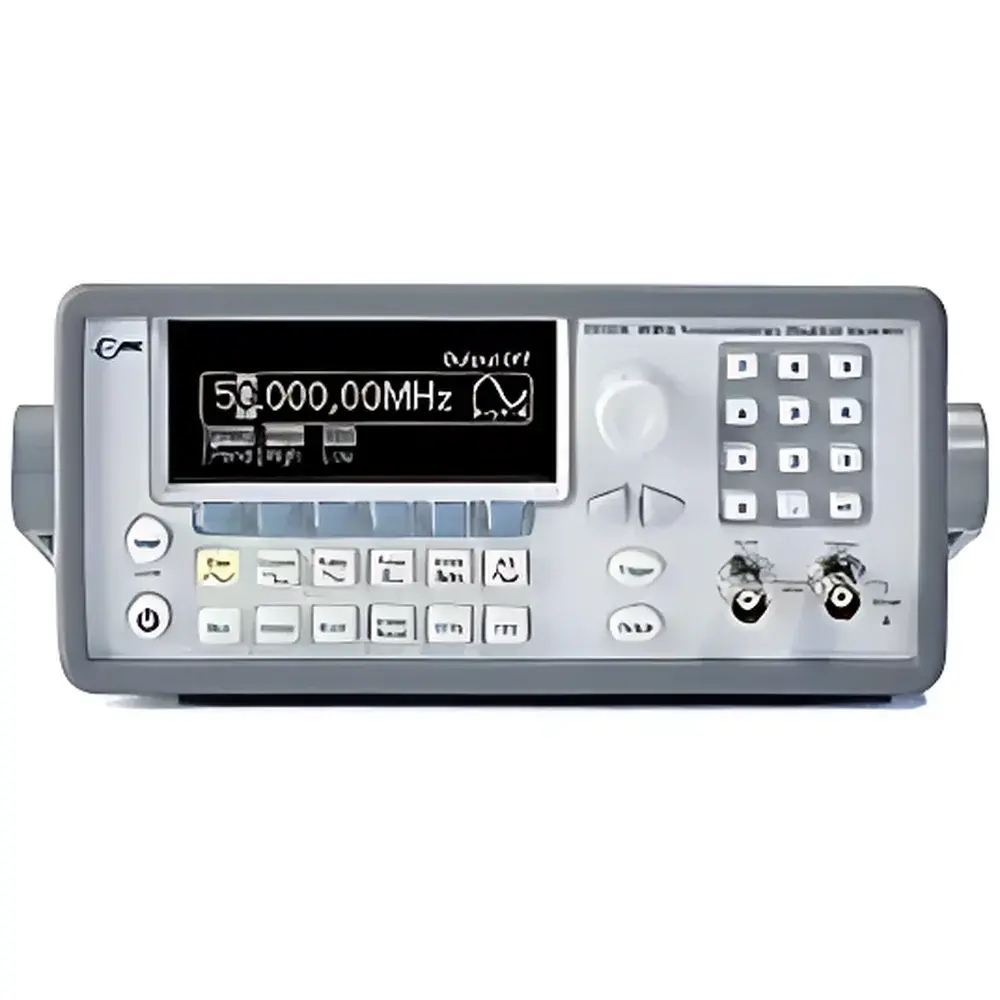
BNC Model 645 Digital Pulse Delay Generator
| Brand | BNC |
|---|---|
| Origin | USA |
| Model | 645 |
| Frequency Range | 50 MHz sine / 10 MHz arbitrary waveform |
| DAC Resolution | 14-bit |
| Sampling Rate | 125 MSa/s |
| Arb Memory Depth | 256 kPoints |
| Waveform Generator Width | 16 bits |
| Memory Depth (Graphics Mode) | 256 kPoints |
| Output Types | Pulse, Ramp, Triangle, Noise |
| Modulation Modes | AM, FM, PM (PSK), FSK, PWM |
| Sweep Types | Linear & Logarithmic |
| Interfaces | USB, LAN, GPIB |
| Software | wavePRO waveform creation, editing, and import |
Overview
The BNC Model 645 Digital Pulse Delay Generator is a high-precision, multi-function signal source engineered for demanding timing-critical applications in physics laboratories, nuclear instrumentation systems, laser synchronization setups, and automated test environments. Unlike conventional function generators, the Model 645 implements a dual-domain architecture: it combines a high-fidelity arbitrary waveform generator (ARB) with dedicated digital pulse delay logic, enabling sub-nanosecond timing resolution and deterministic latency control. Its core operation relies on a low-jitter clock distribution network synchronized to an internal 125 MSa/s sampling engine, ensuring phase coherence across multiple output channels and precise alignment between trigger events and waveform playback. Designed and manufactured in the United States by Berkeley Nucleonics Corporation—a leader in precision electronic instrumentation since 1979—the Model 645 meets stringent requirements for reproducibility, thermal stability, and electromagnetic compatibility in regulated R&D and industrial settings.
Key Features
- 50 MHz maximum sine wave output and 10 MHz bandwidth for arbitrary waveform generation, supporting fast transient simulation and high-speed system characterization
- 14-bit vertical resolution DAC with 125 MSa/s sampling rate and 256 kPoints of onboard arb memory—enabling accurate reproduction of complex transient signals including exponential decays, damped oscillations, and custom sensor response profiles
- Dedicated graphics mode with 16-bit word width and 256 kPoints depth for high-resolution pattern generation, suitable for FPGA stimulus, digital logic testing, and optical pulse shaping
- Comprehensive waveform library: pulse (adjustable width, delay, repetition rate), ramp, triangle, Gaussian and uniform noise, plus user-defined sequences
- Full modulation suite including AM, FM, PM (with PSK capability), FSK, and PWM—supporting dynamic parameter sweeps and protocol emulation for embedded system validation
- Linear and logarithmic frequency/phase sweeps for impedance spectroscopy, filter characterization, and resonance mapping applications
- Triple-standard computer interface: USB 2.0 (for configuration and firmware updates), 10/100/1000BASE-T Ethernet (LAN) with SCPI-over-TCP/IP support, and IEEE-488.2 GPIB (for legacy ATE integration)
Sample Compatibility & Compliance
The Model 645 is compatible with standard 50 Ω coaxial signal paths and supports TTL-, ECL-, and LVDS-level triggering via configurable output drivers. All analog outputs are DC-coupled and feature programmable offset and amplitude scaling (±10 V range, 1 mV resolution). The instrument complies with FCC Part 15 Class A and CE EN 61326-1:2013 for electromagnetic immunity and emissions in laboratory and light-industrial environments. While not certified for medical or safety-critical deployment, its design adheres to GLP-aligned documentation practices—including full audit trails in wavePRO software—and supports traceable calibration via NIST-traceable reference standards.
Software & Data Management
wavePRO is BNC’s native PC-based application for waveform synthesis, editing, and instrument control. It provides intuitive graphical waveform construction tools, mathematical equation entry (e.g., sin(2π·f·t)+0.3·exp(−t/τ)), and direct import of CSV, MATLAB (.mat), and binary data files. All waveform edits, parameter configurations, and session logs are stored in XML-based project files with timestamped metadata. Remote operation is supported via SCPI commands over LAN or USB; GPIB enables seamless integration into LabVIEW, Python (PyVISA), and MATLAB instrument control frameworks. Firmware updates preserve user-defined waveform libraries and calibration offsets without requiring factory recalibration.
Applications
- Synchronization of pulsed lasers, photomultiplier tubes (PMTs), and time-of-flight detectors in nuclear and particle physics experiments
- Triggering and gating of high-speed digitizers (e.g., 1+ GS/s oscilloscopes) with deterministic jitter < 25 ps RMS
- Stimulus generation for radiation detector testing, including pulse pile-up simulation and dead-time analysis
- Calibration of time-interval analyzers (TIAs) and time-to-digital converters (TDCs) using precisely spaced edge transitions
- Embedded system verification where hardware-triggered state machines require repeatable, multi-channel timing sequences
- Education and advanced electronics labs requiring hands-on exploration of digital timing, modulation theory, and mixed-signal behavior
FAQ
What is the minimum pulse width and delay resolution achievable with the Model 645?
The Model 645 achieves 100 ps delay resolution and supports pulse widths down to 2 ns, limited only by analog output bandwidth and load impedance.
Can multiple Model 645 units be synchronized to operate as a single multi-channel timing system?
Yes—via external 10 MHz reference input and programmable trigger delay alignment, up to eight units can be phase-locked with sub-200 ps inter-unit skew.
Does the Model 645 support streaming arbitrary waveforms from host memory during runtime?
No—waveforms must be preloaded into onboard memory; however, wavePRO enables rapid batch loading and channel assignment via scripting.
Is the GPIB interface fully SCPI-compliant?
Yes—full IEEE 488.2 and SCPI-1999 compliance is implemented, including *IDN?, :OUTP:STAT?, and :FUNC:ARB:DATA? command sets.
How is calibration maintained over temperature and time?
The unit incorporates oven-controlled crystal oscillators (OCXO) and auto-calibrating DAC references; annual calibration is recommended per ISO/IEC 17025 guidelines.