
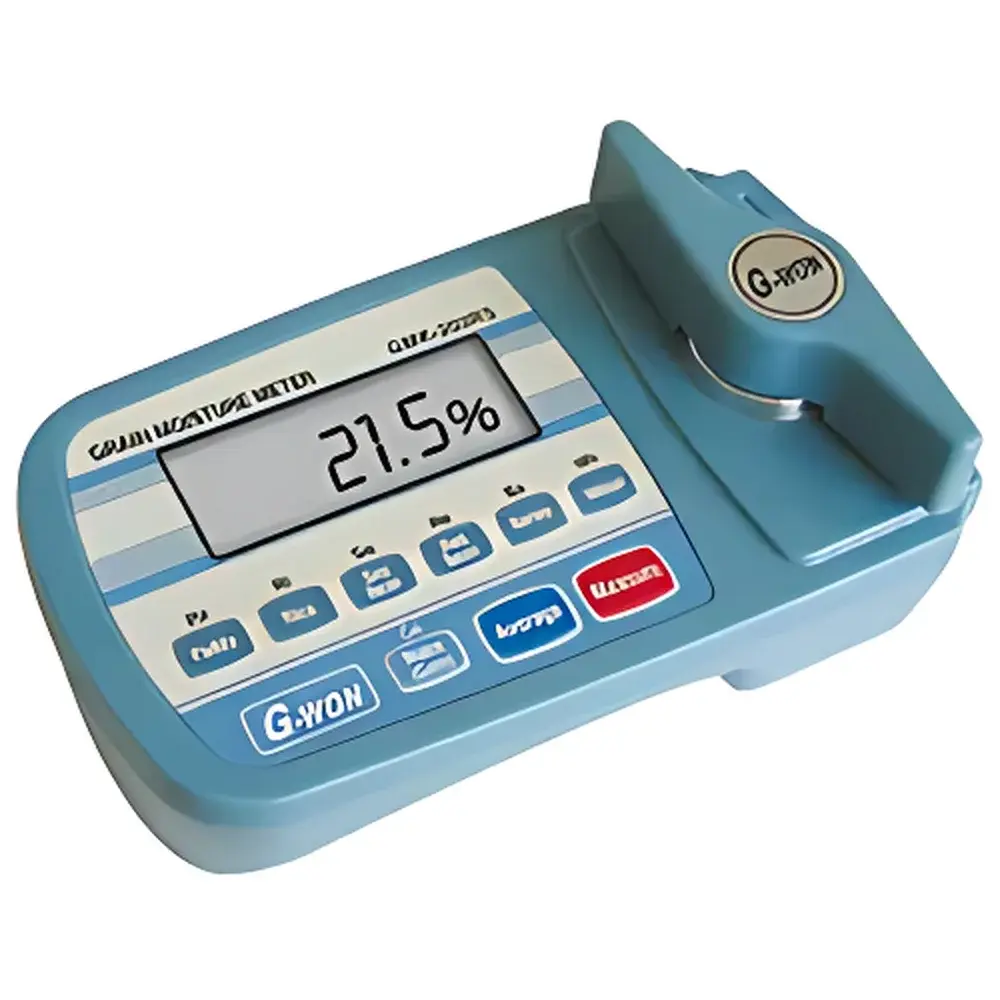
G-WON GMK-303CF Capacitance-Based Moisture Analyzer for Coffee Beans and Cereals
| Brand | G-WON |
|---|---|
| Origin | South Korea |
| Model | GMK-303CF |
| Measurement Principle | Capacitance Method |
| Display | Large LCD with Digital Readout |
| Temperature Compensation | Automatic |
| Calibration | Auto-Calibration Routine Prior to Each Measurement |
| Power Supply | 4 × 1.5 V AA Batteries |
| Accuracy | ±0.5% (w/w) |
| Dimensions | 164 × 94 × 40 mm |
| Weight | ~1.2 kg |
| Moisture Range (Coffee) | 6.5–23.5% |
| Rice | 8.3–26.0% |
| Paddy | 8.5–40.0% |
| Wheat | 8.5–35.0% |
| Soybean | 8.5–21.5% |
| Sunflower Seed | 4.5–13.5% |
| Maize/Corn | 8.7–22.8% |
Overview
The G-WON GMK-303CF is a portable, capacitance-based moisture analyzer engineered for rapid, non-destructive moisture quantification in bulk agricultural commodities—specifically optimized for roasted and green coffee beans, paddy rice, milled rice, wheat, soybeans, sunflower seeds, and maize. Unlike loss-on-drying (LOD) or Karl Fischer titration methods, this instrument employs high-frequency capacitive sensing to detect dielectric permittivity changes correlated with water content in heterogeneous particulate matrices. The measurement principle relies on the distinct dielectric response of bound versus free water within grain microstructures, enabling field-deployable analysis without sample grinding, heating, or chemical reagents. Its compact form factor, battery-powered operation, and real-time digital output make it suitable for quality control checkpoints at origin mills, roasting facilities, storage silos, and port-side inspection stations.
Key Features
- Capacitance sensing architecture calibrated for 7 major agricultural commodities, with preloaded moisture calibration curves traceable to reference oven-dry standards (ASTM D4940, ISO 712)
- Integrated automatic temperature compensation algorithm that adjusts dielectric response thresholds across ambient operating temperatures from 5 °C to 40 °C
- Self-initiated auto-calibration sequence executed prior to every measurement cycle—verifies sensor baseline stability and electrode integrity; analysis is inhibited if calibration fails, ensuring data integrity
- Large backlit LCD display with 4-digit resolution and unit-specific % (w/w) readout, supporting immediate visual verification under variable lighting conditions
- Touch-sensitive keypad with tactile feedback, designed for gloved operation in dusty or humid environments
- Auto-save functionality retains up to 100 sequential measurements with timestamp (year/month/day/hour/minute), accessible via on-device scroll navigation
- Intelligent power management including low-battery warning indicator and auto-shutdown after 5 minutes of inactivity
Sample Compatibility & Compliance
The GMK-303CF is validated for use with whole, unground kernels and beans exhibiting particle size distributions typical of post-harvest handling (e.g., coffee cherry parchment, hulled rice, cleaned wheat). It is not intended for powdered, pelleted, or highly processed derivatives. Moisture ranges reflect empirical correlation datasets derived from comparative testing against AOAC 950.46 and ISO 6540 reference methods. While not certified for regulatory submission under FDA 21 CFR Part 11, its auto-calibration log, measurement timestamping, and failure-lockout protocol support GLP-aligned documentation practices in internal QC workflows. Device construction complies with IEC 61000-6-3 (EMC emission) and IEC 60529 IP54 ingress protection for dust and splash resistance.
Software & Data Management
Data retrieval is performed locally via on-screen navigation—no PC connectivity or proprietary software is required. Each stored record includes sample type identifier, moisture value, date/time stamp, and pass/fail status of the preceding auto-calibration. For traceability, users may manually annotate batch IDs or lot numbers using alphanumeric input. Export functionality is not embedded; however, manual transcription into LIMS or Excel is facilitated by consistent field formatting and stable display retention (>10 s post-measurement). Audit trail integrity is maintained through immutable auto-calibration event logging—no user-editable calibration coefficients are exposed.
Applications
- Roaster-side verification of green coffee moisture prior to drum roasting (target range: 10.5–12.5%) to prevent scorching or under-development
- Post-drying validation at rice mills to confirm compliance with Codex Alimentarius moisture limits (<14% for milled rice)
- Storage facility monitoring of wheat and maize to mitigate mycotoxin risk associated with prolonged exposure above 14.5% moisture
- Origin export certification support where rapid screening replaces lab-based LOD for preliminary shipment release decisions
- Field-based assessment of sunflower seed drying progress during harvest, where low-end sensitivity (down to 4.5%) enables early-stage process control
FAQ
Does the GMK-303CF require periodic factory recalibration?
No—its auto-calibration routine eliminates the need for scheduled recalibration. However, annual verification against NIST-traceable moisture standards is recommended for audit readiness.
Can the instrument measure moisture in roasted versus green coffee interchangeably?
Yes—the preloaded coffee profile accounts for density and dielectric shifts between roast levels; no manual mode switching is required.
What happens if auto-calibration fails during startup?
The display shows “CAL ERROR” and disables measurement until successful recalibration is completed—preventing invalid data generation.
Is the device compliant with ISO/IEC 17025 requirements for accredited labs?
It is not a primary reference instrument per ISO/IEC 17025 Annex B; it serves as a field screening tool aligned with method validation guidelines in ISO 5725 for intermediate precision.
How does temperature variation affect measurement repeatability?
Automatic temperature compensation maintains ≤±0.3% RSD across 15–35 °C ambient conditions when used per manufacturer’s sampling protocol (consistent fill volume, tamping pressure, and rest time).




