
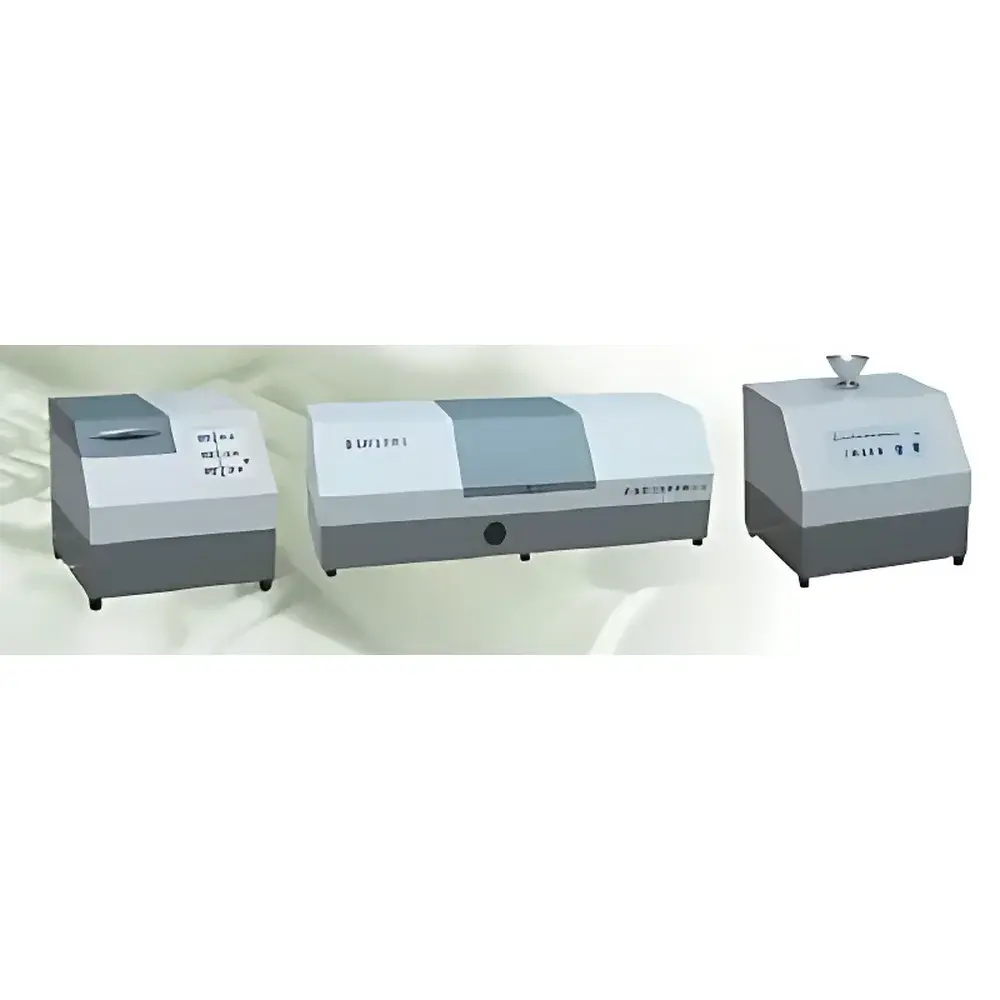
Rise RISE-2028 Dual-Mode Dry/Wet Laser Particle Size Analyzer
| Origin | Beijing, China |
|---|---|
| Manufacturer Type | Authorized Distributor |
| Regional Origin | Domestic (China) |
| Model | RISE-2028 |
| Pricing | Available Upon Request |
| Measurement Range (Wet) | 0.02–1200 µm |
| Measurement Range (Dry) | 0.1–1200 µm |
| Accuracy Error | < ±1% (D50, NIST-traceable standard reference materials) |
| Repeatability | < ±1% (D50, same sample, repeated measurements) |
| Power Supply | AC 220 V ±10%, 50 Hz, 200 W |
| Dimensions (L×W×H) | 950 × 330 × 300 mm |
| Weight | 50 kg |
| Laser Source | He-Ne gas laser, λ = 632.8 nm, lifetime >25,000 h |
| Maximum Detection Angle | 135° |
| Detector Array | Non-uniform cross-three-dimensional扇-shaped matrix (translated as “non-uniform crossed 3D sectoral matrix”) |
| Default Size Classes | 130 channels (0.02–2000 µm), fully customizable from 1–130 channels |
| Data Output | Excel-compatible CSV, PDF, image (PNG/JPEG), printable reports with header/footer customization |
| Software | PADMAS v5.x (Particle Diameter Measure & Analysis System) |
Overview
The Rise RISE-2028 Dual-Mode Dry/Wet Laser Particle Size Analyzer is an industrial-grade optical instrument engineered for precise, reproducible particle size distribution (PSD) characterization across diverse material classes. It operates on the fundamental principle of Mie scattering theory—applied over the full measurement range—incorporating user-defined or default optical parameters (e.g., particle refractive index, dispersion medium refractive index, and absorption coefficient) to compute volume-based PSD from angular light scattering intensity profiles. Unlike fixed-parameter or Fraunhofer-based systems, the RISE-2028 performs true unconstrained inverse scattering analysis: no a priori assumptions regarding distribution shape (e.g., log-normal or Rosin-Rammler) are imposed during computation. This ensures fidelity to actual sample morphology, particularly critical for polydisperse, irregular, or aggregated particulates encountered in pharmaceuticals, ceramics, battery cathode materials, catalysts, and mineral processing.
Key Features
- Single-Optical-Path Fourier Design: Eliminates multi-lens assemblies and manual alignment; enables broad dynamic range (0.02–1200 µm wet / 0.1–1200 µm dry) with high angular resolution up to 135°.
- Stable He-Ne Laser Source: 632.8 nm wavelength, spectral linewidth <0.002 nm, power stability ±0.5% over 8 hours—certified for long-term baseline consistency and compliant with ISO 13320:2020 requirements for laser source stability.
- Non-Uniform Crossed 3D Sectoral Detector Array: Optimized spatial sampling density at low- and high-scattering angles enhances sensitivity to both submicron fines and coarse fractions, minimizing inversion artifacts inherent in uniform linear arrays.
- Integrated Dual-Dispersion Architecture: Independent, software-synchronized dry and wet modules share a common optical bench and detection system—reducing footprint, calibration drift, and inter-method variability.
- Intelligent Dispersion Control: Touch-panel–driven ultrasonic (0–590 s, 100 W), stirring (0–3000 rpm), and circulation (0–5000 rpm) functions operate concurrently with measurement; real-time feedback prevents bubble-induced noise and sedimentation-related bias.
Sample Compatibility & Compliance
The RISE-2028 accommodates powders, suspensions, emulsions, and slurries spanning organic polymers, inorganic oxides, metals, pharmaceutical actives, and geological samples. Dry-mode operation requires no solvents or dispersants—ideal for moisture-sensitive, volatile, or hazardous materials (e.g., LiCoO₂, MgH₂, or API powders). Wet-mode compatibility includes aqueous and non-aqueous media (e.g., isopropanol, cyclohexane), supported by a 400 mL stainless-steel dispersion cell with seamless cleaning geometry. All hardware complies with GB/T 19001–2016 (ISO 9001:2015) manufacturing standards (Q/01RZ01-2004), and software supports audit trails, electronic signatures, and report export formats aligned with FDA 21 CFR Part 11 readiness for GLP/GMP environments. Instrument validation documentation—including IQ/OQ protocols and D50 accuracy verification using NIST SRM 1963 and SRM 2800—is provided with each unit.
Software & Data Management
PADMAS v5.x serves as the analytical engine and interface platform. It delivers ISO 13320-compliant data reduction, supporting differential (dV/dlogD), cumulative (Q3), Rosin-Rammler, and user-defined classification schemes. Standard outputs include D10, D50, D90, span, specific surface area (volume- and mass-based), and statistical moments (μ₁, μ₂, μ₃). Reports are exportable to Excel (.xlsx), vector graphics (.pdf), raster images (.png), and print-ready layouts with editable headers, footers, and corporate branding. Batch processing, inter-instrument comparison overlays, and trend analysis across time-series datasets are natively supported. The software architecture logs all parameter changes, measurement events, and user actions—enabling full traceability per ALCOA+ principles.
Applications
- Quality control of spray-dried excipients and milled active pharmaceutical ingredients (APIs) under ICH Q5A and USP <729> guidelines.
- Characterization of electrode slurry components (e.g., graphite, NMC, LFP) for lithium-ion battery R&D and production release testing.
- Monitoring attrition and agglomeration behavior of catalysts during fluidized-bed reactor commissioning.
- Grading of ceramic raw materials (e.g., alumina, zirconia) to ensure green-body density uniformity.
- Validation of milling efficiency in pigment and inkjet ink formulation development.
FAQ
Does the RISE-2028 require annual recalibration?
No scheduled recalibration is mandated; however, daily verification using traceable reference standards (e.g., NIST SRM 1963) is recommended per ISO 21501-4 and internal quality procedures.
Can the instrument measure nanoparticles below 100 nm in wet mode?
Yes—the 0.02 µm lower limit (20 nm) is validated for monodisperse latex standards and colloidal silica under optimized dispersion and refractive index input.
Is the dry dispersion module compatible with explosive or pyrophoric powders?
Dry measurement uses oil-free compressed air; users must integrate external inert gas purging (e.g., N₂ or Ar) and grounding protocols per ATEX/IECEx requirements—hardware supports such modifications via auxiliary gas inlet ports.
How is data integrity ensured during long-term unattended operation?
PADMAS implements automatic file versioning, cyclic buffer overwrite protection, and SHA-256 hash logging for all raw scattering patterns and processed reports—meeting Annex 11 and EU GMP Annex 11 expectations.
What support is provided for method development with challenging samples?
Rise provides application-specific dispersion protocols—including surfactant selection matrices, sonication energy maps, and shear-rate optimization curves—validated across >200 material categories and documented in the included Application Handbook v3.0.
Related Products



