
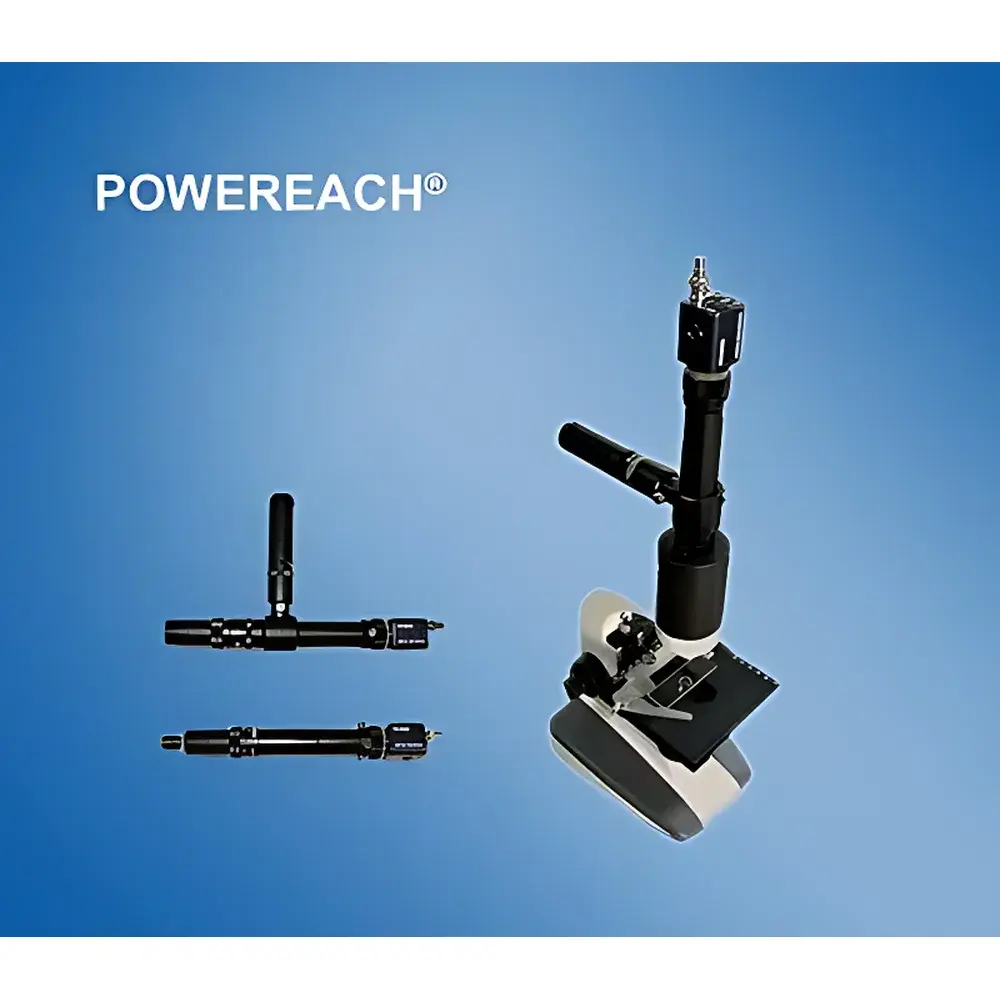
JZ95MS Microscopic Optical Imaging & Analysis System
| Origin | Shanghai, China |
|---|---|
| Manufacturer Type | Authorized Distributor |
| Origin Category | Domestic (PRC) |
| Model | JZ95MS |
| Pricing | Upon Request |
Overview
The JZ95MS Microscopic Optical Imaging & Analysis System is a precision-engineered modular platform designed for high-resolution real-time observation, quantitative morphological analysis, and dynamic process monitoring of microscale structures. Built upon an advanced long-working-distance continuous zoom optical architecture, the system enables stable, vibration-resistant imaging across magnifications ranging from 0.75× to 160× (depending on configured objective and auxiliary optics), with effective pixel resolution down to 0.42 µm/pixel (24 pixels/µm at maximum magnification). Its core optical design follows Köhler illumination principles and supports multiple illumination modalities—including coaxial epi-illumination, oblique incident lighting, and transmitted brightfield—ensuring optimal contrast and signal-to-noise ratio for diverse specimen types. The system is fundamentally intended for applications requiring non-destructive, label-free, time-resolved visualization of structural evolution: crystallization kinetics, polymer chain alignment under applied electric fields, cellular morphodynamics, thin-film phase transitions, and microfluidic particle behavior. Unlike conventional benchtop microscopes, the JZ95MS features a compact, low-profile zoom tube optimized for integration into industrial automation environments—such as semiconductor wafer inspection stations, inline coating thickness monitors, or pharmaceutical granulation lines—where space constraints and mechanical stability are critical.
Key Features
- Modular continuous zoom optical path (0.75×–160×) with fixed-axis mechanical stabilization to suppress vibration-induced image drift
- Extended working distance (7.5–90 mm, model-dependent) enabling unobstructed observation of samples in liquid cells, environmental chambers, or under process conditions
- Multi-mode illumination compatibility: coaxial epi-illumination, angled reflective lighting, and transmitted brightfield
- Interchangeable objective lens configurations supporting wide-field, high-NA, and telecentric imaging geometries
- Integrated C-mount interface compliant with industrial CCD/CMOS sensors (including progressive-scan and global-shutter cameras)
- Optical train equipped with standardized filter threads (M25.5×0.5, M30.5×0.5) for polarizers, IR-cut filters, bandpass filters, and custom spectral selection
- Ruggedized aluminum-alloy housing with ESD-safe surface treatment for cleanroom and production-floor deployment
Sample Compatibility & Compliance
The JZ95MS accommodates opaque, translucent, and transparent specimens—including silicon wafers, liquid crystal cells, biological tissue sections, polymer films, mineral grains, and colloidal suspensions—without requiring conductive coating or vacuum environments. Its long working distance and flexible illumination options permit direct imaging of samples housed in Petri dishes, microfluidic chips, or industrial reaction vessels. The system complies with ISO 10934-1 (optical microscopy terminology), ISO 9342 (microscope magnification calibration), and ASTM E2817 (standard guide for digital image acquisition in materials characterization). When deployed in regulated environments, the optional audit-trail-enabled image acquisition software supports 21 CFR Part 11 compliance through user authentication, electronic signatures, and immutable metadata logging—including timestamped calibration records, illumination settings, and objective identification.
Software & Data Management
The bundled professional image analysis suite provides ISO/IEC 17025-aligned quantitative metrology tools for morphology-based measurement and statistical reporting. It supports 24-bit RGB, HSV, Lab, and YUV color space processing; implements adaptive thresholding, watershed segmentation, and automated agglomerate splitting for complex particulate systems; and delivers >120 parametric descriptors per region-of-interest—including Feret diameter, aspect ratio, convexity, circularity, solidity, and grayscale texture metrics (GLCM entropy, contrast, homogeneity). All measurements are traceable to NIST-traceable stage micrometers and certified reference standards. Raw image data (TIFF, BMP, RAW) and processed results (CSV, XLSX, PDF) are stored with embedded EXIF metadata. Database export functionality enables integration with LIMS or MES platforms via ODBC drivers. Report templates adhere to GLP documentation requirements, embedding scale bars, calibration certificates, operator IDs, and instrument configuration logs.
Applications
- Semiconductor: Defect mapping on photomasks, solder paste inspection, bump height profiling
- Pharmaceuticals: Granule size distribution in fluid-bed dryers, tablet coating uniformity assessment, crystal habit analysis per ICH Q5A
- Materials Science: Grain boundary quantification in metallurgical mounts, phase fraction analysis in composites, pore network characterization
- Life Sciences: Live-cell motility tracking, neurite outgrowth measurement, mitotic index scoring
- Industrial Coatings: Pigment dispersion homogeneity, film thickness estimation via edge-detection, scratch depth quantification
- Geosciences: Mineral liberation analysis (MLA), coal maceral identification, porosity-permeability correlation studies
FAQ
What magnification range does the JZ95MS support in standard configuration?
The base system achieves 0.75×–4.5× optical zoom; extended magnification up to 160× is attainable using auxiliary objectives and digital interpolation—calibrated against NIST SRM 2053.
Can the system be integrated into an automated production line?
Yes—the low-profile zoom tube (height < 85 mm) and rigid mounting flange support direct integration into robotic workcells, PLC-controlled conveyors, and AOI stations.
Is the software validated for use in GMP-regulated environments?
The image acquisition module supports 21 CFR Part 11 compliance when deployed with role-based access control, electronic signatures, and audit-trail logging enabled.
Which camera interfaces are supported?
Standard C-mount interface compatible with USB3 Vision, GigE Vision, and Camera Link cameras meeting EMVA 1288 noise and dynamic range specifications.
Does the system include calibration certification?
Each shipment includes a factory-issued calibration certificate traceable to national metrology institutes, covering magnification accuracy, field flatness, and illumination uniformity.




