
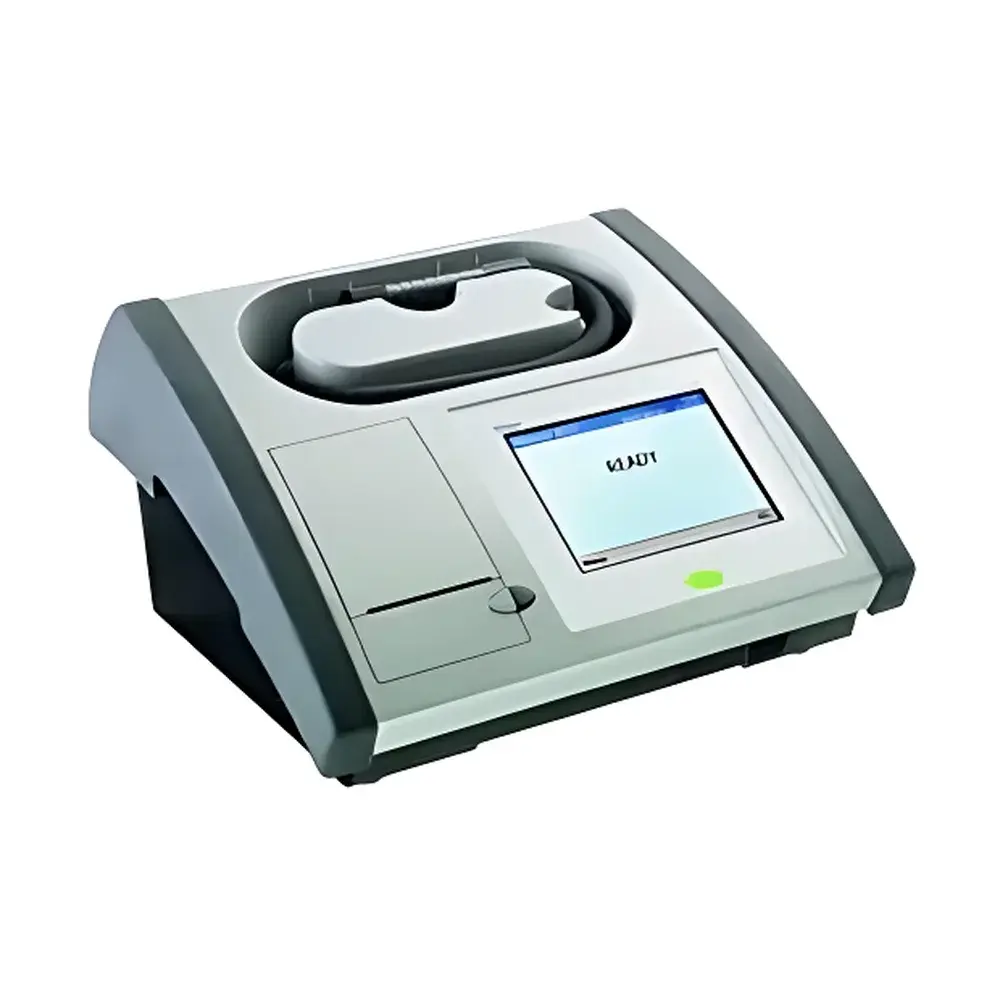
Dräger Alcotest 9510 Dual-Technology Breath Alcohol Analyzer
| Origin | Germany |
|---|---|
| Manufacturer Type | Authorized Distributor |
| Origin Category | Imported Instrument |
| Model | Alcotest 9510 |
| Pricing | Upon Request |
Overview
The Dräger Alcotest 9510 is a dual-sensor breath alcohol analyzer engineered for forensic-grade accuracy, operational reliability, and regulatory compliance in law enforcement, workplace testing, and clinical screening environments. It employs two independent, orthogonal measurement principles—non-dispersive infrared (NDIR) spectroscopy at 3.4 µm (C–H stretch absorption band) and electrochemical fuel cell detection—to simultaneously quantify ethanol concentration in exhaled breath. This dual-technology architecture provides real-time cross-validation of results, significantly reducing false positives and enhancing analytical confidence. The instrument operates on the principle that ethanol vapor absorbs specific infrared wavelengths while generating a proportional current in a platinum-based electrochemical cell. Measurement output is reported as breath alcohol concentration (BrAC) in g/L or mg/L, traceable to NIST-certified reference standards. Designed for deployment in both mobile patrol vehicles and fixed-site stations, the Alcotest 9510 meets stringent environmental robustness requirements per EN 50102 and IEC 60529 (IP54 ingress protection), ensuring stable performance under temperature fluctuations (−10 °C to +50 °C), humidity (up to 95% RH non-condensing), and mechanical shock.
Key Features
- Dual independent detection modules: NDIR sensor with temperature-stabilized optical path and high-selectivity ethanol bandpass filter; electrochemical fuel cell with 5-year nominal service life and automatic humidity compensation.
- Self-calibrating IR zeroing cycle: Prior to each test, ambient air in the sample chamber undergoes full-spectrum IR analysis to establish baseline absorbance—eliminating drift from environmental contaminants or residual ethanol.
- 7-inch high-resolution color TFT touchscreen with capacitive multi-touch interface and context-sensitive virtual keypad; supports multilingual UI (English, German, French, Spanish, Polish) with configurable font size for field readability.
- Integrated broadband communication interface (RS-232, USB 2.0, Bluetooth 4.2, and optional Ethernet) enabling seamless integration with RMS (Results Management Systems), digital evidence management platforms, and third-party printers or modems.
- Modular mechanical design: Supports horizontal benchtop, vertical wall-mount, or vehicle-dock configurations via standardized VESA 75/100 mounting patterns; includes vibration-dampened internal chassis for mobile use.
- Onboard thermal line printer with auto-cutter: Generates tamper-evident, time-stamped reports containing BrAC value, test ID, operator code, device serial number, calibration status, ambient temperature/humidity, and graphical trend overlay of the entire breath curve.
Sample Compatibility & Compliance
The Alcotest 9510 accepts standard 1.5 L breath samples collected via disposable mouthpieces compliant with ISO 21148:2019 (Breath alcohol testing devices – Requirements and test methods). Sample flow rate is actively monitored and regulated between 0.5–1.5 L/s to ensure laminar, contamination-free aspiration through the heated sampling line (maintained at 37 °C ± 1 °C). All measurement data—including raw sensor outputs, timestamps, environmental parameters, and operator actions—are stored with immutable audit trails meeting FDA 21 CFR Part 11 and EU Annex 11 requirements for electronic records. The system is certified to EN 15964:2011+A1:2016 (Alcohol interlocks – Performance requirements and test methods) and approved for evidential use by the German Federal Motor Transport Authority (KBA) and the U.S. National Highway Traffic Safety Administration (NHTSA) Conforming Product List.
Software & Data Management
Dräger’s proprietary WinDraeger Data Manager v4.2 software enables centralized configuration, firmware updates, calibration logging, and secure export of encrypted CSV or XML datasets. Each measurement record includes cryptographic hash signatures and digital certificate validation. Role-based access control (RBAC) supports three user tiers: Operator (test execution only), Supervisor (calibration and maintenance), and Administrator (system configuration and audit review). Audit logs capture all critical events—including failed authentication attempts, calibration deviations >±0.01 g/L, and sensor saturation—with UTC timestamps synchronized via NTP. Data exports are compatible with laboratory information management systems (LIMS) and court-admissible digital evidence repositories.
Applications
- Law enforcement roadside screening and evidential breath testing in accordance with local statutory limits (e.g., 0.05 g/L in EU member states, 0.08 g/L in most U.S. jurisdictions).
- Pre-employment, random, post-incident, and return-to-duty alcohol testing in transportation, energy, and defense sectors governed by DOT 49 CFR Part 40 or EU Directive 2003/109/EC.
- Clinical monitoring of patients undergoing alcohol dependency treatment, supporting objective adherence verification in outpatient programs.
- Quality assurance in manufacturing facilities where alcohol exposure poses ignition or solvent interaction hazards.
- Research applications requiring high-fidelity breath ethanol kinetics, including pharmacokinetic modeling and metabolic rate studies.
FAQ
How does the dual-technology architecture improve measurement integrity?
It provides concurrent, physically independent quantification—IR measures molecular absorption, while the fuel cell detects redox current—enabling real-time discrepancy detection and automatic flagging of anomalous readings due to interferents (e.g., acetone, methanol) or sensor degradation.
Is routine calibration required between tests?
No. The integrated IR zeroing cycle performs automatic baseline correction using ambient air before every test. Full calibration is performed biannually using certified ethanol gas standards traceable to PTB (Physikalisch-Technische Bundesanstalt).
Can measurement data be exported to external databases?
Yes—via USB, Bluetooth, or Ethernet using structured XML schema compliant with ASTM E2895-22 (Standard Practice for Electronic Data Interchange in Forensic Toxicology).
What is the operating temperature range for field deployment?
The device functions reliably from −10 °C to +50 °C, with internal thermal regulation maintaining optimal sensor temperature across ambient extremes.
Does the Alcotest 9510 support GLP/GMP-compliant workflows?
Yes—through configurable electronic signatures, 21 CFR Part 11–compliant audit trails, calibration lockout periods, and automated certificate generation upon successful verification.






