
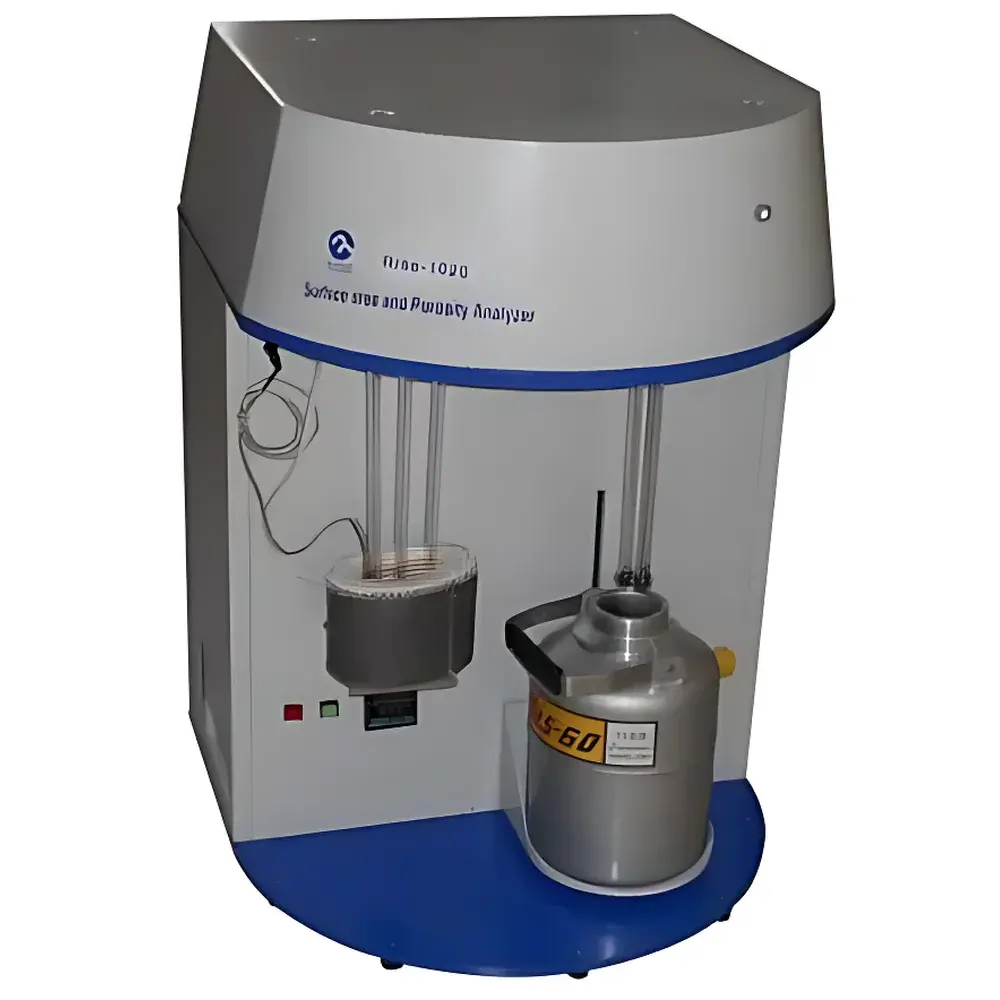
Rise-1030 Automated Specific Surface Area and Pore Size Analyzer
| Origin | Beijing, China |
|---|---|
| Manufacturer Type | Authorized Distributor |
| Origin Category | Domestic (China) |
| Model | Rise-1030 |
| Pricing | Upon Request |
Overview
The Rise-1030 Automated Specific Surface Area and Pore Size Analyzer is a high-precision instrument engineered for comprehensive characterization of porous solids using the static volumetric gas adsorption method at cryogenic temperature (77 K). It operates in strict accordance with internationally recognized standards—including ISO 9277 (BET surface area), ISO 15901 (pore size distribution), and GB/T 19587 (Chinese national standard for nitrogen adsorption)—ensuring metrological traceability and regulatory acceptability in global R&D and quality control laboratories. The system quantifies adsorbed nitrogen mass via pressure transduction across calibrated volumes, applying the ideal gas law and mass balance equations to derive equilibrium adsorption isotherms. From these isotherms, it computes specific surface area (via single-point and multi-point BET, Langmuir models), meso- and macroporous structure (BJH theory), microporous volume and distribution (t-plot, DA, HK methods), and advanced pore size distributions using non-local density functional theory (NLDFT) and grand canonical Monte Carlo (GCMC) kernel models—enabling rigorous microstructural analysis across nanoporous, mesoporous, and hierarchical materials.
Key Features
- Modular all-stainless-steel ultra-high vacuum manifold with integrated leak-tight sealing architecture—eliminates dead volume and minimizes outgassing, achieving ultimate vacuum ≤4.0 × 10⁻⁴ Torr
- Proprietary metal Dewar flask (2.0 L capacity) with optimized thermal geometry—maintains stable 77 K sample temperature for up to 80 hours without liquid nitrogen replenishment; eliminates fragility and handling risk associated with glass Dewars
- High-fidelity sensor array: six imported absolute pressure transducers (0–133 kPa, ±0.1% full-scale accuracy) and one PT-100 temperature sensor (±0.1 °C), digitized via 22-bit ADC for sub-micropascal resolution in pressure differentials
- Triple-sample analysis station: simultaneous measurement of three samples with independent dosing and equilibration control; six-position sample preparation module with programmable degassing capability
- Fully automated adsorption/desorption cycling under PC-based real-time control—no manual valve actuation or timing intervention required
- Remote diagnostic and software update support via secure TLS-encrypted connection, compliant with ITAR-free data governance protocols
Sample Compatibility & Compliance
The Rise-1030 supports a broad range of solid, powdered, granular, and monolithic materials—including zeolites, MOFs, activated carbons, silica gels, alumina catalysts, clays, soils, battery electrode materials, and pharmaceutical excipients. All analytical outputs are generated in alignment with GLP-compliant workflows: audit trails record operator ID, timestamp, method version, calibration history, and raw pressure/temperature logs. Software export modules generate reports conforming to ASTM D3663 (BET surface area), ISO 15901 Annex C (DFT validation), and USP (porous material characterization for drug product development). Data integrity meets FDA 21 CFR Part 11 requirements for electronic records and signatures when deployed with validated user access controls and electronic signature modules.
Software & Data Management
The proprietary RiseAdsorb™ v5.2 acquisition and analysis suite provides ISO 15901-certified isotherm fitting engines, including NLDFT kernels for carbon slit-pore, silica cylindrical, and alumina spherical models, as well as GCMC-derived distributions for heterogeneous surfaces. Raw pressure vs. time datasets are stored in HDF5 format with embedded metadata (sample ID, degas conditions, bath temperature, transducer calibration IDs). Batch processing supports parallel evaluation of up to 24 isotherms with cross-sample statistical comparison. Export options include fully annotated PDF reports, Excel-compatible CSV files (with column headers mapped to IUPAC-recommended nomenclature), and XML schemas compatible with LIMS integration (ASTM E1482, ISO/IEC 17025). All software modules undergo annual third-party verification against NIST-traceable reference materials (e.g., NIST SRM 1990a, 2000c).
Applications
This analyzer serves critical functions across academic, industrial, and regulatory domains: catalyst development teams use BJH and DFT outputs to correlate pore architecture with turnover frequency in hydrodesulfurization reactions; battery R&D labs quantify electrode-specific surface area and interfacial porosity to model Li⁺ ion transport resistance; pharmaceutical scientists assess excipient surface energetics and pore confinement effects on amorphous stability per ICH Q5A guidelines; environmental researchers characterize soil organic carbon accessibility using t-plot and DA micropore metrics; and nanomaterial manufacturers validate batch-to-batch reproducibility of MOF surface area within ±1.5% RSD (n=6) under controlled degas protocols (200 °C, 3 h, 10⁻³ mbar).
FAQ
What adsorption theory models are natively supported for pore size distribution calculation?
NLDFT (carbon, silica, and alumina kernel libraries), GCMC, BJH, DH, and HK methods—with automatic model selection guidance based on IUPAC pore classification and isotherm type (I–VI).
Is the system compliant with FDA 21 CFR Part 11 for regulated environments?
Yes—when configured with role-based authentication, electronic signatures, and audit trail logging enabled, the software satisfies electronic record and signature requirements for GMP/GLP documentation.
Can the instrument perform CO₂ adsorption at 273 K for ultramicropore analysis?
No—the Rise-1030 is optimized for 77 K nitrogen adsorption; CO₂ analysis requires optional low-temperature stage and dedicated CO₂-compatible pressure sensors (not included in base configuration).
What is the minimum detectable surface area and its uncertainty at that limit?
The validated lower detection limit is 0.01 m²/g with an expanded uncertainty (k=2) of ±8% relative, established using certified low-surface-area quartz standards (NIST SRM 1990a).
How is system cleanliness maintained between analyses to prevent cross-contamination?
Each sample port features independent high-vacuum isolation valves and in-line cold traps; automated purge cycles with ultra-high-purity helium precede each analysis, and residual gas analysis (RGA) is available as an add-on module.



