
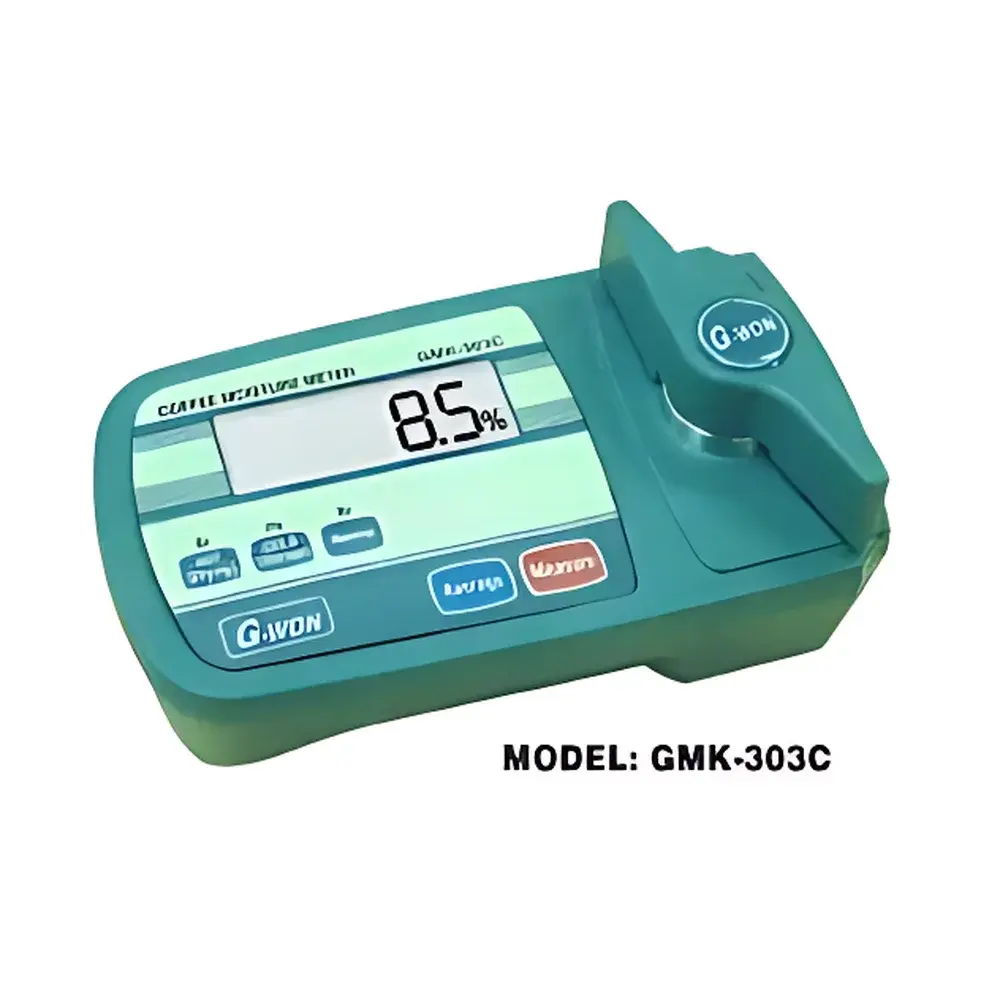
G-WON GMK-303C Capacitance-Based Coffee Bean Moisture Analyzer
| Brand | G-WON |
|---|---|
| Origin | South Korea |
| Model | GMK-303C |
| Measurement Principle | Capacitance Method |
| Sample Type | Whole or Ground Coffee Beans |
| Moisture Range | 6.5–21.0% w/w |
| Resolution | 0.1% |
| Accuracy | ±0.5% |
| Measurement Time | ~3 seconds |
| Temperature Compensation | Automatic |
| Calibration | Auto-calibration with built-in reference protocol |
| Display | Backlit LCD |
| Power Supply | 4 × 1.5 V AA batteries |
| Dimensions | 164 × 94 × 40 mm (L×W×H) |
| Weight | ~1.8 kg |
| Data Handling | Auto-save, Auto-power-off |
| Interface | Touch-sensitive keypad |
Overview
The G-WON GMK-303C is a dedicated capacitance-based moisture analyzer engineered for rapid, non-destructive quantification of water content in coffee beans—both whole and ground. Unlike loss-on-drying (LOD) or Karl Fischer titration methods, the GMK-303C relies on dielectric permittivity measurement: as water content changes, the dielectric constant of the coffee sample shifts proportionally, enabling real-time correlation between capacitance response and gravimetric moisture percentage. This principle ensures repeatable, operator-independent results without sample preparation, heating, or chemical reagents. Designed specifically for roasting facilities, green coffee importers, QC laboratories, and specialty coffee producers, the instrument delivers field-deployable accuracy aligned with industry benchmarks such as SCA (Specialty Coffee Association) Recommended Practice RP-12 and ISO 6673 (coffee—determination of moisture content—capacitance method). Its compact form factor and battery-powered operation support use across receiving docks, roasting floors, and cupping labs—where ambient temperature fluctuations and workflow constraints demand robust, self-stabilizing instrumentation.
Key Features
- Capacitance sensing architecture optimized for roasted and green coffee matrices, minimizing interference from density, particle size, and roast degree variations.
- Integrated automatic temperature compensation algorithm that dynamically adjusts calibration coefficients based on real-time sensor thermal drift—critical for consistent performance across seasonal storage environments (10–35°C operating range).
- Proprietary auto-calibration sequence executed at power-on and before each measurement cycle; utilizes an internal reference standard to verify electrode sensitivity and baseline offset, ensuring metrological traceability without external standards.
- Backlit LCD display with high-contrast alphanumeric rendering for clear readability under variable lighting conditions—including low-light roasting facility environments.
- Touch-sensitive keypad with tactile feedback and debounce logic, reducing misoperation risk during high-volume batch testing.
- Auto-save functionality stores up to 100 measurement records locally, including timestamp, moisture value, and pass/fail flag relative to user-defined specification limits (e.g., 10.5–12.5% for export-grade Arabica).
- Intelligent power management with low-battery indicator and auto-shutdown after 5 minutes of inactivity—extending battery life beyond 2000 measurements per set of AA cells.
Sample Compatibility & Compliance
The GMK-303C is validated for direct measurement of whole-bean and medium-ground coffee samples (particle size distribution compliant with SCA Particle Size Distribution Standard v2.0). It does not require grinding homogenization for routine QC screening, though consistency in fill volume and compaction must be maintained per ASTM D4442 (Standard Test Methods for Direct Moisture Content of Wood and Wood-Based Materials), adapted for porous agricultural commodities. The instrument complies with IEC 61000-6-3 (EMC emission limits) and IEC 61010-1 (safety requirements for electrical equipment for measurement). While not certified to FDA 21 CFR Part 11, its audit-ready data log supports GLP-aligned documentation when paired with controlled SOPs governing calibration frequency, environmental monitoring, and record retention.
Software & Data Management
Data export is performed via manual transcription from the onboard LCD or optional IR interface (not included). No proprietary PC software is bundled; however, raw values are structured for seamless integration into LIMS or Excel-based QA dashboards. Each stored result includes measurement ID, date/time stamp, moisture %, and status flag. The auto-calibration event log is retained separately and accessible via service mode—enabling verification of instrument readiness prior to regulated testing. For traceability, users are advised to document calibration verification outcomes per ISO/IEC 17025 clause 6.4.10 and maintain a calibration register indicating next due date based on usage intensity.
Applications
- Green coffee procurement: Rapid verification of moisture compliance against contract specifications (e.g., ≤12.5% for NY “C” contract delivery).
- Roast house incoming inspection: Screening for pre-roast moisture to anticipate bean expansion behavior and optimize drum charge weight.
- Post-roast quality control: Confirming final moisture stabilization (typically 1.5–2.5% loss post-roast) before packaging and degassing.
- Storage condition monitoring: Trend analysis of moisture migration in parchment or vacuum-sealed bags over time.
- Educational use in coffee science curricula: Demonstrating hygroscopic equilibrium relationships and water activity correlations.
FAQ
Does the GMK-303C require daily calibration with certified reference standards?
No—its auto-calibration routine replaces manual standardization. However, periodic verification using a traceable moisture standard (e.g., NIST SRM 2890) every 30 days is recommended for auditable workflows.
Can it measure moisture in roasted ground coffee immediately after grinding?
Yes, but allow ≥30 seconds for static charge dissipation post-grinding to prevent capacitive noise. Avoid measuring within 1 minute of roasting due to residual thermal transients.
Is the instrument suitable for other agricultural commodities like cocoa beans or nuts?
Not without revalidation. Dielectric response is matrix-specific; G-WON provides no factory calibration curves for non-coffee materials.
What happens if auto-calibration fails?
The unit halts measurement and displays “CAL ERROR”; operation resumes only after successful recalibration—preventing invalid data generation.
How is measurement repeatability affected by bean size variation?
Repeatability remains within ±0.3% RSD when fill volume is standardized to the engraved mark on the sample chamber and tamped consistently using the supplied plunger.







