
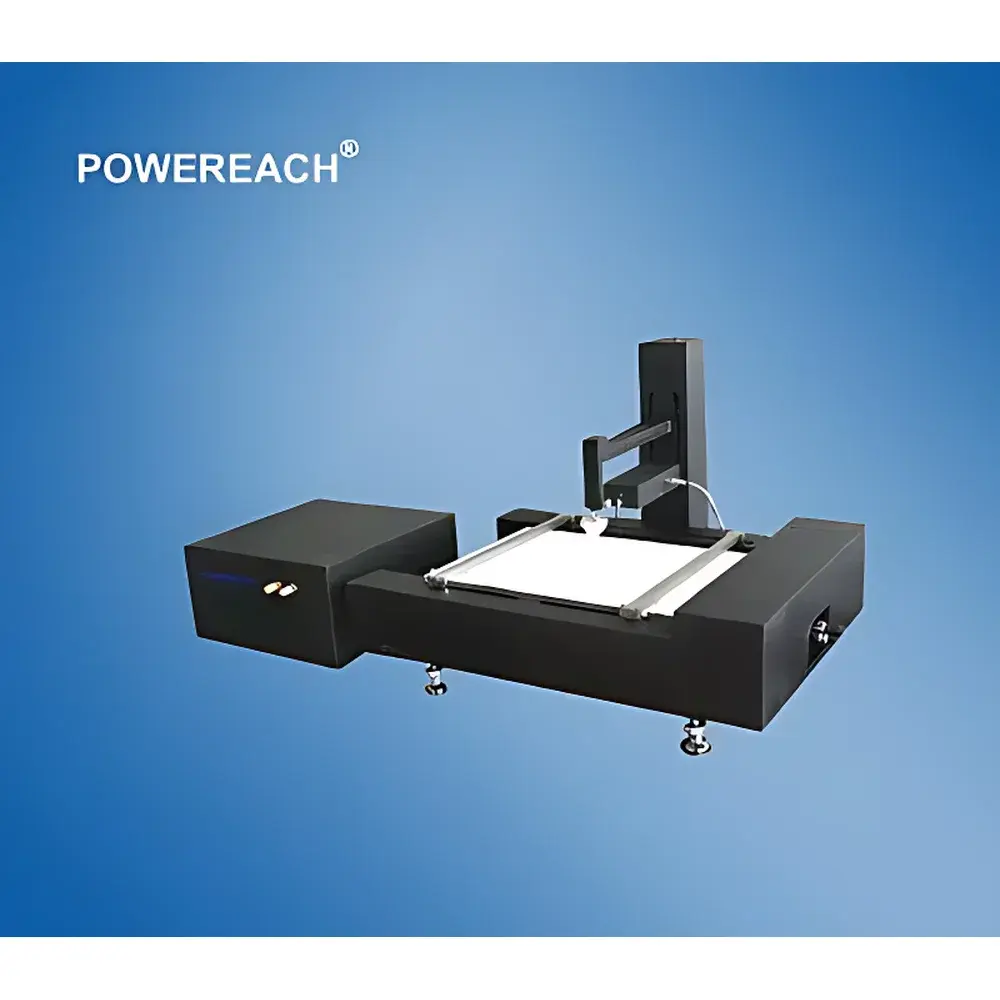
JML04C3 Langmuir-Blodgett Trough System with Wilhelmy Plate Surface Tensiometry
| Origin | Beijing, China |
|---|---|
| Manufacturer Type | Authorized Distributor |
| Origin Category | Domestic (PRC) |
| Model | JML04C3 |
| Price Range | USD 7,000 – 14,000 |
| Surface Tension Range | 0–150 mN/m |
| Resolution | 0.05 mN/m |
| Measurement Method | Wilhelmy Plate |
| Trough Material | PTFE (Full Fluoropolymer Construction) |
| Trough Dimensions | 300 mm × 200 mm |
| Compression Ratio | Up to 90% |
| Barrier Speed | 0.48–97 mm/min |
| Deposition Speed | 0.22–45 mm/min |
| Deposition Modes | Upstroke & Downstroke |
| Power Supply | AC 220 V ±10%, 50 Hz, 150 W Max |
| Operating Temp | Ambient (with optional external thermostatic bath interface) |
| RH Range | 30–85% |
| Compliance | ASTM D971, ISO 6295, ISO 1409, USP <721>, GLP-ready data audit trail capability |
Overview
The JML04C3 Langmuir-Blodgett Trough System is a precision-engineered surface science instrument designed for quantitative characterization of monolayer films at the air–liquid interface. It operates on the fundamental principles of Langmuir film balance methodology, integrating Wilhelmy plate tensiometry to measure surface pressure (π) as a function of molecular area (A), enabling thermodynamic analysis of amphiphilic monolayers—including phospholipids, surfactants, peptides, polymers, and synthetic lung surfactant analogs. The system supports both static compression isotherms and dynamic deposition cycles, making it suitable for fundamental biophysical studies (e.g., membrane phase behavior, lipid raft formation, protein–lipid interactions) and applied research in pulmonary surfactant replacement therapy, environmental organic contaminant adsorption, and functional LB-film fabrication for optoelectronic or sensor applications. Its full PTFE liquid trough minimizes chemical interaction and ensures long-term stability during aqueous or organic subphase experiments.
Key Features
- Fully automated operation via embedded microcontroller and Windows-based host software, reducing operator-induced variability and supporting reproducible protocol execution.
- High-resolution Wilhelmy plate sensor (0.05 mN/m resolution) with temperature-compensated calibration, delivering traceable surface pressure measurements across the full 0–150 mN/m range.
- Large-area PTFE trough (300 mm × 200 mm) optimized for low leakage, high sensitivity, and uniform barrier motion—compatible with standard Petri dish–scale sample volumes and extended lateral domain observation.
- Dual-mode barrier control: programmable constant-pressure deposition (π-controlled) and area-restricted compression/expansion (A-controlled), with adjustable speed profiles (0.22–45 mm/min for deposition; 0.48–97 mm/min for barrier movement).
- Integrated surface tension measurement capability—enabling real-time subphase characterization prior to monolayer formation or during multi-phase interfacial aging studies.
- Modular architecture supports custom configurations: dual-trough systems, temperature-regulated troughs (via external chiller interface), and multi-barrier setups for asymmetric or gradient monolayer studies.
- Compliance-ready data handling: time-stamped parameter logs, user-authenticated session records, and exportable ASCII/CSV datasets compatible with third-party analysis tools (Origin, MATLAB, Python).
Sample Compatibility & Compliance
The JML04C3 accommodates a broad spectrum of amphiphilic materials—including natural and synthetic phospholipids (DPPC, POPG), pulmonary surfactant extracts, block copolymers, dendrimers, and conjugated small molecules—dissolved in volatile organic solvents (chloroform, chloroform/methanol mixtures) or aqueous subphases. Its inert PTFE construction resists corrosion from acidic, basic, or saline subphases (pH 2–12, ionic strength up to 1 M NaCl), ensuring compatibility with physiological and environmental simulation conditions. The system meets core requirements for GLP-compliant laboratories: electronic signatures, audit-trail-enabled software, and metadata-rich data files aligned with FDA 21 CFR Part 11 principles. Experimental protocols conform to ASTM D971 (surface tension of petroleum products), ISO 6295 (determination of interfacial tension), ISO 1409 (plastics—determination of surface tension of polymer films), and USP (surface tension apparatus validation).
Software & Data Management
The proprietary Windows-native software provides intuitive graphical workflow navigation, real-time π–A and γ–A curve visualization, and synchronized parameter logging (barrier position, surface pressure, temperature, timestamp). All curves are vector-rendered for publication-grade output and support direct export to EPS, PNG, or SVG formats. Raw data files include header metadata (operator ID, date/time, calibration constants, environmental conditions) and are structured for seamless import into statistical or modeling platforms. Batch processing tools enable comparative analysis across multiple isotherms—including collapse pressure identification, compressibility modulus (Cs⁻¹) calculation, and phase transition onset detection. Software updates and firmware patches are delivered via secure authenticated channels, preserving system integrity and regulatory traceability.
Applications
- Biophysics: Quantification of lipid monolayer phase transitions, lateral compressibility, and miscibility in model membranes; investigation of SP-B/SP-C peptide insertion kinetics.
- Pulmonary Research: In vitro evaluation of synthetic and animal-derived surfactants for NRDS/ARDS therapeutic development; correlation of monolayer respreading efficiency with clinical outcomes.
- Environmental Science: Adsorption thermodynamics of humic substances, microplastic-associated surfactants, and oil dispersants at water–air interfaces.
- Materials Science: Fabrication and transfer optimization of LB-assembled nanomaterials (graphene oxide, quantum dots, MOFs) for gas sensing, photovoltaics, and nonlinear optical devices.
- Colloid & Interface Science: Critical micelle concentration (CMC) determination, mixed surfactant synergy assessment, and Langmuir–Blodgett film thickness validation via ellipsometry or AFM cross-correlation.
FAQ
What subphase temperature control options are available?
The JML04C3 features standardized ports for integration with external recirculating chillers or heating baths (e.g., Julabo, Thermo Scientific), supporting subphase temperature regulation from 5 °C to 45 °C with ±0.1 °C stability.
Can the system perform sequential multi-layer deposition?
Yes—software-defined deposition cycles support programmable upstroke/downstroke sequences, layer-count tracking, and interlayer pause intervals, enabling precise Y-type, X-type, or Z-type LB film assembly.
Is the Wilhelmy plate sensor calibrated traceably to NIST standards?
Each sensor undergoes factory calibration using certified reference weights and validated against NIST-traceable surface tension standards (e.g., 2-propanol, ethylene glycol); full calibration certificates are supplied with every unit.
Does the software support automated isotherm acquisition with user-defined compression rates?
Yes—compression rate, target surface pressure thresholds, and area limits are fully scriptable; the system executes ramp-and-hold or continuous compression modes with real-time feedback control.
Are custom trough geometries or multi-trough configurations supported?
Custom PTFE troughs (including circular, segmented, or dual-chamber designs) and mechanically synchronized multi-barrier systems are available under OEM engineering services, with lead times quoted upon technical specification review.



