
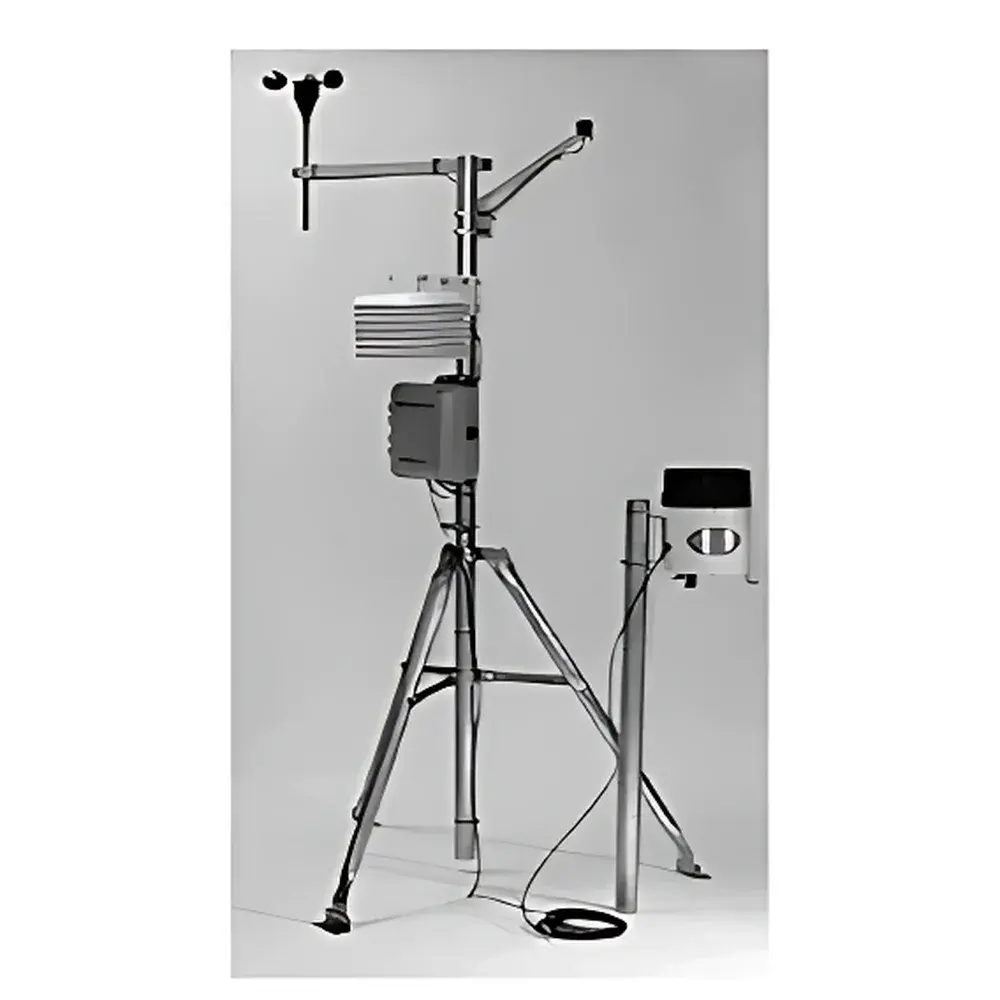
HOBO Micro Weather Station
| Origin | USA |
|---|---|
| Manufacturer Type | Distributor |
| Origin Category | Imported |
| Model | HOBO |
| Quotation | Upon Request |
| Instrument Type | Portable Weather Station |
Overview
The HOBO Micro Weather Station is a field-deployable, low-power environmental monitoring system engineered for long-term, unattended measurement of microclimate parameters in ecological research, agricultural trials, urban meteorology, and environmental impact assessments. Built upon Onset’s proven HOBO data logger architecture, the system operates on the principle of distributed sensor acquisition via a bus-based digital interface (SDI-12 and analog inputs), enabling synchronized, timestamped measurements across up to 15 independent channels. Its design adheres to foundational meteorological best practices—including WMO (World Meteorological Organization) and AASC (American Association of State Climatologists) guidelines for sensor siting, shielding, and exposure—ensuring data integrity suitable for scientific publication and regulatory reporting. The system supports flexible deployment configurations (2 m or 3 m mast heights), with modular mounting hardware to minimize inter-sensor interference—particularly critical for radiation and wind instrumentation where shadowing and turbulence must be rigorously controlled.
Key Features
- Modular, bus-based data acquisition architecture with automatic sensor detection and plug-and-play configuration—no manual wiring diagrams, firmware flashing, or field calibration required.
- Dual data logger options: H21-001 (15-channel, expandable from 10 standard interfaces) and H21-002 (4-channel, compact form factor).
- Low-power operation: 4 × AA alkaline or lithium batteries support ≥12 months of continuous logging at typical 15-minute intervals; battery life scales inversely with sampling frequency.
- Onboard non-volatile EEPROM memory (512 KB) retains up to 500,000 timestamped records with zero data loss during power interruption.
- Industrial-grade enclosure: IP65-rated weather-resistant polymer housing rated for -20°C to +50°C operational range; internal status LEDs indicate battery level, memory usage, and logging activity.
- Configurable sampling interval from 1 second to 18 hours; timekeeping accuracy ±5 seconds per week at +25°C (±2 seconds at first data point).
- Standard RS-232 serial interface for local data download; full transfer of 500,000 records completes in ≤2.5 minutes.
Sample Compatibility & Compliance
The HOBO Micro Weather Station accommodates a validated suite of Onset-certified sensors, each traceably calibrated and documented per ISO/IEC 17025 principles. Compatible parameter domains include air temperature (±0.2°C at 25°C), relative humidity (±2.5% RH, 0–50°C), barometric pressure (±1.5 mbar), precipitation (tipping-bucket, ±1.0% accuracy), PAR (400–700 nm, ±5 µmol/m²/s), total solar irradiance (300–1100 nm, ±5%), wind speed (0–45 m/s, ±4% above 30 m/s), wind direction (0–358°, ±5°), soil volumetric water content (0–40.5%, ±3%), and leaf wetness (0–100%, ±5% repeatability). All sensors meet WMO siting recommendations for height, clearance, and thermal shielding—e.g., temperature/humidity probes require radiation shields; anemometers mount on horizontal booms (48.7 cm or 91.4 cm) to avoid mast-induced flow distortion. System-level compliance supports GLP-aligned data integrity when used with HOBOware’s audit-trail-enabled configuration logs and metadata tagging.
Software & Data Management
HOBOware Pro (v4.x or later) serves as the certified desktop application for system setup, real-time monitoring, data retrieval, and post-processing. It provides intuitive graphical configuration of logging intervals, alarm thresholds (low battery, memory saturation), and sensor-specific scaling. Raw datasets export natively to CSV, Excel (.xlsx), and plain-text formats—preserving UTC timestamps, channel identifiers, and units. Metadata—including sensor model numbers, calibration dates, installation coordinates, and mast height—is embedded in file headers and retained in project archives. For remote operations, optional wireless modems (902–928 MHz ISM band) interface with Base Station Controllers to enable FTP upload, email alerts, and command-based reconfiguration—fully compatible with institutional IT security policies and compliant with basic data governance requirements for field-deployed environmental instrumentation.
Applications
This system is routinely deployed in peer-reviewed studies requiring high-temporal-resolution microclimate characterization: phenological monitoring in vineyards and orchards; evapotranspiration modeling for irrigation scheduling; boundary-layer analysis in urban heat island investigations; eddy-covariance site auxiliary measurements; and long-term ecological research (LTER) network stations. Its portability and minimal infrastructure dependency make it ideal for temporary deployments in protected natural areas, remote watersheds, and developing-region climate observatories. In agronomy, simultaneous leaf wetness, PAR, and soil moisture tracking supports disease-risk forecasting models (e.g., for powdery mildew or late blight). In education, its transparent architecture and open data format facilitate undergraduate training in environmental sensor networks and time-series analysis.
FAQ
What is the maximum number of sensors supported?
The H21-001 data logger supports up to 15 sensors via its bus architecture; the H21-002 supports up to 4.
Are calibration certificates provided with sensors?
Yes—each sensor ships with a factory calibration report traceable to NIST standards; annual recalibration is recommended for humidity, rain gauge, and radiation sensors.
Can the system operate in sub-zero environments?
Yes—the entire system (logger and all standard sensors) is rated for continuous operation from -40°C to +75°C; lithium batteries are strongly recommended below -20°C.
Is the software compliant with FDA 21 CFR Part 11?
HOBOware Pro does not include electronic signature or audit trail features required for Part 11 compliance; however, raw data files and configuration logs may be integrated into validated LIMS or ELN platforms meeting those requirements.
How is sensor cross-talk mitigated during installation?
Through mechanical separation using dedicated mounting arms (e.g., radiation sensors on leveled horizontal booms, anemometers offset from mast shadows), and adherence to WMO-recommended minimum distances between instruments of differing physical domains.
Related Products







