
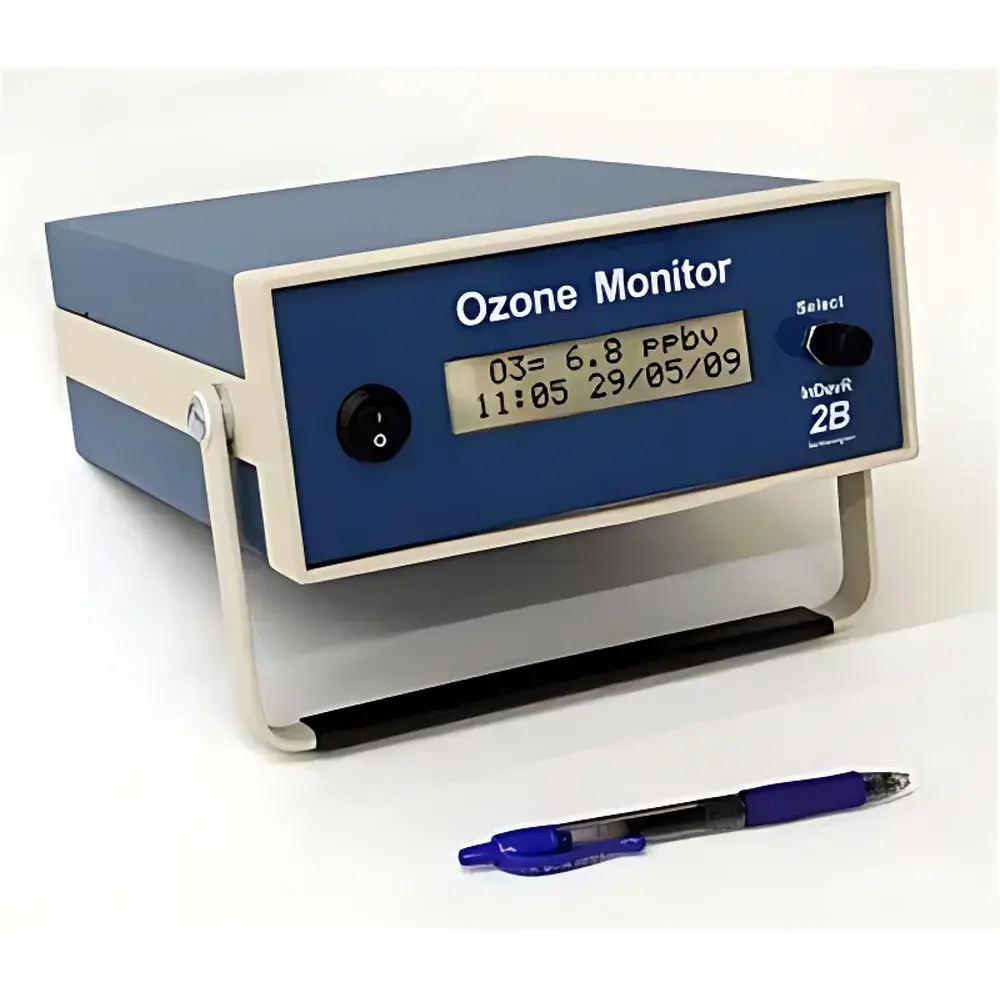
2B Technologies Model 202 UV Absorption Ozone Analyzer
| Origin | USA |
|---|---|
| Manufacturer Type | Authorized Distributor |
| Origin Category | Imported |
| Model | Model 202 |
| Pricing | Available Upon Request |
Overview
The 2B Technologies Model 202 UV Absorption Ozone Analyzer is a compact, field-deployable instrument engineered for high-precision, real-time measurement of ambient and elevated ozone (O₃) concentrations using dual-beam ultraviolet absorption spectroscopy at 254 nm. This principle relies on the well-characterized molar absorptivity of ozone at this wavelength—governed by the Beer–Lambert law—and enables trace-level quantification with minimal interference from other atmospheric constituents. Certified by the U.S. Environmental Protection Agency (EPA) as a Federal Equivalent Method (FEM: EQOA-0410-190), the Model 202 meets the performance requirements specified in 40 CFR Part 58 for ambient air quality monitoring networks. Its design prioritizes metrological integrity: all factory calibrations are NIST-traceable, and baseline stability, sensitivity drift, and noise specifications are rigorously validated under controlled environmental conditions per ISO/IEC 17025-aligned internal protocols.
Key Features
- Dual-beam UV photometric architecture with temperature-stabilized 254 nm low-pressure mercury lamp and matched reference detector—ensuring continuous compensation for lamp intensity drift and optical path degradation.
- Ultra-low power consumption: 4.0 W nominal (2.9 W in low-power mode), compatible with 12 V DC input (e.g., vehicle battery, solar-charged systems) or universal 100–240 V AC adapters.
- Lightweight portable form factor: 2.1 kg including enclosure; 0.7 kg bare instrument—optimized for UAV integration, balloon-borne payloads, mobile ground surveys, and personal exposure studies.
- Extended operational envelope: functional from 0 to 50 °C standard; optional cold-weather modification (-20 to 50 °C) includes heated lamp housing and rotary vane pump for reliable sub-zero flow control.
- High-resolution data acquisition: 0.1 ppb resolution, 10-second default measurement interval, with configurable averaging windows (10 s, 1 min, 5 min, 1 hr).
- Onboard non-volatile memory: stores up to 14,336 data records—equivalent to 1.6 years of hourly averages or 10 days of 1-minute resolution data.
Sample Compatibility & Compliance
The Model 202 is designed for continuous sampling of ambient air, indoor environments, laboratory exposure chambers, and aircraft cabin streams. It accommodates particulate-laden airstreams via optional external particle filters (e.g., Teflon-coated cyclonic or membrane types) meeting EPA PM₂.₅ guidance. Internal flow control maintains ~1.0 L/min across pressure ranges of 30–1000 mbar—enabling stable operation from sea level to ~30 km altitude. All measurements are automatically corrected for temperature and pressure per IUPAC-recommended ideal gas law implementation. The analyzer complies with 40 CFR Part 58 Appendix A (Ambient Air Quality Monitoring Requirements), supports GLP-compliant audit trails when paired with timestamped GPS and external metadata inputs, and satisfies foundational criteria for ISO 17025 accreditation of ozone measurement capability.
Software & Data Management
Data output is provided via RS-232 serial interface (configurable baud rates: 1200–19200), analog voltage (0–2.5 V), and optional USB-to-serial adapter. Three auxiliary analog inputs (0–2.5 V) allow synchronous logging of co-located meteorological parameters—including temperature, pressure, and relative humidity—for post-acquisition environmental correction. Optional SD flash memory module enables secure, removable storage compliant with FAT32 formatting standards. GPS integration provides georeferenced, time-synchronized coordinates (latitude, longitude, altitude) embedded directly into data streams. Firmware supports user-defined units (ppb, ppm, μg/m³, mg/m³, pphm) and automatic unit conversion based on local ambient conditions. Export formats include ASCII CSV for direct ingestion into MATLAB, Python (pandas), R, or EPA’s AQS Data Handling System.
Applications
- Ambient air quality monitoring networks (EPA Core Site and SLAMS programs)
- Mobile platforms: unmanned aerial vehicles (UAVs), tethered balloons, light aircraft, and backpack-mounted exposure assessment systems
- Long-term unattended deployments in remote or off-grid locations powered by solar-charged batteries
- Indoor air quality investigations and occupational health & safety (HSE) compliance assessments
- Controlled laboratory studies on ozone-induced oxidative stress in biological tissues, polymers, and catalyst materials
- Calibration transfer and intercomparison campaigns supporting regional photochemical modeling efforts
FAQ
Is the Model 202 certified by the U.S. EPA for regulatory monitoring?
Yes—the Model 202 is designated as a Federal Equivalent Method (FEM: EQOA-0410-190) under 40 CFR Part 58 and is approved for use in U.S. National Ambient Air Quality Standards (NAAQS) monitoring networks.
Does the instrument provide NIST-traceable calibration documentation?
Each unit ships with a Certificate of Calibration traceable to NIST Standard Reference Materials (SRMs), including documented uncertainty budgets and verification against primary ozone standards.
Can the Model 202 operate autonomously for extended periods without external power?
With the optional rechargeable NiMH battery pack, the analyzer sustains continuous operation for up to 12 hours; when integrated with solar charging systems and low-power mode, deployments exceeding 30 days are routinely achieved.
What is the lowest detectable ozone concentration?
The instrument achieves a 2σ limit of detection of 3.0 ppb, with RMS noise <1.5 ppb or 2% of reading—validated per EPA Traceability Protocol for Gaseous Calibrations.
Is firmware upgrade support available for future enhancements?
Yes—field-upgradable firmware is provided free of charge via serial interface; backward-compatible updates maintain legacy data structure integrity and expand functionality such as enhanced GPS logging or expanded analog input scaling.
Related Products







