
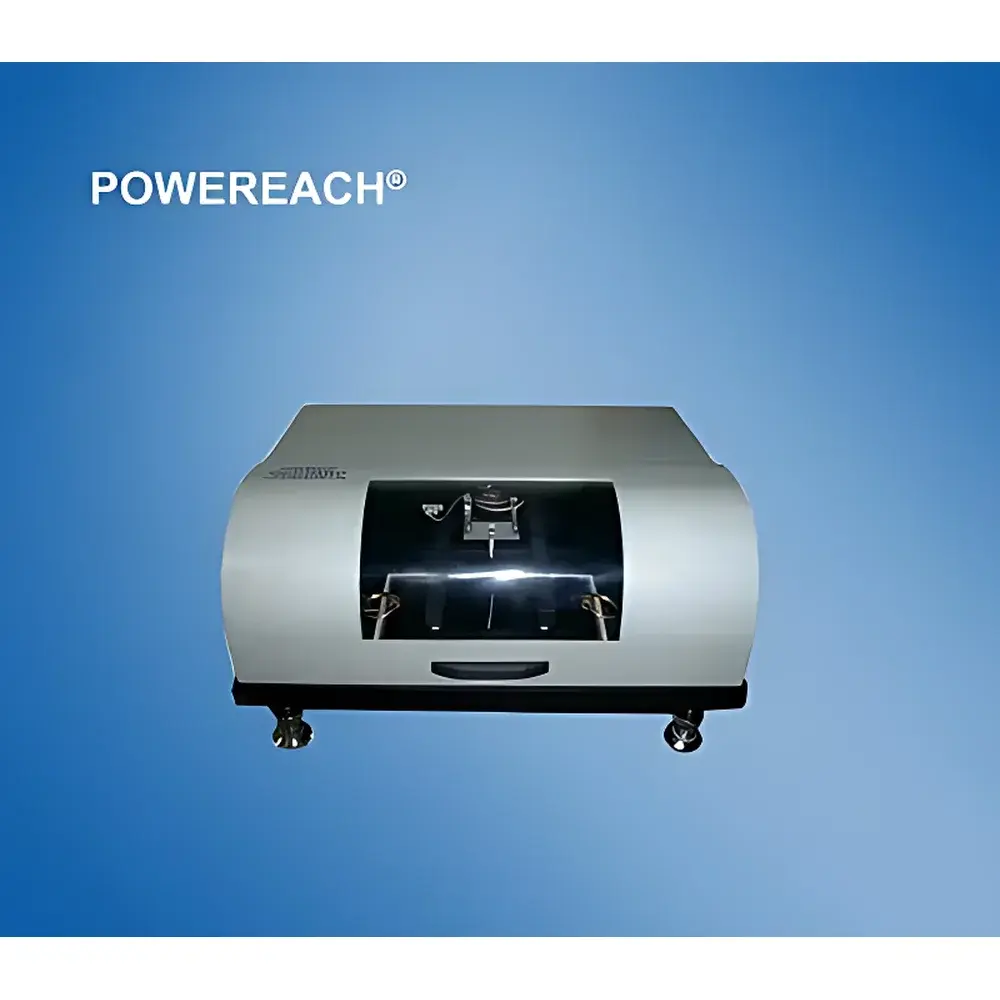
JMP2000 Langmuir Trough-Based Interfacial Dilatational Rheometer
| Origin | Beijing, China |
|---|---|
| Manufacturer Type | Authorized Distributor |
| Origin Category | Domestic (PRC) |
| Model | JMP2000 |
| Pricing | Upon Request |
Overview
The JMP2000 Langmuir Trough-Based Interfacial Dilatational Rheometer is a precision-engineered instrument designed for quantitative characterization of dilatational viscoelastic properties at fluid–fluid (oil/water) and fluid–gas (air/water) interfaces. It operates on the well-established Langmuir trough principle, integrating controlled area modulation with high-sensitivity Wilhelmy plate tensiometry to measure dynamic interfacial tension responses under programmed area perturbations. Unlike conventional static or quasi-static surface pressure-area isotherm systems, the JMP2000 implements three distinct dynamic operational modes—sinusoidal oscillation, macroscopic step deformation (steady-state expansion/compression), and interfacial relaxation—to resolve complex time-dependent interfacial rheological parameters including dilatational modulus (ε), phase angle (Φ), steady-state dilatational viscosity (K), and frequency-resolved storage (ε′) and loss (ε″) moduli. Its architecture supports fundamental investigations into interfacial relaxation kinetics, Gibbs elasticity, and molecular reorganization dynamics in monolayers formed by surfactants, lipids, polymers, and biomimetic amphiphiles.
Key Features
- Fully computer-controlled operation via Windows-compatible host software (Win98/2000/XP) with embedded single-board microcontroller for real-time motion and data acquisition coordination
- Dual-barrier Langmuir trough with large active surface area (up to 96.6 cm²) and low-leakage barrier options (standard leakproof or custom hollow barriers)
- High-resolution Wilhelmy plate tensiometry with 0.05 mN/m sensitivity and minimal mechanical noise, enabling stable long-term measurements under sub-milligram force resolution
- Three programmable compression/expansion modes: (1) sinusoidal oscillation (0.001–1 Hz, amplitude 1–6% of equilibrium area), (2) exponential area change (constant dlnA/dt, tunable initial rate, duration >2000 s), and (3) rapid step-relaxation (5–30% instantaneous area change within 1–2 s)
- Adjustable sampling interval (150–300 s) with dual-speed motor control for precise synchronization between area modulation and tension response capture
- BMP-format image export and ASCII-based data logging for post-acquisition analysis using third-party scientific software (e.g., MATLAB, Origin, Python SciPy)
Sample Compatibility & Compliance
The JMP2000 is compatible with a broad range of interfacial systems, including synthetic and natural surfactants (e.g., SDS, CTAB, Tween series), phospholipid monolayers (DPPC, POPC), polymer-lipid hybrids, peptide-laden interfaces, and colloidal nanoparticle-laden films. Its design conforms to standard laboratory practices for Langmuir monolayer studies as referenced in ASTM D1331 (Surface Tension by Du Noüy Ring or Wilhelmy Plate) and ISO 6295 (Petroleum Products — Determination of Interfacial Tension). While not certified for regulated GxP environments, its data traceability (time-stamped raw files, user-defined experimental metadata) supports GLP-aligned documentation workflows. The system operates at ambient temperature (20–25°C) and relative humidity (30–85%), requiring no external cooling or environmental chamber integration.
Software & Data Management
The native control interface provides intuitive graphical setup of motion profiles, real-time tension vs. area/time plotting, and automated parameter extraction (e.g., ε, Φ, K) from acquired waveforms. All measurement data are saved in plain-text ASCII format with header metadata, ensuring compatibility with audit-ready data management systems. Image outputs conform to standard BMP specifications for inclusion in peer-reviewed publications or internal technical reports. Though not compliant with FDA 21 CFR Part 11 out-of-the-box, the platform permits integration with validated third-party LIMS or ELN solutions through API-accessible data export protocols.
Applications
- Quantitative determination of Gibbs elasticity (εG) and interfacial relaxation times in surfactant-laden oil/water emulsions
- Structure–function correlation of lipid monolayers relevant to pulmonary surfactant research and membrane biophysics
- Characterization of interfacial aging, hysteresis, and metastability in LB film deposition processes
- Frequency-domain analysis of interfacial viscoelasticity for stimuli-responsive amphiphiles (pH-, temperature-, or light-switchable systems)
- Validation of coarse-grained molecular dynamics simulations of monolayer mechanics
- Development of functionalized interfaces for biosensors, optical waveguides, and templated nanomaterial synthesis
FAQ
What interfacial rheological parameters can the JMP2000 directly calculate?
It computes dilatational modulus (ε), phase angle (Φ), steady-state dilatational viscosity (K), storage modulus (ε′), loss modulus (ε″), and relaxation time constants from time-resolved interfacial tension data.
Is the Wilhelmy plate calibration traceable to national standards?
Calibration follows manufacturer-recommended procedures using certified reference weights; users may implement NIST-traceable mass standards for enhanced metrological rigor.
Can the system be integrated with external environmental control units?
Yes—the trough base accommodates optional thermostatic submersible plates or custom-built temperature-regulated enclosures, though such modifications fall outside standard configuration.
What is the minimum detectable area change during sinusoidal mode?
With 0.05 mN/m force resolution and typical monolayer compressibility, area changes as small as ~0.5% of equilibrium area yield measurable tension deviations under optimal signal-to-noise conditions.
Does the software support batch processing of multiple relaxation experiments?
Raw data files are structured for automated parsing; batch analysis requires user-developed scripts or integration with external numerical platforms.



