
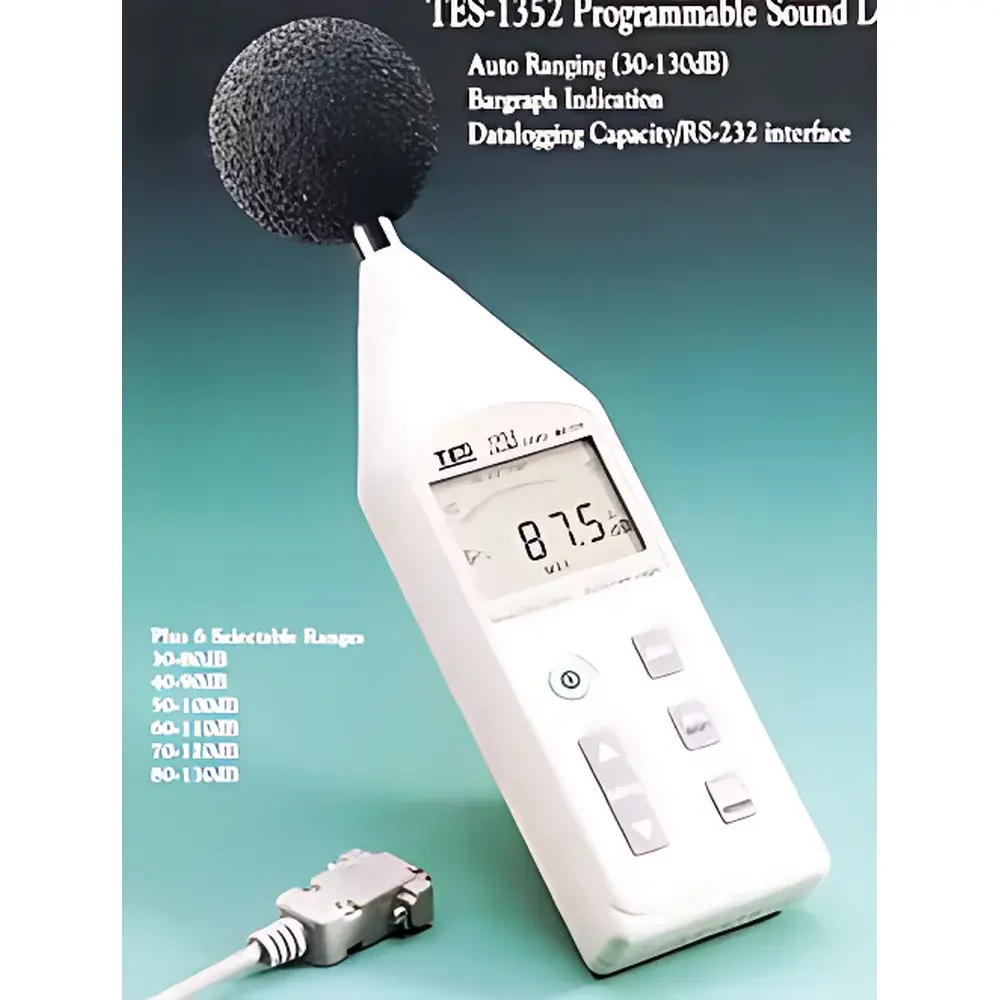
TES-1352 Programmable Sound Level Meter
| Origin | Beijing, China |
|---|---|
| Manufacturer Type | Authorized Distributor |
| Origin Category | Domestic (PRC) |
| Model | TES-1352 |
| Price Range | USD 1,400–2,800 (FOB) |
| Frequency Range | 31.5 Hz – 8 kHz |
| Measurement Range | 30 dB to 130 dB (A-weighted and C-weighted) |
| Accuracy | ±1.5 dB |
| Compliance | IEC 651:1979 (Type 2), ANSI S1.4-1983 (Type 2) |
| Microphone | 1/2″ electret condenser |
| Display | 4-digit LCD (0.1 dB resolution), quasi-analog bar graph (1 dB steps, 50 dB span, 20 Hz update rate) |
| Time Weighting | Fast (125 ms), Slow (1 s) |
| Dynamic Range | 50 dB per range |
| Overload Indication | Visual alert above upper limit / below lower limit of selected range |
| Auto-ranging | Full 30–130 dB coverage across six fixed ranges (30–80, 40–90, …, 80–130 dB) |
| Analog Outputs | AC (0.707 Vrms at full scale), DC (10 mV/dB) |
| Data Logging | 16,000-sample internal memory |
| Operating Environment | 0–50 °C, 10–90 %RH (non-condensing) |
| Power | One 9 V alkaline battery (IEC 6LR61) |
| Dimensions & Weight | 265 × 72 × 21 mm, 325 g |
| Accessories | Instruction manual, 9 V battery, RS-232 cable (DB9M-to-DB25F adapter included), carrying case, calibration screwdriver, windscreen, software CD, 3.5 mm mono jack plug |
Overview
The TES-1352 Programmable Sound Level Meter is a precision-engineered, Type 2 compliant instrument designed for occupational noise assessment, environmental sound monitoring, and industrial hygiene applications. It operates on the fundamental principle of acoustic pressure transduction via a stable 1/2-inch electret condenser microphone, converting incident sound pressure fluctuations into proportional electrical signals. Signal conditioning includes A- and C-frequency weighting networks aligned with IEC 651:1979 and ANSI S1.4-1983 standards—ensuring metrological traceability for regulatory reporting in workplace safety (e.g., OSHA 29 CFR 1910.95, EU Directive 2003/10/EC) and community noise studies. Its 31.5 Hz–8 kHz frequency response covers the full audible spectrum relevant to human hearing sensitivity and machinery emission characterization, while the 30–130 dB dynamic measurement range accommodates both low-level ambient background noise and high-intensity industrial sources.
Key Features
- Full compliance with IEC 651:1979 and ANSI S1.4-1983 Type 2 specifications for field-deployable sound level instrumentation
- Automatic ranging across six fixed 10-dB-spaced scales (30–80 dB to 80–130 dB), enabling seamless transition between low- and high-amplitude measurements without manual intervention
- Dual time-weighting modes (Fast: 125 ms integration; Slow: 1 s integration) for capturing transient peaks or steady-state averages per ISO 1996-2 and ANSI S1.43
- High-resolution 4-digit LCD display with 0.1 dB resolution and real-time quasi-analog bar graph updated every 50 ms for visual trend interpretation
- Integrated data logging capability storing up to 16,000 timestamped samples—sufficient for multi-shift or multi-day continuous monitoring campaigns
- Standard RS-232 serial interface (with DB9M-to-DB25F adapter) supporting bidirectional communication for remote configuration, real-time streaming, and post-acquisition export
- Dual analog outputs: AC line-level (0.707 Vrms at full scale) for oscilloscope or spectrum analyzer interfacing, and linear DC output (10 mV/dB) for PLC or SCADA integration
- Robust mechanical design: compact housing (265 × 72 × 21 mm), lightweight (325 g), and optimized for handheld use with ergonomic grip and tactile button feedback
Sample Compatibility & Compliance
The TES-1352 is calibrated and validated for use with standard 1/2″ free-field electret condenser microphones, including the supplied windscreen-equipped transducer optimized for outdoor and turbulent airflow conditions. It supports both A-weighting (for hearing-risk assessment per ISO 1999 and NIOSH criteria) and C-weighting (for peak impact noise evaluation). All measurements adhere to Type 2 tolerances defined in IEC 651 and ANSI S1.4—making it suitable for non-critical compliance tasks such as preliminary site surveys, engineering controls verification, and educational laboratory instruction. While not certified for legal metrology (e.g., court-admissible evidence), its ±1.5 dB accuracy meets requirements for routine industrial hygiene monitoring under OSHA HCS and EU-OSHA frameworks. The device operates reliably within 0–50 °C and 10–90 %RH (non-condensing), with battery life exceeding 25 hours under typical usage.
Software & Data Management
Bundled PC software enables full configuration of logging intervals (1–3600 sec), trigger thresholds, weightings, and time constants. Acquired datasets export in CSV format for analysis in Excel, MATLAB, or dedicated acoustics platforms (e.g., Brüel & Kjær PULSE, HEAD Acoustics ArtemiS). The software supports audit-trail generation—including operator ID, calibration date, and instrument serial number—for GLP-aligned documentation. Though not FDA 21 CFR Part 11 compliant out-of-the-box, raw log files retain unaltered timestamps and measurement metadata, facilitating third-party validation for quality system integration. Firmware updates are delivered via serial upload, ensuring long-term adaptability to evolving measurement protocols.
Applications
- Workplace noise mapping and daily exposure assessment (LEX,8h) in manufacturing, construction, and transportation sectors
- Environmental noise baseline studies near airports, highways, rail corridors, and urban development zones
- Product noise certification testing for consumer appliances, HVAC systems, and power tools per ISO 3744 and ISO 7779
- Educational demonstrations of psychoacoustics, frequency analysis, and decibel scaling principles
- Pre-commissioning verification of acoustic enclosures, mufflers, and vibration-damping installations
- Community complaint investigation and mitigation strategy validation
FAQ
Is the TES-1352 suitable for octave-band or 1/3-octave spectral analysis?
No. The TES-1352 provides broadband A- and C-weighted Leq, Lmax, Lmin, and Lpeak values only. Spectral decomposition requires dedicated analyzers with real-time FFT or filter banks.
Does it support external calibration with a pistonphone or sound calibrator?
Yes. The built-in microphone accepts standard 1 kHz, 94 dB or 114 dB calibrators (e.g., G.R.A.S. 42AG, B&K 4231). Calibration offset adjustment is accessible via menu navigation.
Can logged data be exported in real time during acquisition?
Yes—via RS-232 streaming mode, enabling live feed to custom scripts or SCADA dashboards without interrupting internal storage.
What is the recommended recalibration interval?
Annual traceable recalibration against national standards (e.g., NIST-traceable lab) is advised for continued compliance with ISO/IEC 17025 requirements.
Is the DC analog output isolated or referenced to chassis ground?
The DC output is single-ended and referenced to instrument common. For noise-sensitive environments, use shielded twisted-pair cabling and ensure proper grounding topology.







