
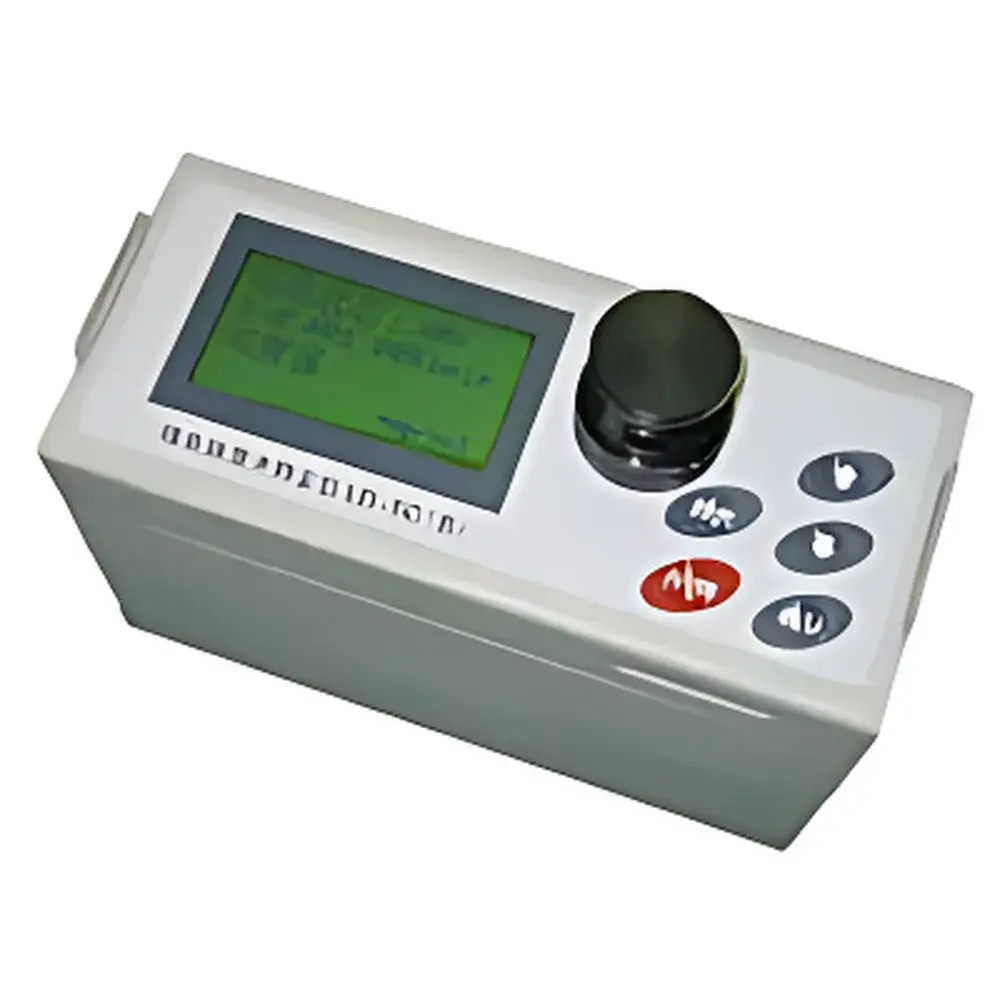
LD-5C(B) Microcomputer-Based Laser Dust Monitor with Interchangeable Particle Size Selective Inlets
| Origin | Beijing, China |
|---|---|
| Manufacturer Type | Authorized Distributor |
| Origin Category | Domestic (PRC) |
| Model | LD-5C(B) |
| Pricing | Available Upon Request |
| Measurement Principle | 90° Light Scattering (Laser Nephelometry) |
| Particle Size Cutpoints | PM₁₀, PM₅, PM₂.₅, TSP |
| Detection Sensitivity | 0.001 mg/m³ (high), 0.01 mg/m³ (low) |
| Accuracy | ±10% |
| Repeatability | ±2% |
| Measurement Range | 0.001–10 mg/m³ and 0.01–100 mg/m³ |
| Flow Control | Constant-Flow Pump (Adjustable, Certified for ISO/CEN/NIOSH Sampling Protocols) |
| Data Storage | 99 cyclic records (standard mode) |
| Sampling Duration | 0.1 min to 9,999 min (user-definable) |
| Alarm Threshold | Up to 65 mg/m³ (configurable) |
| Output Interfaces | RS232 serial port, analog output (0–1 V), digital TTL-level output, thermal printer port |
| Power Supply | Rechargeable Ni-MH battery pack (4 × 1.2 V), 8 h continuous operation |
| Weight | 2.4 kg |
| Compliance | GBZ1-2002, GBZ2-2002, WS/T206-2001, LD98-1996, TB/T2323-92, Hygiene Norms for HVAC Systems (MoH [2006] No.58) |
Overview
The LD-5C(B) Microcomputer-Based Laser Dust Monitor is a field-deployable, real-time aerosol mass concentration analyzer engineered for occupational hygiene, indoor air quality (IAQ), and ambient particulate monitoring. It operates on the principle of 90° laser light scattering (nephelometry), where a collimated diode laser beam interacts with airborne particles in a precisely conditioned sample stream. The intensity of scattered light is linearly correlated to particle surface area—and, via calibration against gravimetric reference methods—converted into mass concentration (mg/m³). Unlike passive optical sensors, the LD-5C(B) integrates a constant-flow sampling pump and an optically isolated measurement chamber protected by a laminar purge air curtain, minimizing contamination of critical optics and ensuring long-term signal stability. Its dual-range detection capability (0.001–10 mg/m³ and 0.01–100 mg/m³) enables reliable quantification across low-concentration environments (e.g., office HVAC ducts) and high-dust industrial settings (e.g., cement handling zones). The instrument’s design conforms to the physical sampling requirements defined in ISO 7708:1995 (particle size-selective sampling) and supports traceable calibration through built-in optical reference scatter plates.
Key Features
- Interchangeable size-selective inlets compliant with PM₁₀, PM₅, PM₂.₅, and TSP definitions per GB/T 17095-1997 and ISO/CEN standards.
- Integrated 40 mm filter cassette holder enabling concurrent real-time nephelometric measurement and gravimetric sample collection for subsequent elemental or organic speciation analysis (e.g., IC, ICP-MS, GC-MS).
- Constant-flow control system maintaining stable volumetric flow rates under variable backpressure—critical for accurate cutpoint fidelity during extended duct sampling.
- Optical protection architecture featuring a laminar sheath-air curtain that physically separates suspended dust from the laser diode and photodetector assembly.
- Self-calibrating zero-point adjustment via embedded software algorithm, reducing drift-induced error and eliminating manual optical alignment.
- Multi-mode operational firmware: IAQ Mode (for public building ventilation assessment), Ambient Mode (programmable timed sampling), and Occupational Health Mode—automatically computing Time-Weighted Average (TWA) and Short-Term Exposure Limit (STEL) per GBZ2-2002.
- Large backlit LCD with Chinese-language menu navigation, supporting intuitive configuration without external PC dependency.
Sample Compatibility & Compliance
The LD-5C(B) is validated for use with standard 40 mm diameter PVC, PTFE, or quartz fiber filters (e.g., Pallflex EPM 2000, Whatman QM-A). Its inlet geometry and flow profile meet the aspiration efficiency criteria specified in ISO 13137:2013 for personal samplers and ANSI/AIHA Z312.1-2022 for fixed-site monitors. Regulatory alignment includes full technical conformance with China’s national occupational health standards (GBZ1-2002, GBZ2-2002), public health protocols (WS/T206-2001), and railway industry guidelines (TB/T2323-92). While not certified for FDA 21 CFR Part 11 or EU IVDR, its data export structure (ASCII CSV via RS232) supports integration into GLP-compliant laboratory information management systems (LIMS) when paired with audit-trail-enabled acquisition software.
Software & Data Management
Data acquisition and configuration are managed via embedded firmware with non-volatile memory. All measurements—including timestamp, cutpoint selection, averaging interval, and alarm status—are stored internally with checksum validation. Continuous logging mode retains up to 9,999 sequential concentration readings; standard mode cycles through 99 entries. Export is supported via RS232 to Windows-based desktop software (supplied), which provides visualization of TWA/STEL trends, K-factor derivation (mass-to-light-scatter conversion coefficient), and compliance reporting templates aligned with GBZ2-2002 Annex B. Analog output (0–1 V) permits direct connection to building management systems (BMS) or PLC controllers for automated ventilation response. Thermal printer output delivers hard-copy field reports with embedded instrument ID and calibration date.
Applications
- Ongoing monitoring of HVAC exhaust streams in commercial buildings per MoH Hygiene Norms for Central Air Conditioning Systems (2006).
- Workplace exposure assessment in mining, construction, foundry, and pharmaceutical manufacturing facilities—supporting respirable dust hazard evaluation under GBZ1-2002.
- Field validation of air purifier performance via time-resolved concentration decay curves using analog output integration.
- Long-term ambient PM₂.₅ trend analysis in urban microenvironments, leveraging programmable sampling intervals and battery-powered portability.
- Source apportionment studies requiring co-located real-time scattering data and filter-based chemical analysis (e.g., sulfate/nitrate quantification).
FAQ
Does the LD-5C(B) provide NIST-traceable calibration?
The instrument includes factory calibration against ISO 12103-1 A1 test dust and internal optical reference plates. Field recalibration requires gravimetric comparison using a certified reference sampler (e.g., SKC IOM + analytical balance); full NIST traceability is achieved at the reference lab level—not instrument level.
Can the LD-5C(B) be used for respirable dust (e.g., < 4 µm) measurement?
No. The available inlets (PM₁₀, PM₅, PM₂.₅, TSP) do not conform to the MPPD-based respirable convention (ISO 7708:1995, IOM sampler geometry). Respirable fraction assessment requires dedicated cyclones (e.g., GK2.65) not supported by this platform.
Is the analog output (0–1 V) linear across the full measurement range?
Yes—the analog signal scales linearly with displayed mass concentration (mg/m³) within each selected range (0.001–10 or 0.01–100 mg/m³). Zero offset and span are software-configurable.
What maintenance intervals are recommended for optical components?
Under typical indoor use, optical path inspection and gentle lens cleaning with spectroscopic-grade methanol are advised every 6 months. In high-dust environments, quarterly verification using the built-in scatter plate is recommended.
Does the device support remote data transmission via GSM or Wi-Fi?
No. Communication is limited to wired interfaces: RS232, analog voltage, TTL digital pulse, and thermal printer. Integration with wireless telemetry requires third-party serial-to-IP gateways.







