
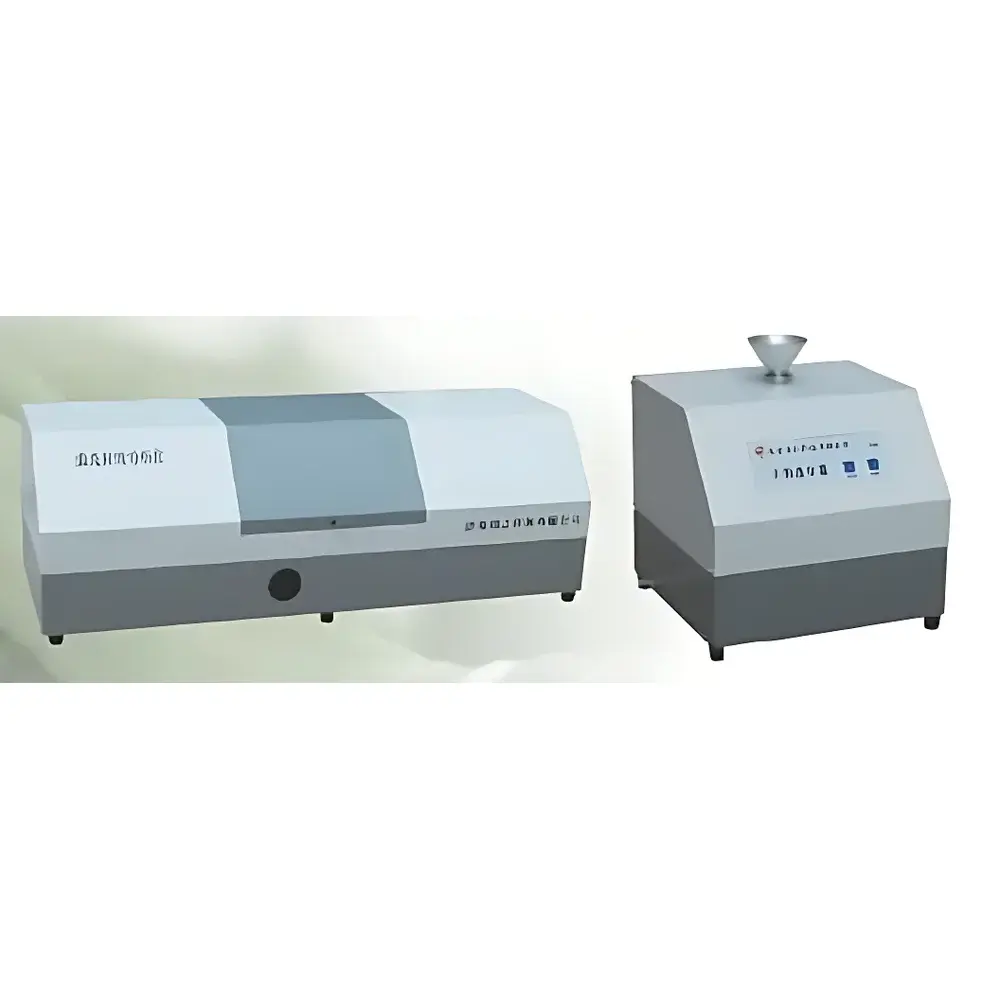
Rise-2016 Dry-Dispersion Laser Diffraction Particle Size Analyzer
| Origin | Beijing, China |
|---|---|
| Manufacturer Type | Authorized Distributor |
| Origin Category | Domestic (PRC) |
| Model | Rise-2016 |
| Price Range | USD 14,000–21,000 |
| Dispersion Method | Dry dispersion only |
| Measurement Range | 0.1–800 µm |
| Repeatability | < ±1% RSD (NIST-traceable standard reference material, D₅₀) |
| Measurement Time | ≤10 seconds per analysis |
| Laser Source | He-Ne, 632.8 nm, >25,000 h lifetime |
| Detector Array | Non-uniform, cross-dimensional 3D扇-shaped matrix, max detection angle 105° |
| Power Supply | AC 220 V ±10%, 50 Hz, 200 W |
| Dimensions (L×W×H) | 950 × 330 × 300 mm |
| Weight | 40 kg |
Overview
The Rise-2016 Dry-Dispersion Laser Diffraction Particle Size Analyzer is an industrial-grade instrument engineered for rapid, reproducible particle size distribution (PSD) characterization of free-flowing dry powders. It operates on first-principles Mie scattering theory—fully accounting for particle refractive index, absorption coefficient, and dispersant optical properties—to deliver mathematically rigorous inversion of angular light intensity data into volumetric PSD. Unlike constrained fitting algorithms that assume pre-defined distribution models (e.g., log-normal or Rosin-Rammler), the Rise-2016 implements unconstrained inverse modeling: no a priori assumptions are imposed on particle population behavior, enabling faithful reconstruction of true polydispersity across its full 0.1–800 µm dynamic range. This approach demands high-fidelity optical design and detector architecture—realized here through a single-convergent Fourier optical path, eliminating multi-lens alignment drift and enabling permanent calibration stability.
Key Features
- He-Ne laser source (632.8 nm) with narrow linewidth (<0.002 nm) and long-term power stability (<±0.5% over 8 hours), ensuring consistent scattering signal integrity
- Optimized dry dispersion module integrating silent oil-free air compressor (7 bar output), integrated refrigerated dryer (dew point ≤3 °C), and precision-controlled powder feeder delivering uniform mass flow rates from 0.1 to 5 g/min
- Three-stage dispersion mechanism: pneumatic shear in converging nozzle, inter-particle collision in turbulent acceleration zone, and wall-impact attrition in conical disperser—achieving deagglomeration without thermal degradation or chemical contamination
- Proprietary 3D fan-shaped photodetector array with 105° maximum scattering angle coverage and non-uniform angular resolution—enhancing sensitivity to fine submicron modes while preserving coarse-tail fidelity
- Single-optical-path Fourier configuration eliminates need for mechanical lens switching or realignment; system remains factory-calibrated for life under normal operating conditions
- Integrated PADMAS v4.2 software platform compliant with FDA 21 CFR Part 11 requirements for electronic records and signatures (audit trail, user access control, data integrity validation)
Sample Compatibility & Compliance
The Rise-2016 is validated for use with thermally stable, non-volatile, non-fibrous dry powders including metal oxides (e.g., TiO₂, Al₂O₃), pharmaceutical excipients (lactose, microcrystalline cellulose), catalysts (zeolites, Pt/C), battery cathode materials (LiCoO₂, NMC), and ceramic precursors. It excludes samples prone to electrostatic aggregation, hygroscopic deliquescence, or mechanical fragmentation during pneumatic transport (e.g., fragile biologics, soft polymers, or highly cohesive nanoclays). Instrument performance meets ISO 13320:2020 (Particle size analysis — Laser diffraction methods) and ASTM E2881-23 (Standard Practice for Determination of Particle Size Distribution of Powders by Laser Diffraction). All reported D₁₀, D₅₀, D₉₀, span, specific surface area (volume- and mass-based), and cumulative/differential distributions are traceable to NIST SRM 1963 (silica, 10.0 ± 0.2 µm) and SRM 1979 (silica, 100.2 ± 0.7 µm) via documented calibration protocols.
Software & Data Management
PADMAS (Particle Diameter Measure & Analysis System) provides comprehensive post-acquisition processing under GLP/GMP-aligned workflows. Raw scattering patterns are stored in binary HDF5 format with embedded metadata (timestamp, operator ID, instrument serial, environmental conditions). The software supports up to 130 user-definable size classes between 0.02 and 2000 µm, with export options for Excel (.xlsx), CSV, PDF reports (including vector-based graphs), and image formats (PNG, SVG). Statistical functions include batch averaging (up to 99 repeats), outlier rejection (Dixon Q-test), comparative overlay of multiple runs, and ISO-standardized classification schemes (e.g., ASTM E11 sieve equivalents). All report templates comply with internal QA documentation standards and support configurable headers/footers, digital signature fields, and revision-controlled versioning. Audit logs record every parameter change, data export event, and user login—retained for ≥36 months.
Applications
- Quality control of active pharmaceutical ingredients (APIs) and blend uniformity assessment per USP and
- In-process monitoring of spray-dried lactose carriers in dry powder inhaler (DPI) formulation development
- Characterization of sintered ceramic green bodies and post-machined abrasive grits for ISO 6344 compliance
- Batch release testing of lithium-ion battery cathode powders (Ni-rich NMC, LFP) against OEM particle size specifications
- R&D screening of nanoparticle agglomerate breakage efficiency across different disperser geometries and airflow profiles
- Regulatory submission support for FDA ANDA filings requiring robust PSD methodology validation (ICH Q5A, Q5C)
FAQ
Does the Rise-2016 support wet dispersion mode?
No. The Rise-2016 is exclusively configured for dry dispersion. For aqueous or organic solvent-based analysis, the Rise-2020 dual-mode platform is recommended.
What sample preparation steps are required prior to measurement?
Minimal preparation: dry samples must be oven-conditioned at ≤60 °C for 2 hours (if hygroscopic) and passed through a 100-µm sieve to remove lumps. No grinding or sonication is permitted.
How is instrument calibration verified?
Daily verification uses NIST-traceable silica standards (SRM 1963 and SRM 1979); full calibration is performed annually by certified service engineers using ISO 21507-compliant procedures.
Can the system interface with LIMS or MES platforms?
Yes. PADMAS supports OPC UA and ASTM E1461-compliant data export via secure FTP or direct SQL database push (Microsoft SQL Server, Oracle 12c+).
Is remote diagnostics supported?
Yes. With customer authorization, encrypted remote desktop access enables real-time troubleshooting and firmware updates under ISO/IEC 27001-certified cybersecurity protocols.



