
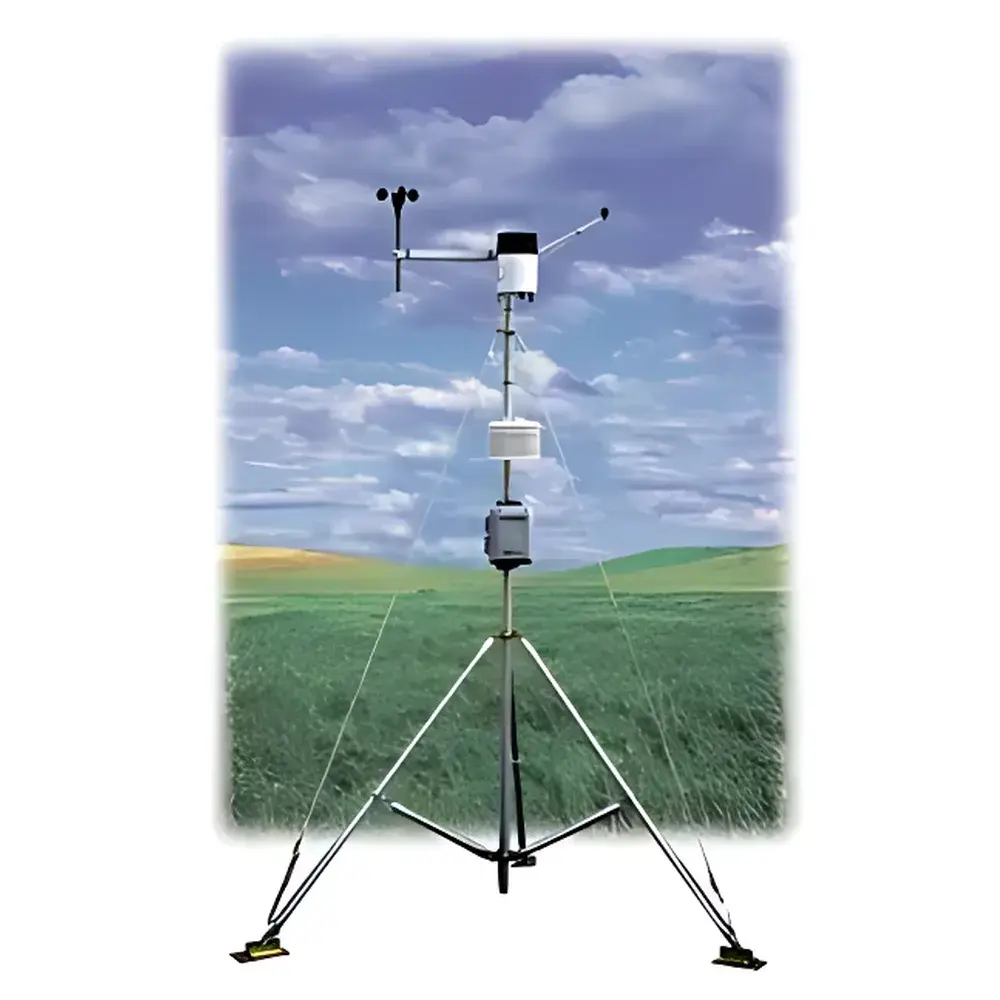
HOBO-001 Compact Automatic Weather Station
| Origin | USA |
|---|---|
| Manufacturer Type | Authorized Distributor |
| Origin Category | Imported |
| Model | HOBO-001 |
| Pricing | Upon Request |
Overview
The HOBO-001 Compact Automatic Weather Station is a field-deployable, low-power environmental monitoring system engineered for long-term, unattended measurement of microclimate parameters in agricultural, ecological, hydrological, and research applications. Built upon Onset’s proven HOBO® platform, the system operates on the principle of distributed sensor acquisition via a robust, bus-based data logger architecture—eliminating complex wiring schemes and enabling plug-and-play integration of up to 15 analog and digital sensors. Its design adheres to foundational meteorological best practices outlined by the World Meteorological Organization (WMO) and the American Association of State Climatologists (AASC), particularly in sensor siting, shielding, and thermal stability. The system captures time-synchronized measurements across atmospheric, terrestrial, and radiometric domains—including air temperature and relative humidity (with optional radiation shield), barometric pressure, precipitation volume, wind speed and direction, photosynthetically active radiation (PAR), global solar irradiance, soil moisture, leaf wetness, and ambient light conditions. All measurements are timestamped with traceable accuracy (±5 seconds per week at +25°C) and stored locally in non-volatile EEPROM memory.
Key Features
- Modular, bus-architecture data logger with auto-sensing capability for up to 15 sensors—no manual channel configuration or firmware reprogramming required
- Ultra-low power consumption: operational life of ≥12 months on four AA alkaline batteries; compatible with high-performance lithium cells rated for -40°C to +70°C operation
- 512 KB of onboard EEPROM memory—retains up to 500,000 timestamped records with zero data loss during power interruption
- RS-232 serial interface for local data retrieval; download rate of 500,000 records completed in ≤2.5 minutes
- Configurable sampling interval from 1 second to 18 hours, programmable via HOBOware software
- Weather-resistant, IP65-rated polycarbonate enclosure; operating temperature range: -20°C to +50°C (logger); extended sensor ranges down to -40°C
- Integrated status indicators for battery level, memory capacity, and logging activity—enabling rapid field diagnostics
- Optional remote communication via 902–928 MHz wireless modem (line-of-sight range up to 7 km with Yagi antenna), supporting FTP upload and email alerting
Sample Compatibility & Compliance
The HOBO-001 supports a comprehensive suite of calibrated, NIST-traceable sensors compliant with international field measurement conventions. Air temperature and humidity sensors are supplied with WMO-compliant radiation shields to minimize solar heating error. Rain gauges utilize stainless-steel tipping-bucket mechanisms calibrated to ASTM D5098 (Standard Practice for Calibration of Precipitation Gauges). PAR and pyranometer sensors conform to ISO 9060:2018 spectral classification (Class C) and feature stable silicon photodiode detectors with documented annual drift (<±2%). Soil moisture probes employ capacitance-based dielectric measurement validated against gravimetric standards. All sensors meet IEC 60529 ingress protection requirements appropriate to their deployment class. System-level documentation supports GLP-aligned data integrity protocols, including audit-ready metadata logging (sensor ID, calibration date, installation height, orientation).
Software & Data Management
Data configuration, deployment setup, retrieval, and post-processing are managed exclusively through HOBOware Pro—a Windows-based desktop application certified for compatibility with FDA 21 CFR Part 11 Annex 11 environments when deployed with electronic signature and audit trail modules enabled. HOBOware supports automated scheduler templates, real-time data visualization, statistical aggregation (min/max/avg/std dev), unit conversion, and export to CSV, Excel (.xlsx), and plain-text formats. Raw binary files include embedded CRC checksums and full sensor metadata headers. For enterprise integration, HOBOlink cloud service (optional subscription) provides secure HTTPS API access, role-based user permissions, and automated data routing to third-party platforms including AWS IoT Core and custom SCADA systems.
Applications
The HOBO-001 serves as a foundational tool in precision agriculture (irrigation scheduling, frost prediction, evapotranspiration modeling), ecological site characterization (phenology studies, habitat microclimate mapping), urban heat island assessment, watershed monitoring (precipitation-runoff correlation), and educational field labs. Its compact footprint and dual-height mounting options (2 m or 3 m tripod configurations) allow deployment in constrained spaces—orchards, greenhouses, rooftop arrays, forest understories, and coastal zones—without compromising representativeness. Sensor modularity enables application-specific builds: e.g., a vineyard deployment may prioritize leaf wetness, PAR, and soil moisture; while an alpine station emphasizes low-temperature-rated air/soil thermistors and wind instrumentation.
FAQ
What is the maximum number of sensors supported, and how are they connected?
The HOBO-001 data logger accommodates up to 15 sensors via its daisy-chainable bus interface—requiring no individual wiring to the logger. Each sensor self-identifies upon connection.
Does the system comply with WMO siting guidelines?
Yes—when installed using the included 2 m or 3 m tripods, radiation shields, and horizontal booms, the sensor layout satisfies WMO No. 8 Guide specifications for exposure, height, and separation distances.
Can data be retrieved remotely without visiting the site?
Yes—using the optional wireless modem and base station controller, data can be downloaded over RF links up to 7 km (line-of-sight) and automatically uploaded to cloud storage or email.
Is calibration documentation provided with each sensor?
Each sensor ships with a factory calibration certificate indicating date, reference standard used (NIST-traceable), and measured deviation at multiple points across its range.
What is the expected battery life under typical field conditions?
With a 15-minute logging interval and standard AA alkaline cells, battery life exceeds 12 months. Lithium AA cells extend this to >24 months in sub-zero environments.
Related Products







