
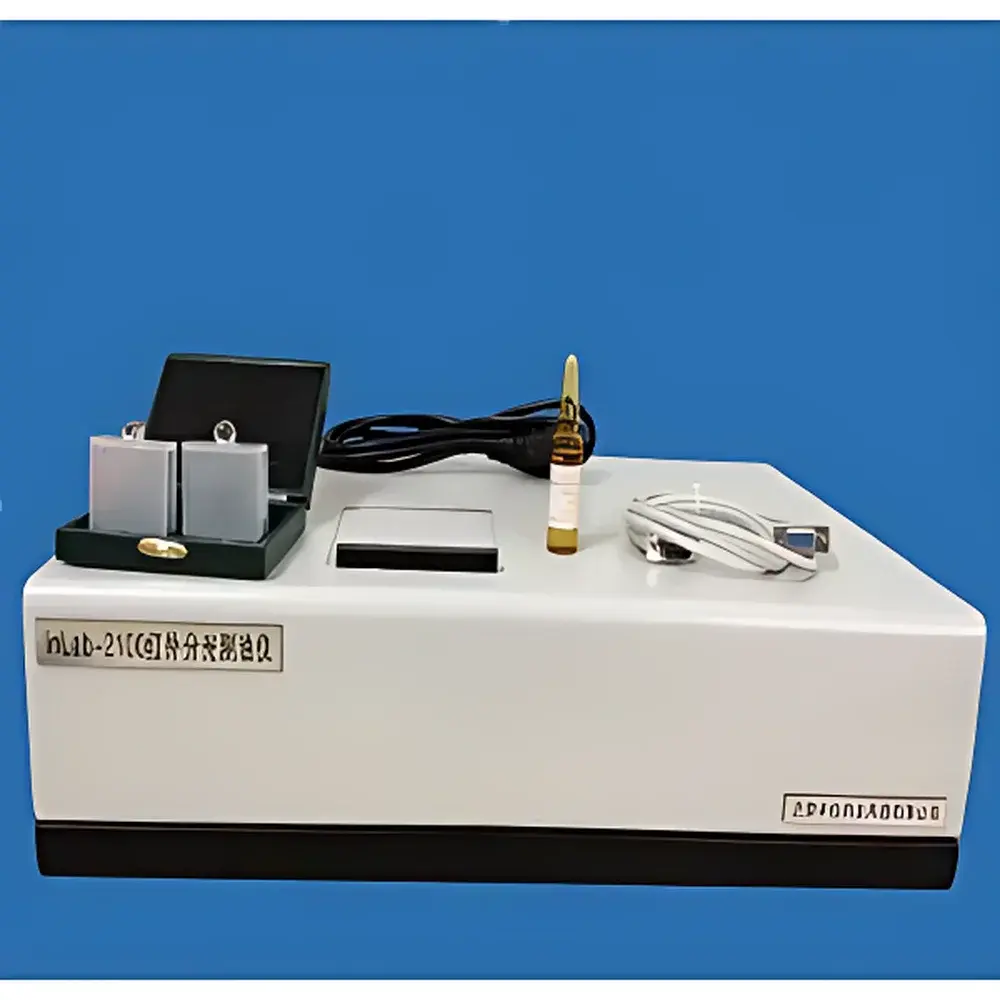
InLab-2100 Infrared Spectrophotometric Oil Content Analyzer
| Origin | Beijing, China |
|---|---|
| Manufacturer Type | Authorized Distributor |
| Origin Category | Domestic (China) |
| Model | InLab-2100 |
| Price Range | USD 1,400 – 7,000 |
| Instrument Type | Benchtop Laboratory Analyzer |
| Measurement Principle | Infrared Spectrophotometry (C–H Stretch Absorption at ~2960 cm⁻¹, ~2930 cm⁻¹, ~2850 cm⁻¹) |
| Measurement Range | 0.15 mg/L to 100 mg/L (using 5 cm quartz cuvette) |
| Detection Limit | <0.12 mg/L (CCl₄ extract, direct measurement with 5 cm quartz cuvette) |
| <0.001 mg/L (water sample, 100 | 1 extraction ratio, 5 cm quartz cuvette) |
| Accuracy | ±0.5 mg/L (C < 10 mg/L) |
| Resolution | 0.1 ppm |
| Measurement Frequency | 10 measurements/min |
| Wavenumber Range | 3400 cm⁻¹ – 2400 cm⁻¹ |
| Absorbance Range | 0.0000 – 3.000 AU |
| Baseline Drift | <0.001 AU/60 min |
| Repeatability | ≤1% (for 20 mg/L oil standard) |
| Linearity (R²) | >0.999 |
| Dimensions | 550 mm × 380 mm × 150 mm |
| Weight | 15 kg |
| Power Supply | 220 V ± 22 V AC, 50 Hz ± 1 Hz, 35 VA |
| Operating Environment | 5 °C – 35 °C, 20% – 80% RH |
| Interface | USB or RS-232 |
Overview
The InLab-2100 Infrared Spectrophotometric Oil Content Analyzer is a benchtop laboratory instrument engineered for quantitative determination of total petroleum hydrocarbons (TPH), animal and vegetable oils, and total oil content in aqueous and solid-phase environmental samples. It operates on the principle of mid-infrared absorption spectroscopy, specifically targeting the asymmetric and symmetric C–H stretching vibrations of aliphatic hydrocarbons near 2960 cm⁻¹, 2930 cm⁻¹, and 2850 cm⁻¹ — spectral regions defined by ISO 9377-2 and codified in China’s national standard GB/T 16488–1996, “Water Quality — Determination of Petroleum Hydrocarbons and Animal/Vegetable Oils — Infrared Spectrophotometric Method.” The system employs a fixed-path, post-dispersion optical architecture: light from an electronically modulated infrared source passes through a diffraction grating monochromator, then traverses the sample cuvette before detection via a thermoelectrically cooled photodetector. This design eliminates mechanical choppers, enhances thermal stability, and delivers high signal-to-noise ratio (SNR) essential for trace-level quantification in compliance-critical environmental testing.
Key Features
- Compliant optical architecture: Pre-aligned, detachable integrated optical module ensures long-term wavelength stability and minimizes alignment drift.
- Electronically modulated infrared source: Eliminates moving parts, reduces thermal load, improves system longevity and reliability.
- Lock-in amplifier-based signal processing: Enhances detection sensitivity and lowers practical detection limit to <0.12 mg/L in CCl₄ extract (5 cm pathlength).
- Full-spectrum scanning capability (3400–2400 cm⁻¹): Enables absorbance curve visualization for interference identification (e.g., surfactants, solvents, humic substances).
- Universal cuvette compatibility: Accommodates pathlengths from 1 cm to 5 cm in quartz cuvettes — supports both high-sensitivity low-concentration and high-dynamic-range applications.
- Extraction solvent validation function: Quantitatively assesses spectral purity of CCl₄, tetrachloroethylene (C₂Cl₄), or alternative IR-transparent solvents prior to analysis.
- Dual-mode operation: Functions as a dedicated oil analyzer or as a general-purpose infrared spectrophotometer for method development and spectral library reference.
- Rapid measurement cycle: Single-sample analysis completed in ≤30 seconds, supporting throughput of up to 10 determinations per minute.
- Robust mechanical and electrical integration: Self-contained optical and electronic subsystems reduce field service complexity and improve mean time between failures (MTBF).
Sample Compatibility & Compliance
The InLab-2100 is validated for use across diverse environmental matrices including surface water, groundwater, seawater, domestic wastewater, industrial effluents, soil leachates, and cooking fume condensates — all in accordance with GB/T 16488–1996 and aligned with ISO 9377-2 (petroleum hydrocarbons in water) and EPA Method 1664 (n-hexane extractable material). It supports solvent extraction protocols using carbon tetrachloride (CCl₄), tetrachloroethylene (C₂Cl₄), or other IR-transparent media meeting ASTM D7066 spectral purity criteria. Instrument performance meets GLP-relevant requirements for baseline stability ( 0.999 over 0.15–100 mg/L), and repeatability (≤1% RSD at 20 mg/L). While not FDA 21 CFR Part 11–certified out-of-the-box, audit-ready data logs (timestamped absorbance values, calibration coefficients, user IDs) are stored in structured .csv format and support retrospective review under ISO/IEC 17025 quality management frameworks.
Software & Data Management
The embedded Windows-based application provides full control of measurement, calibration, and spectral acquisition. Key functions include automatic zero-point correction, multi-point linear regression (up to 6 standards), real-time spectral overlay, and interference flagging based on spectral shape deviation. All raw absorbance data, calibration curves, and metadata (operator ID, date/time, cuvette pathlength, solvent batch ID) are saved to configurable directories (default: C:oildatadat). Export options include CSV for LIMS integration and PNG/PDF for report generation. Backup utilities facilitate scheduled mirroring to network drives or external storage. No cloud connectivity or remote telemetry is implemented — data sovereignty and local network security are preserved by design.
Applications
- Regulatory monitoring of petroleum hydrocarbons in municipal and industrial wastewater discharge permits (e.g., China’s “Integrated Wastewater Discharge Standard” GB 8978).
- Soil contamination assessment following spill events — quantification of TPH in TCLP or Soxhlet extracts.
- Performance verification of oil-water separators and API/API-type treatment units.
- Quality control of organic solvents used in extraction workflows (e.g., spectral confirmation of CCl₄ purity).
- Research-grade quantification of C–H–containing organics beyond petroleum — including fatty acid methyl esters (FAME), biodiesel blends, and synthetic lubricants.
- Method development for non-standard matrices (e.g., high-salinity brines, viscous emulsions) using custom pathlength and dilution protocols.
FAQ
What extraction solvents are compatible with the InLab-2100?
CCl₄ (analytical grade, charcoal-purified), tetrachloroethylene (C₂Cl₄), and other IR-transparent solvents meeting ASTM D7066 spectral transmittance criteria may be used. The instrument includes a built-in solvent purity check function.
Is the InLab-2100 suitable for field deployment?
No — it is designed exclusively for controlled laboratory environments (5–35 °C, ≤80% RH, vibration-isolated benchtop). It lacks battery power, ruggedized housing, or environmental sealing.
Does the system support automated calibration verification?
Yes — the software enables scheduled calibration checks using certified reference standards; all verification events are logged with timestamps and operator IDs.
Can measurement data be exported to LIMS?
Yes — all results export to comma-separated values (CSV) files containing full metadata, enabling seamless ingestion into most laboratory information management systems.
What maintenance is required beyond routine cleaning?
Optical components require periodic inspection; quartz cuvettes must be cleaned with IR-grade solvents (e.g., CCl₄ or C₂Cl₄) and lint-free wipes. Grating and detector modules are factory-sealed and not user-serviceable.
Related Products







