
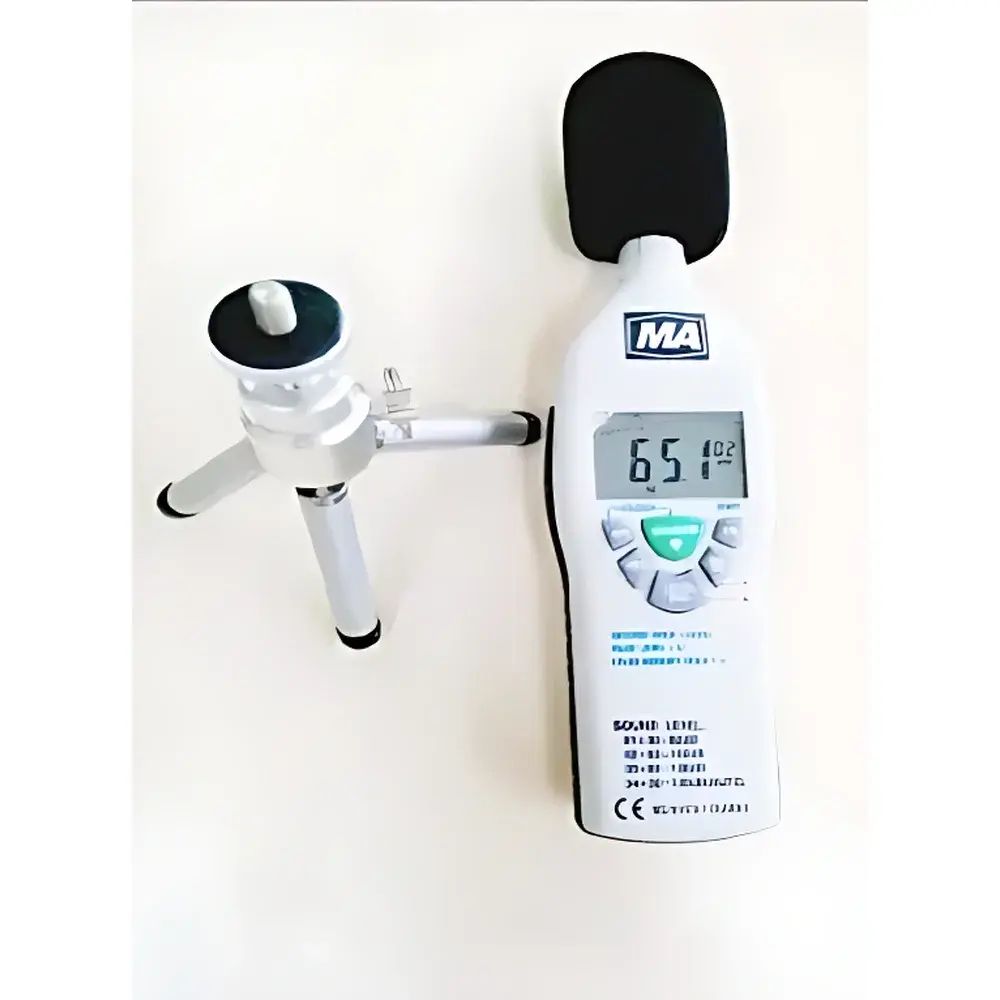
YSD130(A) Intrinsically Safe Mining Sound Level Meter
| Origin | Beijing |
|---|---|
| Manufacturer Type | Distributor |
| Origin Category | Domestic (China) |
| Model | YSD130(A) |
| Price Range | USD 140–280 |
| Frequency Range | 31.5 Hz – 8 kHz |
| Measurement Range | 30 dB – 130 dB |
| Accuracy | ±1.4 dB |
Overview
The YSD130(A) Intrinsically Safe Mining Sound Level Meter is a certified Class I, Division 1 (Exib I Mb) acoustic measurement instrument engineered for continuous, reliable noise monitoring in hazardous underground mining environments. Designed in strict compliance with GB 3836.1–2010 (Explosive Atmospheres – Part 1: Equipment – General Requirements) and GB/T 3785.1–2010 (Electroacoustics – Sound Level Meters – Part 1: Specifications), it employs a 1/2-inch externally polarized condenser microphone and digital signal processing architecture to deliver real-time A- and C-weighted sound pressure level (SPL) measurements under demanding operational conditions. Its core measurement principle follows IEC 61672-1:2013 Class 2 requirements for sound level meters—ensuring traceable, repeatable quantification of broadband noise across the audible spectrum from 31.5 Hz to 8 kHz. The device operates without external power sources, drawing ≤80 mA from a single 9 V alkaline battery (6F22), enabling up to 15 hours of field use before automatic shutdown after 15 minutes of inactivity.
Key Features
- Intrinsically safe design certified to Exib I Mb per GB 3836.4–2010, approved for use in methane- and coal-dust-laden underground mine roadways and working faces
- Four selectable measurement ranges: Low (30–80 dB), Medium (50–100 dB), High (80–130 dB), and Auto-ranging (30–130 dB) for dynamic environmental adaptation
- Dual time-weighting modes: Fast (125 ms integration time) and Slow (1 s integration time), aligned with IEC 61672-1 temporal response definitions
- A- and C-frequency weighting networks implemented in hardware, supporting occupational health assessments per ISO 9612 and regulatory exposure limit evaluation
- 0.1 dB resolution display with 4-digit LCD and integrated backlight for low-illumination shaft environments
- Real-time analog bar graph updating at 20 Hz for rapid visual trend assessment during mobile surveys
- Onboard data storage for up to 50 measurement records, including timestamped Lmax, Lmin, and Leq values
- Auto-capture function triggered by threshold exceedance, supporting event-based logging without manual intervention
- IP54-rated enclosure providing dust resistance and protection against water splashes during wet mining operations
Sample Compatibility & Compliance
The YSD130(A) is validated for airborne noise measurement in confined, high-humidity, and particulate-rich underground mining zones. It complies with mandatory Chinese safety certification frameworks: Coal Mine Safety Mark (MA certification), National Explosion-Proof Electrical Equipment Quality Supervision and Inspection Center (CQMEX) approval, and third-party type examination reports issued under CNAS-accredited laboratories. While not CE-marked or FDA-registered (as it is not medical or food-related equipment), its metrological performance aligns with international best practices referenced in ISO 9612:2009 (Acoustics – Determination of Occupational Noise Exposure) and supports documentation required for GLP-aligned occupational hygiene reporting. All calibration procedures are traceable to national acoustic standards maintained by the China Institute of Metrology (CIM).
Software & Data Management
Data retrieval is performed via manual transcription from the onboard LCD or direct recording during field operation. The instrument does not feature USB/Bluetooth connectivity or proprietary PC software; however, stored readings (50 entries) include peak hold, min/max tracking, and time-stamped exposure metrics compatible with standard spreadsheet-based analysis workflows. Users may export logged values into Excel-compatible formats for statistical evaluation of time-weighted average (TWA) exposures, dose calculations per OSHA 1910.95 or MSHA Part 62 guidelines, and archival in enterprise EHS management systems. Audit trails are maintained manually via field logbooks, consistent with current regulatory expectations for Class II mining instrumentation where electronic audit trails (e.g., 21 CFR Part 11) are not mandated.
Applications
- Continuous noise mapping of continuous miners, roof bolters, and conveyor transfer points in active longwall and room-and-pillar operations
- Compliance verification against China’s “Workplace Occupational Health Standards – Noise Exposure Limits” (GBZ 2.2–2007)
- Pre-shift and post-shift hearing conservation program assessments in accordance with AQ/T 9006–2010 (Safety Production Standardization Basic Specification)
- Engineering control validation studies following installation of mufflers, enclosures, or vibration isolation mounts on diesel-powered equipment
- Acoustic characterization of ventilation fan arrays and compressed air systems in intake and return airways
- Supporting risk assessment documentation for mine safety inspection authorities and provincial emergency management bureaus
FAQ
Is the YSD130(A) suitable for surface quarry operations?
Yes—its IP54 rating, wide dynamic range, and intrinsically safe construction make it appropriate for both underground and surface mining applications where explosive atmospheres may be present.
Does it support Leq or dose calculation internally?
No—the unit displays instantaneous, Lmax, and Lmin values only. Time-averaged metrics require external computation using recorded time-stamped data.
Can the microphone be calibrated in-field?
Field calibration requires a Class 1 acoustic calibrator (e.g., 1 kHz, 94 dB or 114 dB reference tone). The device includes a 1/2-inch microphone input compatible with standard pistonphones meeting IEC 60942 requirements.
What battery life can be expected during continuous logging?
Under typical usage (LCD backlight off, Fast mode, no frequent data review), battery life exceeds 12 hours. With backlight enabled and frequent menu navigation, runtime reduces to approximately 8–10 hours.
Is firmware upgrade capability available?
No—the YSD130(A) implements fixed-function embedded firmware with no user-upgradable memory or interface ports. Functional updates are delivered via replacement units per manufacturer service bulletins.







