
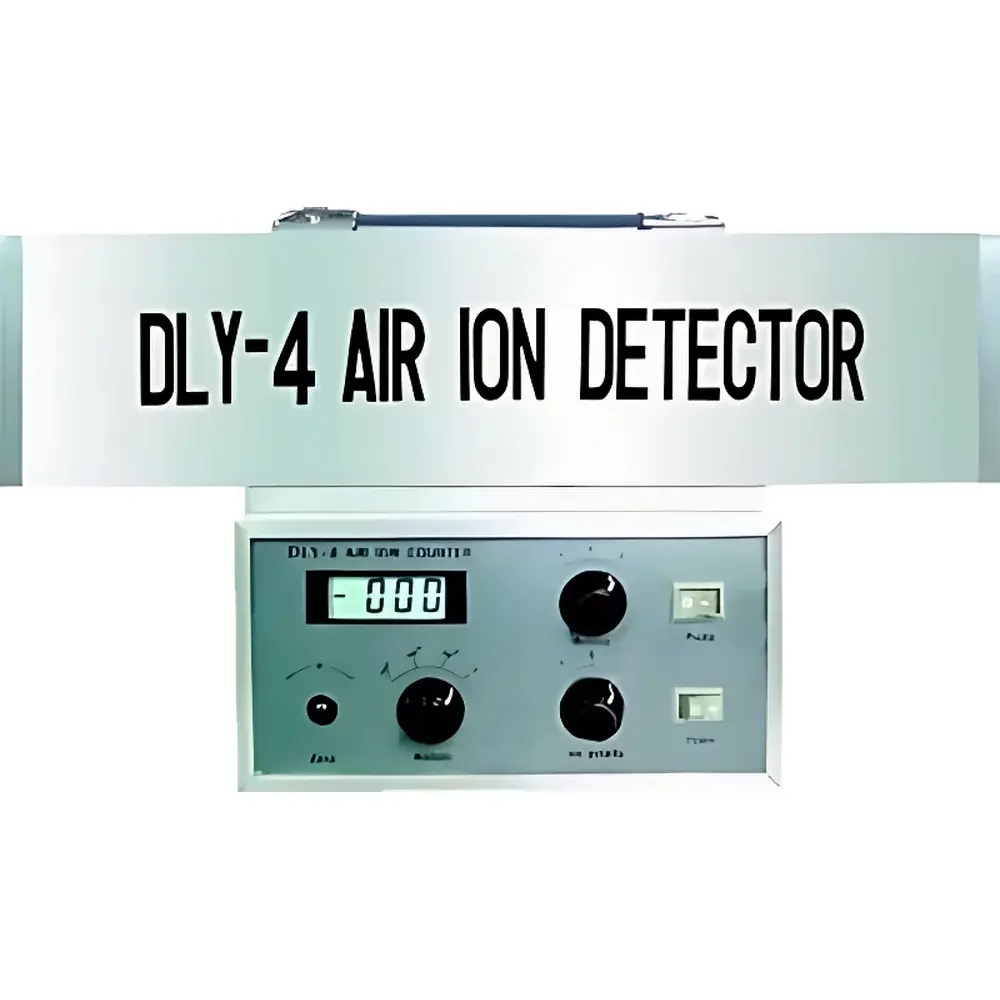
DLY-4 Ultra-High-Sensitivity Air Negative Ion Concentration Analyzer
| Origin | Beijing, China |
|---|---|
| Manufacturer Type | Authorized Distributor |
| Origin Category | Domestic (PRC) |
| Model | DLY-4 |
| Pricing | Available Upon Request |
| Ion Concentration Range | 1–1.999×10⁹ ions/cm³ |
| Resolution | 1 ion/cm³ |
| Ion Mobility Ranges | 1.0 / 0.4 / 0.15 cm²/(V·s) (3-step selection) |
| Sampling Airflow Velocity | 180 cm/s |
| Response Time Constant | ~15 s |
| Accuracy | ±10% for ion concentration and ion mobility |
| Power Supply | DC 12 V or AC 220 V |
| Operating Environment | –0 to +40 °C, ≤90% RH (short-term operation permitted above 90% RH) |
| Compliance | GB/T 18809–2002 |
Overview
The DLY-4 Ultra-High-Sensitivity Air Negative Ion Concentration Analyzer is a precision electrometer-based instrument engineered for quantitative measurement of low-level atmospheric negative ion concentrations—particularly in challenging low-emission scenarios where conventional ion counters lack sufficient resolution. It operates on the principle of Gerdien tube aspiration electrophoresis: ambient air is drawn at a controlled velocity (180 cm/s) through a cylindrical capacitor electrode system; negative ions migrate under a defined electric field, inducing a measurable current proportional to their concentration and mobility. This design enables direct, real-time quantification of ion number density (ions/cm³) with single-ion resolution—critical for evaluating weakly emissive materials such as functional textiles, photocatalytic coatings, mineral-based wall paints, and low-output ion-generating devices. Unlike general-purpose ion meters optimized for ambient outdoor or indoor air monitoring, the DLY-4 is specifically calibrated and validated for laboratory-grade material emission testing under controlled conditions, minimizing interference from environmental background ion fluctuations.
Key Features
- Ultra-high resolution detection capability: 1 ion/cm³—enabling reliable quantification of sub-10² ions/cm³ emissions typical of passive ion-releasing materials.
- Three selectable ion mobility ranges (1.0, 0.4, and 0.15 cm²/(V·s)) to accommodate diverse ion species (e.g., O₂⁻, CO₃⁻, NO₂⁻) and optimize signal-to-noise ratio across material-specific emission profiles.
- Stable aspiration airflow control (180 cm/s) ensures consistent sampling volume and minimizes boundary layer effects, supporting reproducible inter-laboratory comparisons.
- Fast dynamic response with time constant of ~15 seconds—suitable for both steady-state emission assessment and transient release kinetics studies.
- Dual power input compatibility (DC 12 V for portable field deployment; AC 220 V for benchtop laboratory use) enhances operational flexibility without compromising measurement stability.
- Robust thermal and humidity tolerance (–0 to +40 °C; ≤90% RH), with documented short-term operability beyond 90% RH—essential for testing hygroscopic materials or high-humidity environments.
Sample Compatibility & Compliance
The DLY-4 is routinely deployed in material science laboratories evaluating surface-modified fabrics, ceramic-based antimicrobial coatings, tourmaline-infused polymers, and mineral composites intended for indoor air quality enhancement. Its sensitivity allows differentiation between baseline atmospheric ion levels (~200–2000 ions/cm³) and material-specific emissions ranging from <10 to ~5×10⁴ ions/cm³. To isolate sample contribution from ambient background, the instrument supports integration with custom-built shielded test chambers—including Faraday-cage enclosures and laminar-flow sample holders—designed per user-specified geometry and ventilation parameters. All measurements comply with the methodology and performance criteria stipulated in GB/T 18809–2002 “Determination of Air Negative Ion Concentration,” including calibration traceability to reference ion sources, documented environmental conditioning prior to testing, and mandatory background subtraction protocols.
Software & Data Management
While the DLY-4 operates as a stand-alone analog/digital hybrid instrument with front-panel LED display and manual range selection, it features a standardized analog output (0–5 V DC) compatible with third-party data acquisition systems (e.g., National Instruments DAQ, LabVIEW, MATLAB). Users may configure time-series logging, statistical averaging (mean, SD, min/max over user-defined intervals), and mobility-range-specific calibration tables. For regulated environments—including GLP-compliant material safety evaluation labs—the system supports audit-ready documentation when paired with validated acquisition software that enforces electronic signatures, change logs, and 21 CFR Part 11–compliant metadata tagging (timestamp, operator ID, calibration status, environmental sensor readings).
Applications
- Quantitative emission profiling of textile finishes (e.g., silver-zinc oxide nanocomposite coatings) under ISO 18184–derived exposure protocols.
- Performance validation of building materials (e.g., negative-ion-emitting tiles, plasters) per Chinese Green Building Assessment Standard (GB/T 50378).
- Comparative analysis of ion generation efficiency across catalyst formulations (TiO₂, tourmaline, monazite) under controlled UV/visible irradiation.
- Research into charge dissipation mechanisms in electrostatic-sensitive packaging films and antistatic medical drapes.
- Baseline characterization of indoor microenvironments during HVAC commissioning—especially in healthcare and cleanroom facilities where ultra-low ion backgrounds are specified.
FAQ
What ion mobility ranges does the DLY-4 support, and how are they selected?
The instrument provides three discrete mobility settings—1.0, 0.4, and 0.15 cm²/(V·s)—selected manually via front-panel switch. Each setting corresponds to a specific electrode bias configuration optimized for common small-ion species encountered in material emission testing.
Is the DLY-4 suitable for outdoor ambient air monitoring?
It is not recommended for uncontrolled outdoor use due to its high sensitivity and susceptibility to wind-induced flow turbulence and particulate interference. It is engineered for enclosed, stabilized test chambers or laminar-flow hoods.
Does the DLY-4 include NIST-traceable calibration?
The unit ships with factory calibration against a certified radioactive ²¹⁰Po source (±5% uncertainty); users must perform periodic verification using the included calibration kit or accredited secondary standards compliant with GB/T 18809–2002 Annex B.
Can the DLY-4 distinguish between negative and positive ions?
No—it measures only negative ion concentration. A companion positive-ion variant (DLY-4P) is available for bipolar characterization, but the two units operate independently and cannot be synchronized.
What maintenance is required to sustain long-term accuracy?
Biannual cleaning of the aspiration inlet and electrode surfaces with anhydrous ethanol; annual verification of airflow velocity using a calibrated hot-wire anemometer; and replacement of the internal radioactive calibration source every 10 years (half-life of ²¹⁰Po = 138 days; source replenishment is managed by authorized service centers).
Related Products







