
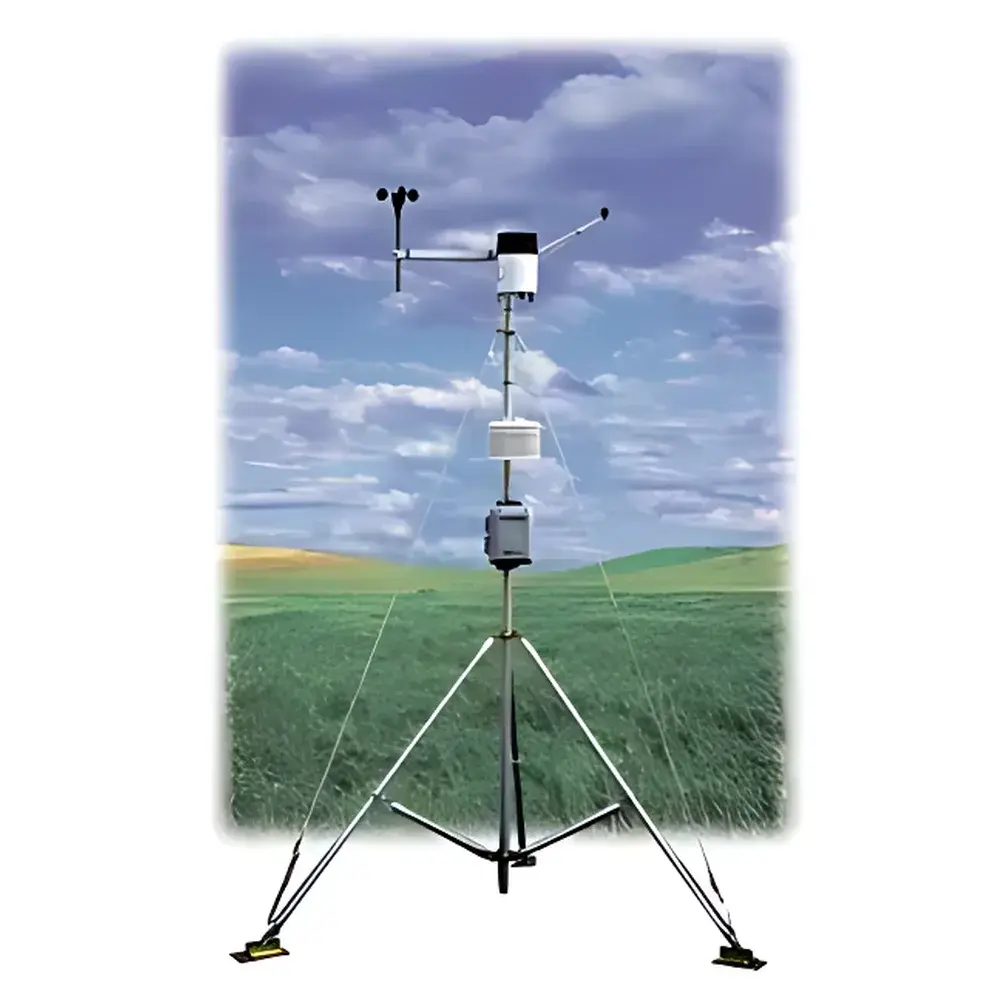
HOBO U30 Small Automatic Weather Station
| Origin | USA |
|---|---|
| Manufacturer Type | Authorized Distributor |
| Origin Category | Imported |
| Model | HOBO U30 |
| Pricing | Upon Request |
Overview
The HOBO U30 Small Automatic Weather Station is a modular, low-power environmental monitoring system engineered for long-term, unattended deployment across diverse field conditions—from agricultural research plots and ecological reserves to urban microclimate studies and industrial site compliance monitoring. Built on Onset’s proven HOBO platform architecture, the U30 integrates precision sensor interfacing with flexible communication options to support real-time telemetry or local data logging without reliance on continuous network infrastructure. Its core measurement principle relies on digital acquisition of analog and smart sensor outputs via calibrated 12-bit ADCs, synchronized time-stamped sampling (±5 s/week accuracy), and non-volatile internal memory (512 KB) capable of storing up to 500,000 measurements. The system operates across an extended temperature range of –40 °C to +60 °C (with GSM variant limited to –30 °C minimum), meeting NEMA 6-rated enclosure specifications when correctly installed—ensuring protection against dust ingress, temporary submersion, and heavy precipitation.
Key Features
- Four configurable communication variants: U30-WiFi (IEEE 802.11b/g, WPA2/AES encrypted), U30-GSM (quad-band 850/900/1800/1900 MHz, FCC-certified), U30-ETH (10/100Base-TX with 256-bit AES encryption), and U30-NRC (USB-only local configuration and retrieval)
- Dual-layer protective housing constructed from polycarbonate/PBT blend with stainless-steel hinge pins and brass mounting hardware; inner shell features polycarbonate with brass gasketing
- Expandable sensor interface supporting up to 10 channels (standard 5), accommodating both analog (0–20 mA, 0–20 VDC) and Onset Smart Sensor protocols
- Onboard relay output (SPST, 30 V / 1 A max) programmable for alarm activation—configurable as normally open, normally closed, or pulse mode
- Flexible power management: rechargeable 4 V sealed lead-acid battery (4.5 Ah or 10 Ah options) with typical 3–5 year service life; optional solar charging (1.2 W / 3 W / 6 W panels) or AC adapter compatibility
- User-defined logging intervals from 1 second to 18 hours; storage modes include overwrite-on-full or stop-on-full
- Seven status LEDs provide at-a-glance operational feedback for power, communication, sensor activity, and alarm states
Sample Compatibility & Compliance
The U30 station natively supports Onset’s full suite of calibrated environmental sensors—including air temperature/humidity (S-THB-M002/M008), barometric pressure (S-BPB-CM50), PAR and total solar radiation (S-LIA-M003/S-LIB-M003), tipping-bucket rainfall (S-RGB-M002), soil moisture (EC-5, EC-10, EC-20, 10HS), leaf wetness (S-LWA-M003), and wind speed/direction (S-WCA-M003, S-WSA-M003). It also accepts third-party sensors via analog input adapters (S-CIA-CM14, S-VIA-CM14) or pulse interfaces (S-UCC-M006, S-UCD-M006), including compatibility with select R.M. Young Company anemometers using dedicated signal-conditioning adapters (S-WCB/C/D/E-M003). All sensor calibrations are traceable to NIST standards. The system complies with FCC Part 15 Subpart B (U30-GSM/WiFi), IEC 60529 (NEMA 6 enclosure rating), and meets requirements for GLP-aligned field data collection under ISO/IEC 17025 and ASTM D5098 (for soil moisture applications).
Software & Data Management
Data acquisition and configuration are managed through Onset’s HOBOlink cloud platform—a secure, browser-based interface compliant with FDA 21 CFR Part 11 for audit trail, electronic signature, and role-based access control. HOBOlink provides real-time dashboards, automated alerting (email/SMS), customizable reporting, and export in CSV, Excel, or XML formats. For offline operation, the U30-NRC variant uses HOBOware Pro desktop software (Windows/macOS) for setup, firmware updates, and raw data download via Mini-USB. All data packets include embedded timestamps, sensor metadata, and CRC error-checking. Internal memory retention is non-volatile; no data loss occurs during power interruption. Firmware updates are delivered over-the-air (OTA) for WiFi/GSM/ETH models, ensuring continued regulatory alignment and feature enhancement without physical site visits.
Applications
The HOBO U30 serves mission-critical roles in academic, governmental, and commercial environmental monitoring programs. In agronomy, it enables irrigation scheduling via integrated soil moisture and ET₀ modeling. In atmospheric science, multi-node deployments support boundary layer profiling and urban heat island analysis. Environmental consultants deploy U30 networks for EPA-mandated stormwater runoff monitoring, landfill gas tracking, and ambient air quality baseline assessments. Forestry researchers utilize its compact footprint and low maintenance for canopy microclimate mapping. Industrial hygienists apply it for OSHA-compliant workplace thermal stress evaluation. Its modularity, ruggedized design, and certification-ready data integrity make it suitable for inclusion in ISO 14001 environmental management systems and NSF/ANSI 40 and 60 certification pathways.
FAQ
What communication options are available for remote data transmission?
The U30 offers four variants: WiFi (802.11b/g), GSM (quad-band cellular), Ethernet (10/100Base-TX), and NRC (no remote connectivity—USB only).
Can the U30 operate in extreme cold environments?
Yes—the base unit functions from –40 °C to +60 °C, though the GSM module is rated down to only –30 °C.
How many sensors can be connected simultaneously?
The system supports up to 10 sensor inputs (5 standard, expandable), with maximum channel allocation depending on sensor type (e.g., air temp/humidity occupies 2 channels, wind speed/direction occupies 3).
Is the system compatible with third-party sensors?
Yes—via analog adapters (0–20 mA, 0–5 V) or pulse-input modules, including certified interfaces for R.M. Young anemometers.
What data security measures are implemented?
WiFi models support WPA2-PSK with AES encryption; Ethernet models use 256-bit AES Rijndael; all cloud communications are TLS 1.2+ secured with role-based authentication and full audit logging per 21 CFR Part 11.
How is calibration traceability maintained?
All Onset factory-calibrated sensors include NIST-traceable certificates; field recalibration services are available through Onset’s ISO/IEC 17025-accredited laboratory.
Related Products







