
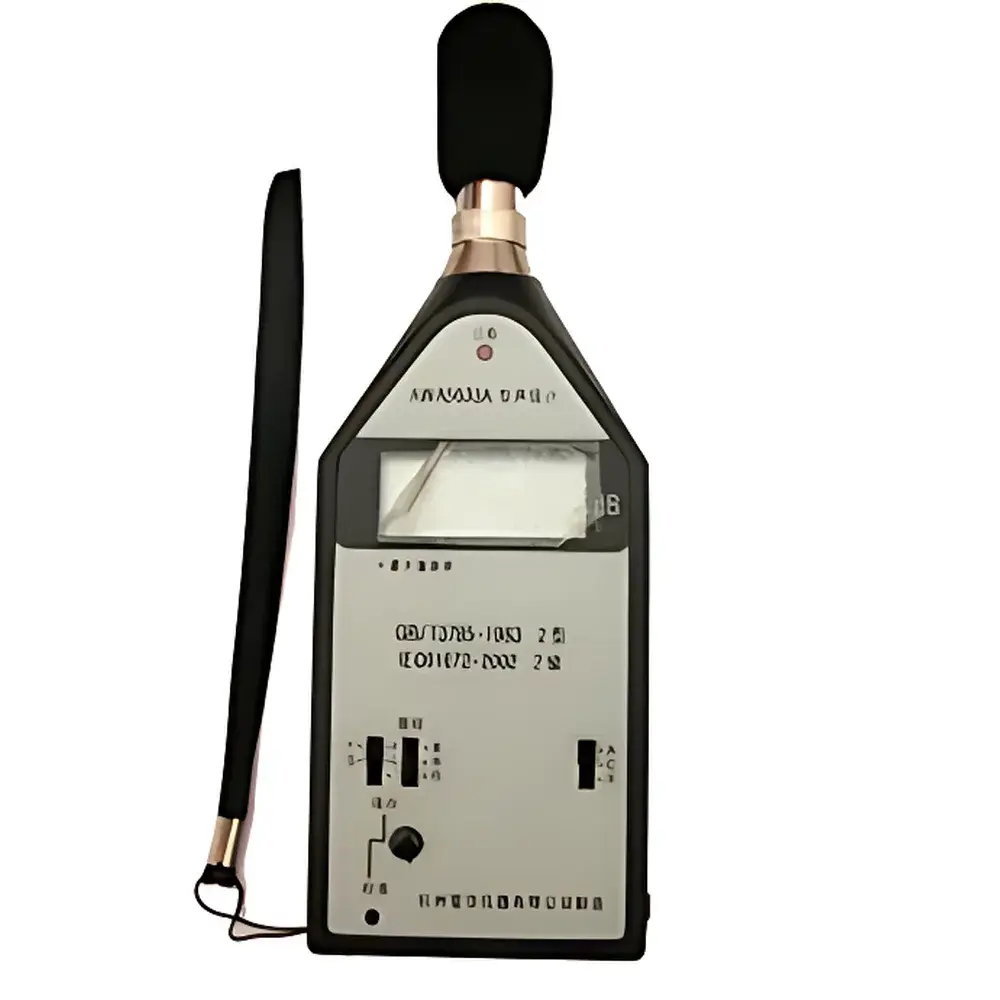
AWA5633A Portable Sound Level Meter
| Origin | Zhejiang, China |
|---|---|
| Manufacturer Type | Authorized Distributor |
| Origin Category | Domestic (China) |
| Model | AWA5633A |
| Pricing | Available Upon Request |
| Noise Floor | <30 dB(A) |
| Max. Measurable Level | 130 dB |
| Microphone | 12.7 mm (½″) Electret Condenser |
| Frequency Range | 20 Hz – 8 kHz |
| Frequency Weightings | A, C |
| Detection | Digital True RMS, Dynamic Range ≥60 dB |
| Time Weightings | Fast (F), Slow (S) |
| Range Selection | Manual, 3 ranges |
| Display | 3½-digit LCD, update rate: 1 reading/sec |
| Output | AC output (rms) |
| Calibration | Compatible with standard acoustic calibrators (e.g., 94 dB/114 dB @ 1 kHz) |
| Power | 4×AA (R6) alkaline batteries, ~20 h continuous operation |
| Operating Environment | 0–40 °C, RH <85% (non-condensing) |
| Dimensions (L×W×H) | 210×75×32 mm |
| Mass | 300 g (including batteries) |
Overview
The AWA5633A Portable Sound Level Meter is a compact, hand-held instrument engineered for field-deployable noise assessment in compliance with international metrological standards. It operates on the principle of airborne sound pressure measurement using a precision electret condenser microphone coupled with digital true-root-mean-square (true RMS) detection circuitry. The device conforms to IEC 61672-1:2002 Class 2 and GB/T 3785–2010 Type 2 specifications—ensuring traceable accuracy for routine environmental, occupational, and industrial noise monitoring. Its lightweight chassis (300 g including batteries), ergonomic form factor (210 × 75 × 32 mm), and battery-powered architecture support extended unattended operation—making it suitable for mobile surveys, site audits, and preliminary acoustic screening where portability and operational simplicity are critical.
Key Features
- True RMS digital detection with ≥60 dB dynamic range ensures accurate representation of both steady-state and fluctuating noise sources.
- Dual frequency weightings (A and C) enable evaluation of human-perceived loudness (A-weighting) and low-frequency energy content (C-weighting), supporting regulatory assessments per ISO 1996, OSHA 1910.95, and EU Directive 2003/10/EC.
- Manual 3-range selection (e.g., 30–90 dB, 50–110 dB, 70–130 dB) provides optimal signal-to-noise ratio across diverse acoustic environments without auto-ranging artifacts.
- Fast (F) and Slow (S) time weightings comply with ANSI S1.4 and IEC 61672-1 requirements for temporal averaging—essential for characterizing impulsive, intermittent, or continuous noise emissions.
- Integrated 3½-digit LCD display updates at 1 Hz, offering real-time readouts with peak-hold functionality for capturing transient maximum levels during measurement sessions.
- AC output enables connection to external data loggers, spectrum analyzers, or oscilloscopes for waveform capture and post-processing analysis.
- Low self-noise (<30 dB(A)) minimizes instrument-induced bias during low-level measurements such as background noise characterization in quiet zones or residential areas.
Sample Compatibility & Compliance
The AWA5633A is designed for direct air-coupled measurement of sound pressure levels generated by mechanical equipment, road traffic, construction activities, HVAC systems, and electroacoustic transducers. It does not require sample preparation or coupling media. All calibration procedures follow standardized acoustic calibrator protocols (e.g., Class 1 pistonphones per IEC 60942), ensuring traceability to national metrology institutes. The instrument meets Class 2 performance criteria under IEC 61672-1:2002 and GB/T 3785–2010, validating its use in legally defensible noise mapping, workplace exposure assessments, and pre-compliance environmental reporting. While not certified for GLP/GMP-regulated laboratories, its documented metrological chain supports QA/QC workflows in municipal environmental agencies and third-party testing firms.
Software & Data Management
The AWA5633A operates as a standalone analog/digital hybrid meter and does not include embedded memory or USB connectivity. Data acquisition relies on manual logging or external recording via its AC output interface. For structured data collection, users may integrate the unit with compatible third-party software platforms (e.g., MATLAB, LabVIEW, or custom Python-based DAQ scripts) using standard analog input modules. Calibration events must be recorded manually in accordance with ISO/IEC 17025 documentation requirements. Though lacking built-in audit trail or electronic signature capabilities, the device supports 21 CFR Part 11-aligned workflows when paired with validated external logging systems that enforce user authentication, change control, and data integrity safeguards.
Applications
- Environmental noise monitoring around industrial facilities, transportation corridors, and urban development sites per ISO 1996-1 and ISO 1996-2.
- OHS-compliant workplace noise exposure assessments aligned with ISO 9612 and national occupational safety regulations.
- Preliminary building acoustics evaluations—including façade transmission loss screening and room reverberation checks.
- Product noise certification testing for consumer appliances, power tools, and automotive components prior to formal anechoic chamber validation.
- Educational laboratory instruction in acoustics fundamentals, instrumentation metrology, and environmental engineering curricula.
FAQ
What standards does the AWA5633A comply with?
It meets IEC 61672-1:2002 Class 2 and GB/T 3785–2010 Type 2 requirements for sound level meters.
Can it measure impulse noise?
Yes—its Fast (F) time weighting and true RMS detection allow reliable capture of short-duration events, though peak hold resolution is limited to displayed LMAX values without external high-speed digitization.
Is periodic calibration required?
Yes—users must perform acoustic calibration before and after each measurement session using a traceable sound calibrator; annual verification against accredited metrology labs is recommended.
Does it support data export or PC connectivity?
No native digital interface exists; however, analog AC output permits integration with external DAQ hardware and software for time-series recording.
What is the expected battery life under typical use?
Approximately 20 hours of continuous operation with fresh alkaline AA cells under ambient temperature conditions (23 °C, 50% RH).
Related Products







