

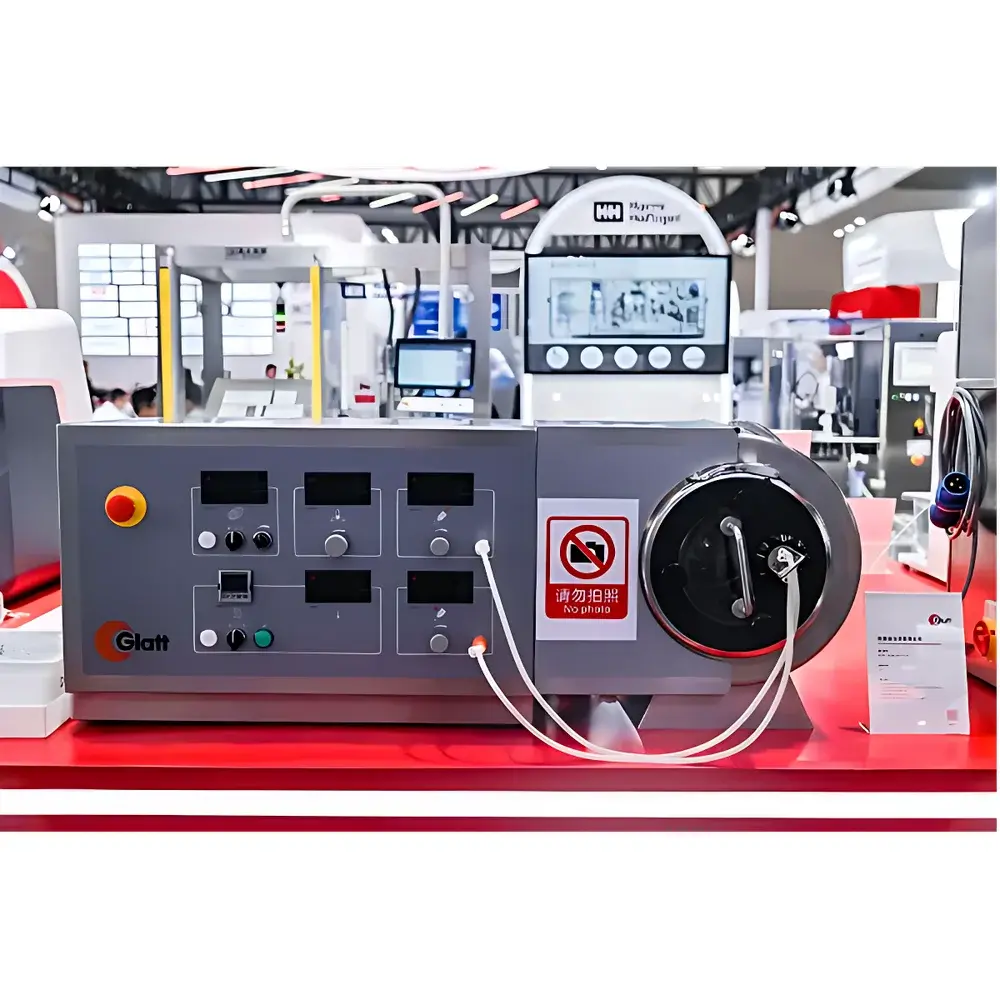
Glatt GC1 High-Efficiency Small-Batch Film Coating System
| Brand | Glatt |
|---|---|
| Origin | Germany |
| Model | GC1 |
| Standard Bowl Capacity | 1.6 L |
| Optional Bowl Capacities | 0.8 L and 2.5 L |
| Spray Gun | Glatt ABC-Technology® Nozzle |
Overview
The Glatt GC1 is a precision-engineered laboratory-scale film coating system designed for development-stage pharmaceutical solid dosage forms. It operates on the principle of fluidized-bed or pan-based film coating—depending on configuration—where atomized polymer solutions or suspensions are applied onto moving particulate substrates (e.g., tablets, pellets, granules) under controlled temperature, airflow, and spray dynamics. Engineered for reproducibility and scalability, the GC1 bridges early-phase formulation screening with pilot-scale process definition. Its modular architecture supports both aqueous and organic solvent-based coating formulations, enabling robust method development aligned with ICH Q5A–Q5E and Q8(R2) guidelines. The system is intended for use in R&D laboratories, academic research facilities, and regulatory-compliant development units operating under GLP or GMP-aligned documentation practices.
Key Features
- Modular Bowl System: Three interchangeable stainless-steel coating bowls (0.8 L, 1.6 L standard, and 2.5 L) allow seamless adaptation to varying batch sizes—from micro-formulation trials (≤50 g) to pilot-relevant batches (up to 500 g), minimizing material waste and accelerating DoE studies.
- ABC-Technology® Spray Gun: Patented nozzle design prevents stringing, dripping, and nozzle clogging during low-flow-rate application. Independent external adjustment of spray angle, distance, and axis alignment ensures consistent droplet distribution without disassembly.
- Ergonomic Process Access: Front-mounted control panel, tilting bowl interface, and tool-free bowl clamping reduce operator fatigue and improve repeatability across multiple users and shifts.
- Cleaning-In-Place (CIP) Readiness: Smooth internal surfaces, minimal dead-leg geometry, and standardized O-ring seals facilitate rapid cleaning validation per FDA Guidance for Industry: Process Validation (2011) and EU Annex 15.
- Integrated Environmental Control: Precise regulation of inlet air temperature (±0.5 °C), relative humidity (±3% RH), and airflow velocity (±2% FS) ensures thermodynamic stability during sensitive polymer film formation.
Sample Compatibility & Compliance
The GC1 accommodates a broad spectrum of solid dosage forms—including immediate-release and modified-release tablets, extruded pellets, spheronized beads, and multiparticulates—with diameters ranging from 0.5 mm to 12 mm. Its design conforms to ISO 14644-1 Class 7 cleanroom integration requirements when installed with appropriate HVAC interfaces. All wetted parts comply with USP and ASTM F899 stainless-steel specifications. Documentation packages support 21 CFR Part 11-compliant electronic records when paired with validated third-party SCADA or MES platforms. The system is routinely deployed in laboratories adhering to ISO/IEC 17025 accreditation scopes for analytical method development and coating process characterization.
Software & Data Management
While the GC1 operates via an embedded HMI with real-time parameter logging (temperature, airflow, spray rate, drum speed), it supports optional integration with Glatt’s GMP-validated Process Analytical Technology (PAT) suite—including NIR probe coupling and multivariate data trending. All critical process parameters (CPPs) are timestamped and stored locally with audit-trail functionality. Export formats include CSV and XML for traceability in quality review workflows. Data integrity meets ALCOA+ principles, and raw files remain uneditable post-acquisition—ensuring compliance during regulatory inspections (e.g., FDA PAI, EMA GMP audits).
Applications
- Formulation screening of enteric, sustained-release, and taste-masking polymer coatings (e.g., Eudragit®, cellulose acetate phthalate, HPMC)
- Optimization of spray rate, inlet air temperature, and pan rotation speed using Design of Experiments (DoE)
- Stability-indicating coating uniformity assessment via weight gain distribution analysis (per USP )
- Scale-up modeling from lab to production using dimensionless numbers (e.g., Froude, Reynolds) and residence time distribution profiling
- Teaching and hands-on training in pharmaceutical engineering curricula, including GMP simulation exercises
FAQ
What is the minimum practical batch size supported by the GC1?
Typical lower limits are 30–50 g for 0.8 L bowl operation, contingent on particle morphology and coating viscosity.
Can the GC1 be qualified under GMP for clinical trial material production?
Yes—when operated within a qualified environment and supported by IQ/OQ/PQ protocols, it is suitable for Phase I/II clinical supply manufacturing.
Is remote monitoring or network connectivity available?
Standard Ethernet port enables local network access; full OPC UA or MQTT integration requires optional firmware upgrade and IT security review.
Does Glatt provide coating protocol templates or formulation libraries?
Yes—comprehensive technical notes, SOP templates, and historical coating parameter databases are included with commissioning support.
How frequently does the ABC-Technology® nozzle require maintenance?
Under normal aqueous coating conditions, nozzle inspection is recommended every 20–30 hours of cumulative runtime; solvent-based systems may require more frequent checks per cleaning logs.






