
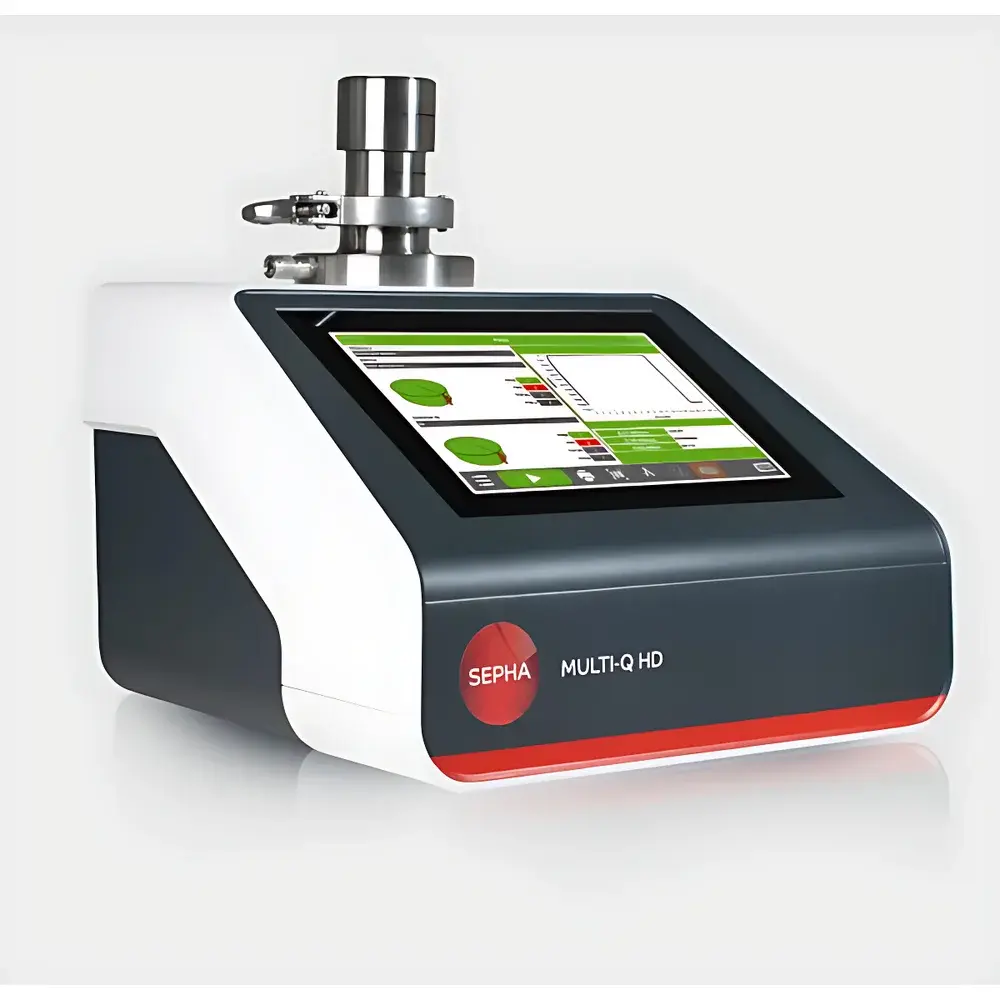
SEPHA Multi-Q HD Non-Destructive Container Closure Integrity Tester
| Brand | SEPHA |
|---|---|
| Origin | United Kingdom |
| Model | Multi-Q HD |
| Detection Principle | Vacuum Decay Method (ASTM F2338-09) |
| Compliance | USP <1207>, FDA-recognized CCIT method |
| Minimum Detectable Leak | ≥1 µm |
| Sensor Type | High-resolution absolute pressure transducer with localized in-chamber placement |
| Test Cycle Time | Optimized for high-throughput QC environments |
| Intended Use | Sterile parenteral packaging (vials, syringes, cartridges, blow-fill-seal containers) |
| Regulatory Context | Supports 21 CFR Part 11-compliant data integrity requirements when integrated with validated software |
Overview
The SEPHA Multi-Q HD is a non-destructive, method-validated Container Closure Integrity Testing (CCIT) instrument engineered for high-sensitivity detection of leaks ≥1 µm in sterile parenteral packaging. Developed in accordance with the scientific and regulatory framework defined in USP and ASTM F2338-09, the system implements vacuum decay methodology—a physically grounded, quantitative technique that measures minute pressure changes within a sealed test chamber over time. Unlike probabilistic dye ingress or subjective bubble emission tests, vacuum decay provides objective, numerical pass/fail criteria based on pressure rise rate, enabling robust statistical process control and full traceability. The Multi-Q HD’s architecture integrates a calibrated, high-stability absolute pressure transducer directly at the test station—eliminating signal lag and enhancing signal-to-noise ratio—thereby achieving reproducible detection of sub-micron-level leakage pathways under controlled environmental conditions.
Key Features
- Non-destructive testing: Preserves product sterility and stability; no sample preparation, labeling, or post-test handling required.
- Method-validated platform: Fully compliant with ASTM F2338-09 and aligned with USP Category 1 (deterministic, quantitative) CCIT requirements.
- 1 µm minimum detectable leak: Achieved through proprietary sensor placement, temperature-compensated pressure measurement, and real-time drift correction algorithms.
- Dual-stage vacuum control: Enables precise conditioning and stabilization prior to decay measurement, reducing false positives from outgassing or thermal effects.
- Modular chamber design: Accommodates vials (2–50 mL), pre-filled syringes, cartridges, and BFS containers without tooling changeover.
- Embedded audit trail: Automatic timestamped logging of all test parameters, operator ID, environmental conditions (temperature/pressure), and raw pressure vs. time datasets.
Sample Compatibility & Compliance
The Multi-Q HD supports a broad range of primary packaging formats used in aseptic manufacturing, including glass and polymer vials, elastomeric stoppered syringes, aluminum-crimped cartridges, and blow-fill-seal (BFS) containers. Its validation package includes documented evidence of specificity, accuracy, precision (repeatability and intermediate precision), robustness, and limit of detection—per ICH Q2(R2) guidelines. The system meets the technical expectations outlined in FDA’s 2022 Guidance on “Container Closure Integrity Testing in Lieu of Sterility Testing as a Component of the Stability Protocol for Sterile Products” and supports GMP-compliant implementation under EU Annex 1 (2022) and PIC/S PI 041-3. All firmware and calibration routines are designed to support 21 CFR Part 11 compliance when deployed with SEPHA’s validated IQ/OQ/PQ documentation suite.
Software & Data Management
The instrument operates via SEPHA’s Multi-Soft HD software platform, a Windows-based application built on .NET Framework with role-based access control (RBAC), electronic signatures, and configurable user permissions. Each test generates an encrypted binary data file containing raw pressure traces, derivative curves, pass/fail logic outputs, and metadata (e.g., batch ID, container type, test date/time). Export options include CSV, PDF reports (with digital signature), and direct integration into LIMS or MES systems via OPC UA or SQL Server connectivity. Audit trails are immutable and retain full history of all user actions—including parameter edits, result overrides, and calibration events—for GLP/GMP inspection readiness.
Applications
- Final container release testing for lyophilized and liquid injectables prior to market distribution.
- Stability study support: CCIT monitoring at multiple timepoints to assess seal degradation under accelerated or real-time storage conditions.
- Process validation: Qualification of stopper seating force, crimping parameters, or BFS sealing temperature profiles.
- Root cause investigation: Differentiation between inherent micro-leakage (e.g., laser-drilled reference standards) and gross defects (e.g., cracked glass, misaligned plungers).
- Regulatory submission support: Generation of scientifically defensible CCIT data packages for IND, NDA, and MAA dossiers.
FAQ
Is the Multi-Q HD suitable for testing silicone-coated or coated rubber stoppers?
Yes—the vacuum decay method is insensitive to surface chemistry or coating variability; it responds solely to mass flow across the closure system.
Does the system require daily calibration verification?
A documented calibration verification using NIST-traceable pressure standards is recommended before first use each day and after any maintenance event.
Can the Multi-Q HD be integrated into automated fill-finish lines?
While primarily designed for offline QC labs, the system supports PLC-triggered start/stop signals and Ethernet/IP communication for semi-automated batch loading in pilot-scale environments.
What environmental controls are necessary during operation?
Testing should occur in a temperature-stable environment (±2°C), free from vibration sources and rapid air currents, to minimize thermal drift and mechanical noise interference.
How does the Multi-Q HD handle variable headspace volumes across different container types?
The software automatically compensates for chamber volume and headspace using pre-defined container profiles, ensuring consistent sensitivity regardless of fill level or geometry.



