
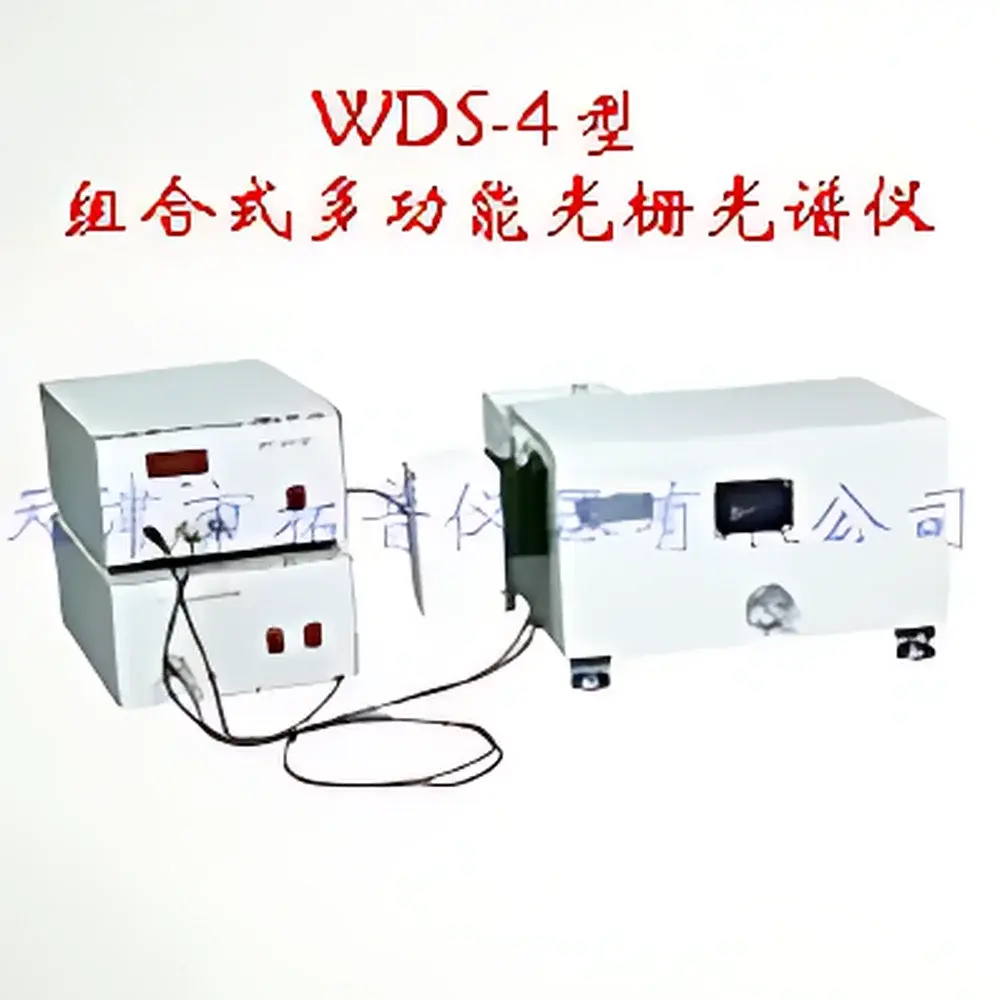
Topo WDS-4 Modular Multi-Function Grating Spectrometer
| Brand | Topo |
|---|---|
| Model | WDS-4 |
| Focal Length | 300 mm |
| Relative Aperture | D/F = 1/7 |
| Stray Light Level | ≤0.3% T |
| Spectral Resolution | Resolves seven polystyrene transmission peaks at 3000 nm |
| Detector Options | TGS pyroelectric detector, PbS photoconductive detector, HgCdTe (MCT) photovoltaic detector |
| Interface | USB |
| Dimensions | 370 × 280 × 200 mm |
| Origin | Tianjin, China |
| Manufacturer Type | Original Equipment Manufacturer (OEM) |
Overview
The Topo WDS-4 Modular Multi-Function Grating Spectrometer is a precision optical instrument engineered for high-fidelity spectral analysis across the near-infrared (NIR) and mid-infrared (MIR) regions. Based on Czerny–Turner optical architecture with a 300 mm focal length monochromator, it delivers stable wavelength dispersion and minimal optical aberration. Its f/7 relative aperture ensures balanced throughput and resolution, while the ≤0.3% stray light specification supports quantitative transmission and absorption measurements in demanding analytical environments. Designed as a modular platform, the WDS-4 accommodates interchangeable detectors—including TGS pyroelectric, PbS, and HgCdTe (MCT)—enabling flexible configuration for varying spectral range requirements (e.g., 0.8–2.5 µm with PbS; 2–12 µm with MCT). The system operates under USB 2.0 interface control, facilitating seamless integration into automated laboratory workflows and custom data acquisition software.
Key Features
- Modular detector bay supporting rapid interchange of TGS, PbS, and HgCdTe detectors without realignment
- Czerny–Turner optical design with 300 mm focal length and ruled or holographic grating options (grating groove density selectable per application)
- Stray light suppression ≤0.3% T, validated per ASTM E275 and ISO 9050 standards for spectrophotometric accuracy
- Resolution verified using the polystyrene film standard (ASTM E1421), resolving seven distinct transmission peaks at ~3000 nm—demonstrating consistent performance in NIR/MIR bandpass characterization
- Compact benchtop form factor (370 × 280 × 200 mm) with rigid aluminum alloy housing for thermal and mechanical stability
- USB 2.0 digital interface compliant with Windows/Linux device driver frameworks; supports LabVIEW™, Python (PyUSB), and MATLAB® SDK integration
Sample Compatibility & Compliance
The WDS-4 is optimized for transmission, reflection, and attenuated total reflectance (ATR) spectroscopy of solid films, liquid cells, and gas-phase samples housed in standardized cuvettes or gas cells. It complies with core optical metrology conventions including ISO/IEC 17025–aligned calibration traceability pathways. When operated with NIST-traceable polystyrene reference films and calibrated tungsten-halogen or blackbody sources, the instrument supports GLP-compliant spectral validation protocols. Its mechanical and electrical design conforms to IEC 61010-1 safety standards for laboratory equipment. While not pre-certified for FDA 21 CFR Part 11, its USB-based data logging architecture allows integration with validated LIMS or ELN systems that implement electronic signature and audit trail functionality.
Software & Data Management
The WDS-4 operates via vendor-neutral USB HID protocol, enabling direct control through third-party spectral acquisition platforms. Included firmware supports full spectral scan control (wavelength range, step size, dwell time, averaging), real-time baseline correction, and dark-current subtraction. Raw spectral data are output in ASCII-compatible .csv format with wavelength (nm or cm⁻¹) and intensity (arbitrary units or calibrated absorbance/transmittance) columns. For regulated environments, users may deploy custom Python or MATLAB scripts incorporating checksums, timestamped metadata headers, and export to HDF5 or NetCDF-4 containers—formats aligned with FAIR data principles and long-term archival requirements in academic and industrial R&D settings.
Applications
- Quality control of polymer composition and degradation via NIR/MIR fingerprint region analysis (e.g., carbonyl stretch at 1710 cm⁻¹, C–H bending modes)
- Pharmaceutical excipient identification and blend uniformity assessment using transmission spectroscopy of compressed tablets
- Environmental monitoring of hydrocarbon vapors (e.g., methane, ethylene) via gas-phase absorption in multipass cells
- Calibration and verification of FTIR spectrometer performance using polystyrene and polyethylene reference standards
- Research-grade spectral library development for machine learning–based classification of unknown organic compounds
- Teaching laboratories for hands-on instruction in diffraction theory, detector physics, and Beer–Lambert law validation
FAQ
What grating options are available for the WDS-4?
Standard configurations include 300, 600, and 1200 grooves/mm blazed gratings optimized for UV-VIS-NIR or MIR ranges; custom holographic gratings can be specified upon order.
Is the WDS-4 compatible with fiber-optic coupling?
Yes—optional SMA-905 or FC/PC input/output ports are available for fiber-coupled operation; alignment fixtures and collimating optics must be selected per wavelength range.
Does the system support automated wavelength calibration?
It does not include built-in calibration lamps, but supports external Hg/Ne or laser line sources; calibration routines can be scripted using provided API functions.
Can the WDS-4 operate under vacuum or purged environments?
The base model is air-path only; vacuum-compatible versions (with CaF₂ or ZnSe windows and O-ring sealed housing) are available as custom-engineered variants.
What is the typical spectral acquisition speed per scan?
Scan duration depends on resolution setting and detector response time—e.g., 100 nm scan at 2 nm step with PbS detector averages ~8–12 seconds; TGS-based MIR scans require longer dwell times due to thermal response characteristics.
Related Products





