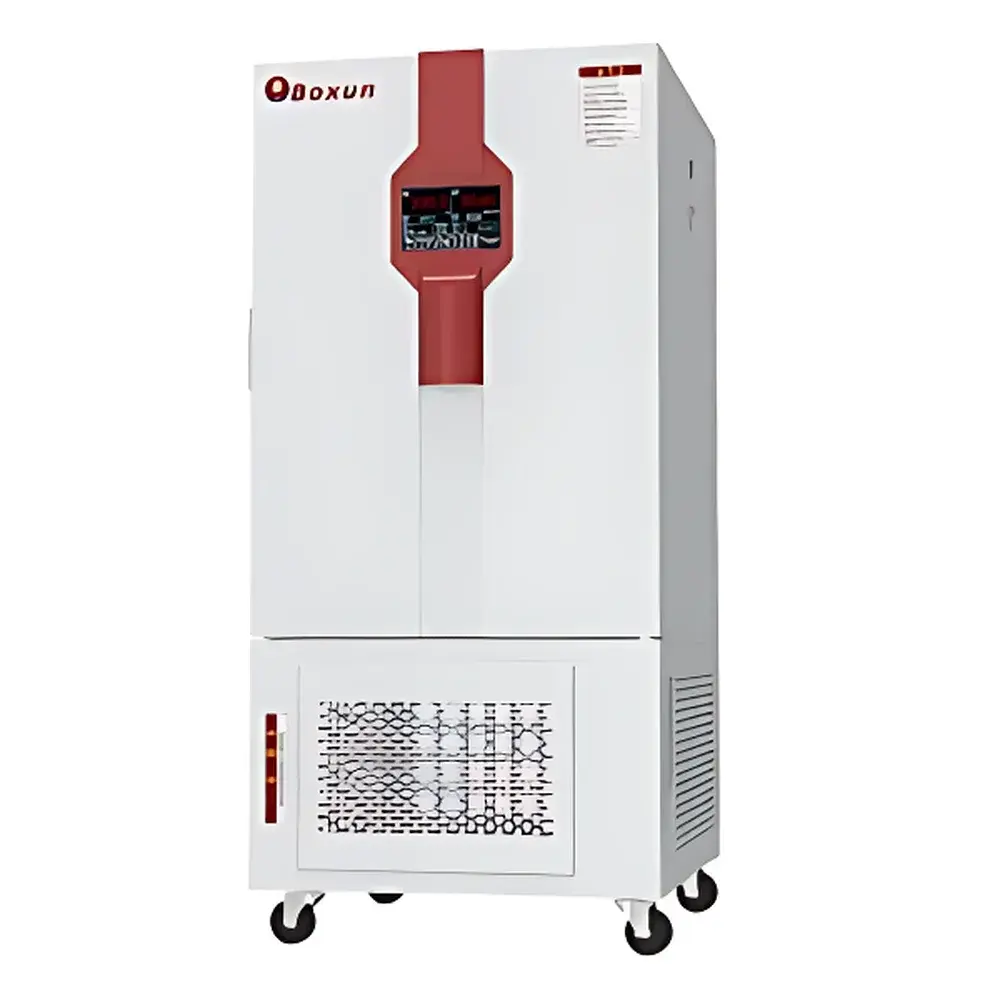
Boxun BXS-250S Expandable Drug Stability Testing Chamber
| Brand | Boxun |
|---|---|
| Origin | Shanghai, China |
| Manufacturer Type | Direct Manufacturer |
| Product Origin | Domestic (China) |
| Model | BXS-250S |
| Price Range | USD 2,800 – 7,000 |
Overview
The Boxun BXS-250S Expandable Drug Stability Testing Chamber is an engineered environmental simulation system designed to meet the stringent requirements of ICH Q1–Q5, USP <1150>, and WHO TRS Annex 2 for pharmaceutical stability testing. It operates on a validated tri-modal control architecture—temperature, humidity, and photometric/UV irradiance—enabling concurrent or independent execution of accelerated, long-term, intermediate, and photostability studies per ICH Q1B and Q5C guidelines. The chamber employs a dual-wall insulated stainless-steel inner chamber with C.H. (Circulating Heat) thermal recovery system, minimizing energy waste and ensuring rapid post-door-open stabilization (<3 min to recover ±0.5 °C at 25 °C). Its core measurement chain integrates calibrated进口 high-accuracy capacitive humidity sensors (±2% RH, 15–98% RH range), Pt1000 temperature probes (±0.15 °C), and NIST-traceable Lux and UV-A (320–400 nm) radiometric sensors—each independently verified and field-replaceable without recalibration downtime.
Key Features
- 7-inch high-resolution resistive touchscreen HMI running Windows CE OS with 512 MB RAM and 2 GB flash storage—supports multi-user password protection (screen lock, parameter edit lock, and admin-level access tiers)
- Fuzzy PID + adaptive algorithm temperature/humidity control with 30 programmable segments × 99 cycles; segment duration configurable from 1 minute to 9999 hours
- Modular expansion architecture: base unit supports seamless integration of optional humidity, photometric (0–10,000 Lux, ±500 Lux accuracy), and UV-A (0–2 W/m², 320–400 nm) modules—up to three independent shelf-mounted zones per module type
- Real-time data logging: 1,000,000-point internal memory with timestamped event logging (power on/off, setpoint changes, alarms, door openings); last 1600 readings and 6.5-hour trend curves viewable onsite
- Comprehensive alarm suite: over-temperature/under-temperature, humidity out-of-spec, door ajar, low water level, sensor fault, and UV/Lux dose completion alerts—with configurable relay outputs and optional GPRS SMS notification
- Regulatory-ready interfaces: isolated RS232, RS485, and USB 2.0 ports; embedded thermal printer (standard); FDA 21 CFR Part 11-compliant software option available with electronic signatures, audit trail, and role-based permissions
Sample Compatibility & Compliance
The BXS-250S accommodates up to 12 adjustable stainless-steel shelves (standard: 3), supporting vials, blister packs, syringes, ampoules, and bulk API containers (max load: 80 kg distributed). Its interior dimensions (506 × 450 × 1100 mm) comply with ICH Q1A(R2) minimum volume-to-sample ratios for forced-air circulation. All materials in contact with test samples are 316L stainless steel or food-grade silicone—non-outgassing and compliant with ISO 10993-5 cytotoxicity requirements. The system meets EN 61000-6-3 (EMC), EN 61000-6-2 (immunity), and UL 61010-1 safety standards. Optional 3Q validation packages (IQ/OQ/PQ) include protocol templates, calibration certificates (at 0 °C, 60 °C, 121 °C for temp; 15 °C/40% RH, 20 °C/60% RH, 30 °C/80% RH for RH), and traceable uncertainty budgets aligned with ISO/IEC 17025.
Software & Data Management
The embedded controller logs all operational parameters—including chamber setpoints, actual values, alarm states, and user actions—with millisecond timestamps. Data export is supported via USB mass-storage mode (CSV format) or serial command protocol for LIMS integration. Optional FDA Edition software provides full 21 CFR Part 11 compliance: electronic signatures, immutable audit trail (including who changed what, when, and why), automatic backup to network drives, and configurable retention policies. GMP Edition adds automated report generation (stability summary, deviation log, trend analysis), batch-specific metadata tagging, and secure remote monitoring via TLS-encrypted web interface. Both editions support CSV, PDF, and XML export for regulatory submission (e.g., eCTD Module 5.3.5.1).
Applications
- ICH Q1A–Q1E compliant accelerated stability studies (40 °C/75% RH, 30 °C/65% RH)
- Long-term storage condition testing (25 °C/60% RH, 30 °C/65% RH, 5 °C ±3 °C)
- Photostability per ICH Q1B: Option A (near-UV exposure ≥200 W·hr/m²) and Option B (visible light exposure ≥1.2 × 10⁶ Lux·hr)
- Forced degradation studies under controlled oxidative, thermal, and hydrolytic stress
- Excipient compatibility screening and packaging interaction testing
- Biologics stability assessment under sub-zero conditions (–10 °C to –5 °C hold phases)
FAQ
Does the BXS-250S meet ICH Q1B photostability requirements?
Yes—the optional shelf-mounted LED-based photometric and UV-A modules deliver traceable, uniform irradiance across the entire shelf surface, satisfying both visible light (≥1.2 × 10⁶ Lux·hr) and near-UV (≥200 W·hr/m²) cumulative dose thresholds defined in ICH Q1B.
Can humidity and UV be controlled simultaneously without cross-interference?
Yes—modular hardware isolation and independent PID loops prevent thermal/hygrometric drift during UV illumination; real-time compensation algorithms maintain ±3% RH stability even during full-power UV operation.
Is 21 CFR Part 11 compliance built-in or optional?
The base controller supports ALCOA+ data integrity principles (Attributable, Legible, Contemporaneous, Original, Accurate), but full 21 CFR Part 11 functionality—including electronic signatures and audit trail—is available only with the FDA Edition software license.
What validation documentation is provided with the system?
Standard delivery includes factory calibration certificates, user manual, and electrical safety report. Optional GMP-compliant 3Q validation packages contain IQ/OQ/PQ protocols, executed reports, uncertainty budgets, and metrological traceability statements—all pre-reviewed for EMA/FDA acceptance.
How is temperature uniformity verified inside the chamber?
Uniformity is validated per ISO 16770 using nine calibrated thermocouples placed at standardized locations (center, six face centers, two upper corners); results demonstrate ≤±1.0 °C spatial variation at 25 °C, meeting ICH Q1A(R2) criteria for “uniform” chambers.