
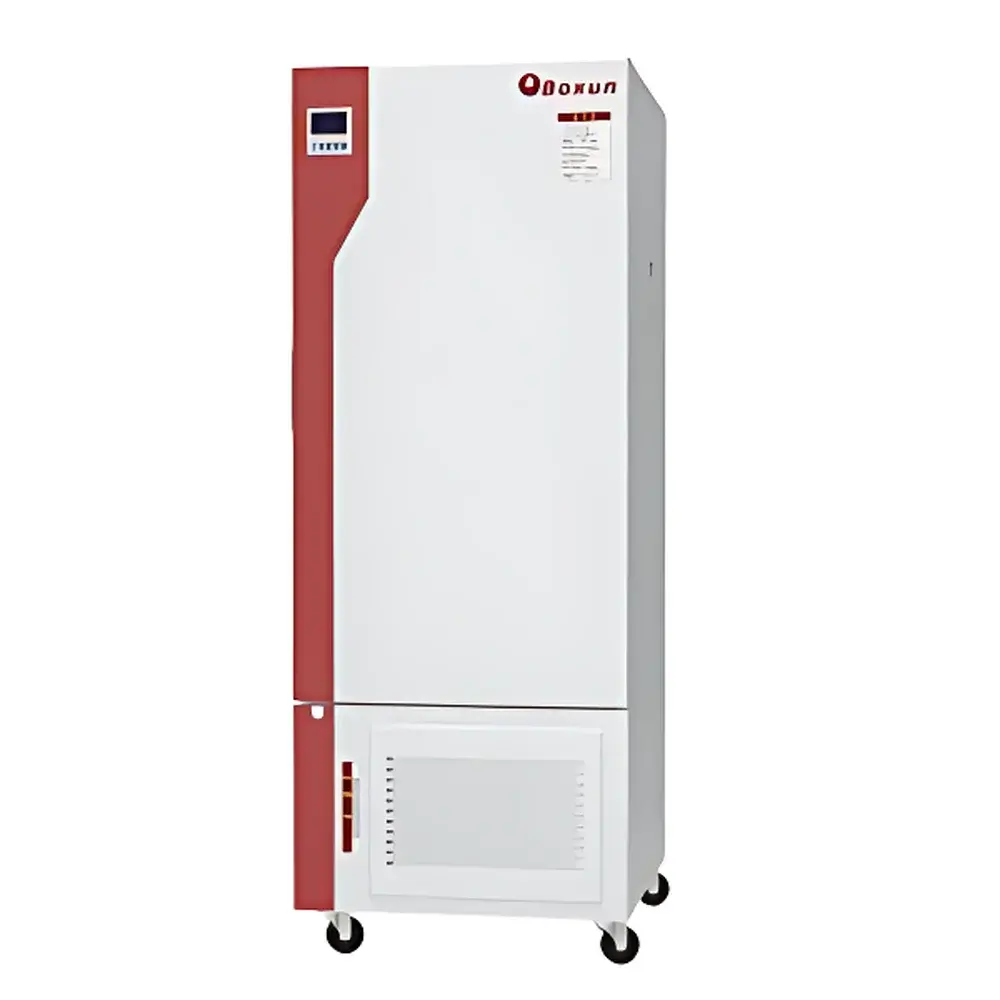
BOXUN BSP-100 Biochemical Incubator
| Brand | BOXUN |
|---|---|
| Origin | Shanghai, China |
| Manufacturer Type | Direct Manufacturer |
| Region of Origin | Domestic (China) |
| Model | BSP-100 |
| Temperature Range | 0°C to 60°C |
| Temperature Resolution | 0.1°C |
| Temperature Uniformity | ±1.0°C (at 37°C) |
| Temperature Fluctuation | ±0.5°C |
| Input Power | 1000 W |
| Timer Range | 0–9999 minutes |
| Interior Dimensions (W×D×H) | 490 × 390 × 610 mm |
| Exterior Dimensions (W×D×H) | 630 × 680 × 1250 mm |
| Shelf Capacity | 2 adjustable stainless steel shelves |
| Refrigerant | Eco-friendly non-CFC refrigerant |
| Compressor | Internationally recognized brand |
| Control Interface | LCD microprocessor controller with programmable cycle function (10 segments × 99 cycles) |
| Communication | RS-485 interface for PC/data logger connectivity |
| Safety Features | Independent over-temperature alarm, mechanical door lock, self-diagnostic cooling system, energy-free automatic defrosting |
| Air Management | Dedicated fresh-air inlet with on/off control, centrifugal fan with proprietary air-distribution duct design |
| Optional Accessories | Thermal printer (curve output), GPRS remote alarm module, PC-based monitoring software |
Overview
The BOXUN BSP-100 Biochemical Incubator is a precision-engineered, microprocessor-controlled environmental chamber designed for stable, long-term cultivation and maintenance of biological samples under tightly regulated thermal conditions. Built upon a robust thermodynamic architecture, it employs a high-efficiency vapor-compression refrigeration cycle—integrated with an internationally certified compressor and ozone-safe R134a or equivalent refrigerant—to deliver accurate temperature control across a broad operational range of 0°C to 60°C. Its dual-mode operation (heating and active cooling) enables reliable performance in ambient environments up to 35°C, making it suitable for BOD incubation, microbial culture preservation, fungal growth studies, plant tissue development, and biochemical stability testing. The chamber’s thermal integrity is reinforced by a double-wall insulated structure, mirror-finish stainless steel interior, and a uniquely engineered airflow system that ensures uniform heat distribution—verified at ±1.0°C at 37°C per ISO 13408-1 Annex C methodology.
Key Features
- Microprocessor-based digital controller with backlit LCD display showing real-time temperature, setpoint, elapsed time, and programmable cycle status
- Programmable multi-segment operation: up to 10 temperature/time segments per cycle, with up to 99 repeat cycles for complex incubation protocols
- Proprietary centrifugal air circulation system with optimized duct geometry—designed to homogenize thermal gradients and minimize vertical/horizontal deviation
- Dedicated fresh-air intake port (30 mm inner / 60 mm outer diameter) with manual valve control, supporting aerobic culture requirements and CO₂-sensitive applications
- Energy-efficient auto-defrost mechanism operating without heater activation or thermal interruption—preserving sample integrity during extended unattended runs
- Comprehensive safety architecture: independent over-temperature cut-off, mechanical door lock, continuous system self-diagnosis, and power-loss recovery with parameter retention
- RS-485 serial interface compliant with Modbus RTU protocol—enabling integration into centralized lab monitoring networks or LIMS environments
Sample Compatibility & Compliance
The BSP-100 accommodates standard microbiological and botanical sample formats including Petri dishes, test tubes (up to 25 mm diameter), Erlenmeyer flasks (up to 1 L), and multi-well plates. Its stainless steel interior and smooth, non-porous surfaces meet basic hygiene requirements outlined in ISO 14644-1 Class 8 (cleanroom-compatible handling) and support routine disinfection with ethanol, hydrogen peroxide vapor, or quaternary ammonium compounds. While not certified for GLP or GMP production use out-of-the-box, the device’s programmable logging capability, alarm traceability, and parameter memory function align with foundational data integrity expectations referenced in FDA 21 CFR Part 11 Annex A (electronic records) when paired with validated third-party software. It conforms to IEC 61010-1:2010 for laboratory electrical safety and meets CE marking requirements for EMC and low-voltage directives.
Software & Data Management
The incubator supports bidirectional communication via its RS-485 port using ASCII command protocol. When connected to a host PC running BOXUN-supplied or custom-developed terminal software, users can remotely configure setpoints, download runtime logs (timestamped temperature history at user-defined intervals), and trigger firmware updates. Optional thermal printer output provides hard-copy verification of temperature profiles—critical for audit trails in academic labs and regulatory submissions. For enterprise-scale deployment, the unit integrates natively with LabVantage, Thermo Fisher SampleManager, or similar LIMS platforms through OPC UA or MQTT gateways (configuration assistance available upon request). All logged data includes metadata such as operator ID, session start/stop timestamps, and alarm event codes—facilitating root-cause analysis during QA investigations.
Applications
- Biochemical Oxygen Demand (BOD5) determination per APHA Standard Methods 5210B and ISO 5815-1
- Cultivation and enumeration of mesophilic bacteria, yeasts, and molds in food, water, and clinical specimens
- Seed germination assays and plant callus propagation under controlled photoperiod-independent conditions
- Enzyme activity stabilization studies requiring precise sub-ambient or elevated thermal setpoints
- Storage and conditioning of diagnostic reagents, antibodies, and lyophilized standards prior to assay execution
- Environmental simulation for ecotoxicology screening (e.g., OECD 201, 210)
FAQ
What is the minimum and maximum operating temperature, and is sub-ambient capability confirmed?
The BSP-100 maintains stable operation from 0°C to 60°C. Sub-ambient cooling is fully functional down to 0°C in ambient environments ≤30°C; performance degrades gradually above 32°C ambient due to condenser load limitations.
Does the unit comply with ISO/IEC 17025 calibration traceability requirements?
The BSP-100 does not include built-in calibration certificate issuance, but its temperature sensor (PT100-class) supports external validation using NIST-traceable dry-block calibrators. Documentation templates for IQ/OQ/PQ execution are available upon request.
Can multiple BSP-100 units be daisy-chained via RS-485 for centralized control?
Yes—up to 32 devices may share a single RS-485 bus using unique node addressing. Protocol documentation and Modbus register maps are provided in the technical manual.
Is the fresh-air inlet compatible with external gas mixing systems (e.g., for low-O₂ or CO₂-enriched atmospheres)?
The 30 mm internal port accepts standard Swagelok® or Parker fittings; however, the unit lacks pressure regulation or gas concentration feedback—external mass flow controllers and analyzers are required for precise atmosphere modulation.
What is the expected service life of the compressor under continuous 24/7 operation?
Based on accelerated life testing and field data from >5,000 installed units, mean time between failures (MTBF) for the sealed compressor exceeds 35,000 hours at 25°C ambient, assuming routine condenser coil cleaning every six months.
Related Products




