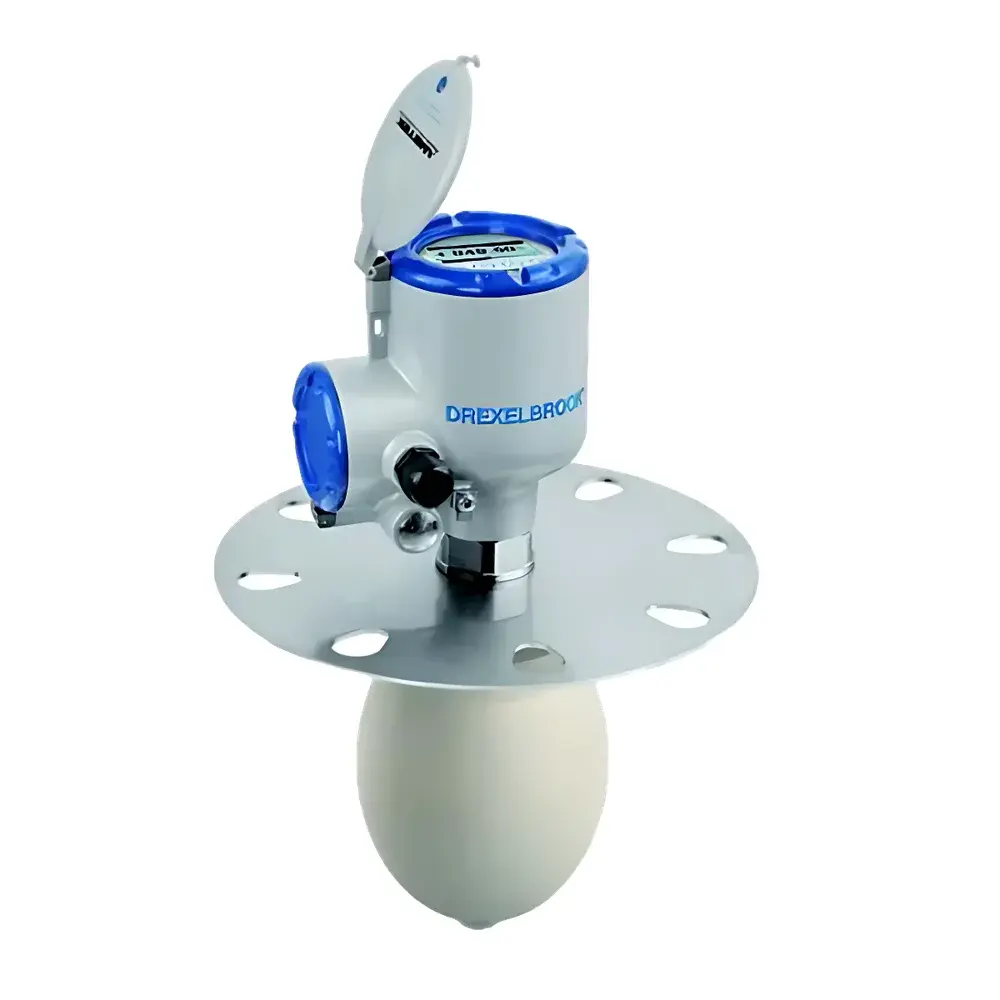
Drexelbrook DR6400 Series FMCW Radar Level Transmitter
| Brand | Drexelbrook |
|---|---|
| Frequency | 24 GHz |
| Measurement Principle | Frequency-Modulated Continuous Wave (FMCW) Radar |
| Antenna Options | 316L Stainless Steel Horn or PP Droplet-Shaped Antenna |
| Output Signal | 2-wire 4–20 mA with HART Protocol |
| Max. Measuring Range | 100 m |
| Accuracy | ±2 mm |
| Operating Pressure | –0.1 to 1.6 MPa |
| Operating Temperature | –50 °C to +130 °C |
| Compliance | Designed for SIL-2 capable systems per IEC 61508, ATEX/IECEx Zone 0/1, FM Class I Div 1 |
Overview
The Drexelbrook DR6400 Series is a high-performance, two-wire FMCW (Frequency-Modulated Continuous Wave) radar level transmitter engineered for continuous, non-contact measurement of solid bulk materials in demanding industrial silos, hoppers, and bins. Unlike pulse radar technologies, FMCW radar transmits a continuously sweeping frequency signal and computes distance by analyzing the frequency difference between the emitted and reflected waves—delivering superior signal-to-noise ratio, immunity to dust, vapor, and acoustic noise, and exceptional stability in low-dielectric applications (εᵣ ≥ 2.0). The DR6400 operates at 24 GHz, enabling narrow beam divergence (<10° typical with horn antenna), precise targeting of material surfaces, and reliable detection even in tall vessels with internal obstructions or steep pile angles. Its robust mechanical design supports operation across extreme ambient and process conditions—from cryogenic storage at –50 °C to high-temperature cement clinker handling up to +130 °C—and maintains accuracy under pressure differentials ranging from vacuum (–0.1 MPa) to 1.6 MPa gauge.
Key Features
- FMCW radar technology ensures high-resolution distance measurement with ±2 mm accuracy over ranges up to 100 m—critical for inventory reconciliation and mass balance calculations in bulk solids handling.
- Two-wire loop-powered architecture with integrated HART 7 protocol enables seamless integration into legacy DCS and PLC systems while supporting remote configuration, diagnostics, and firmware updates without additional wiring.
- Field-replaceable antenna options: corrosion-resistant 316L stainless steel horn antenna for high-temperature or abrasive environments; chemically inert polypropylene (PP) droplet-shaped antenna for low-dielectric powders and aggressive chemical exposure.
- No purge air or mechanical wipers required—eliminating maintenance dependencies associated with contact-based or optical sensors in dusty, humid, or sticky material applications.
- IP67-rated aluminum or stainless steel housing with optional explosion-proof certification (ATEX II 1G Ex ia IIC T6 Ga / IECEx ia IIC T6 Ga / FM Class I, Div 1, Groups A–D) for hazardous area deployment.
- Configurable echo processing algorithms—including dynamic clutter suppression, multi-echo filtering, and surface tracking logic—to distinguish true material surface returns from false echoes caused by ladders, agitators, or vessel walls.
Sample Compatibility & Compliance
The DR6400 is optimized for solid-level measurement across diverse particulate media including cement, fly ash, coal, plastic pellets, grain, limestone, and polymer powders. It performs reliably in applications where dielectric constants fall below 3.0—conditions that challenge many lower-frequency radar and ultrasonic solutions. The transmitter complies with electromagnetic compatibility standards EN 61326-1 (industrial environment) and functional safety requirements per IEC 61508 SIL-2 (hardware fault tolerance ≥ 1, safe failure fraction ≥ 90%). Documentation packages support validation under GMP/GLP frameworks, including traceable calibration certificates, FAT/SAT protocols, and audit-ready configuration logs compliant with FDA 21 CFR Part 11 electronic record requirements when used with certified host systems.
Software & Data Management
Configuration and diagnostics are performed via Drexelbrook’s PC-based DREXView™ software or through HART-compatible handheld communicators (e.g., Emerson 475, Endress+Hauser FieldCare). DREXView provides real-time echo curve visualization, adaptive parameter tuning (e.g., sensitivity, blanking distance, averaging time), and automated commissioning wizards for common silo geometries. All configuration changes are timestamped and user-logged, supporting full change control traceability. The device supports HART variable mapping for primary level, secondary temperature (if equipped with optional RTD input), signal quality index, and diagnostic status—enabling predictive maintenance alerts via asset monitoring platforms such as APM or DeltaV SIS.
Applications
- Cement and mineral processing: raw meal, clinker, gypsum, and slag level monitoring in vertical mills and surge silos.
- Power generation: coal and biomass bunker level control for boiler feed optimization.
- Chemical and plastics: additive, catalyst, and resin pellet inventory management in pressurized or nitrogen-purged vessels.
- Food & agriculture: grain, flour, sugar, and feedstock level assurance in outdoor silos subject to condensation and seasonal temperature swings.
- Waste-to-energy: refuse-derived fuel (RDF) and sewage sludge storage level feedback for feeding system synchronization.
FAQ
Does the DR6400 require recalibration after installation?
No—factory calibration is retained across power cycles and environmental shifts. Zero and span adjustments are only necessary if physical repositioning alters the reference plane or if application-specific echo characteristics demand fine-tuning.
Can it measure through foam or heavy dust layers?
FMCW radar penetrates most dry, non-conductive dust clouds but cannot resolve level beneath wet foam or conductive slurry layers. For such cases, guided wave radar (GWR) or capacitance alternatives may be evaluated.
Is third-party SIL verification documentation available?
Yes—TÜV-certified Functional Safety Assessment reports, hardware reliability data (PFH, PFD), and safety manual excerpts are provided upon request for system integrators performing LOPA or SIL allocation studies.
What mounting configurations are supported?
Top-mounted flanged (ANSI/EN/DIN), threaded (NPT/G), or sanitary clamp (Tri-Clamp®) interfaces are available. Optional extended antennas accommodate thick insulation or deep nozzles without compromising beam focus.
How does it handle changing dielectric properties during blending operations?
The DR6400’s adaptive gain control and multi-echo analysis maintain stable tracking across dielectric transitions—verified in applications involving co-fired ceramic powder blends and pharmaceutical excipient mixtures.