
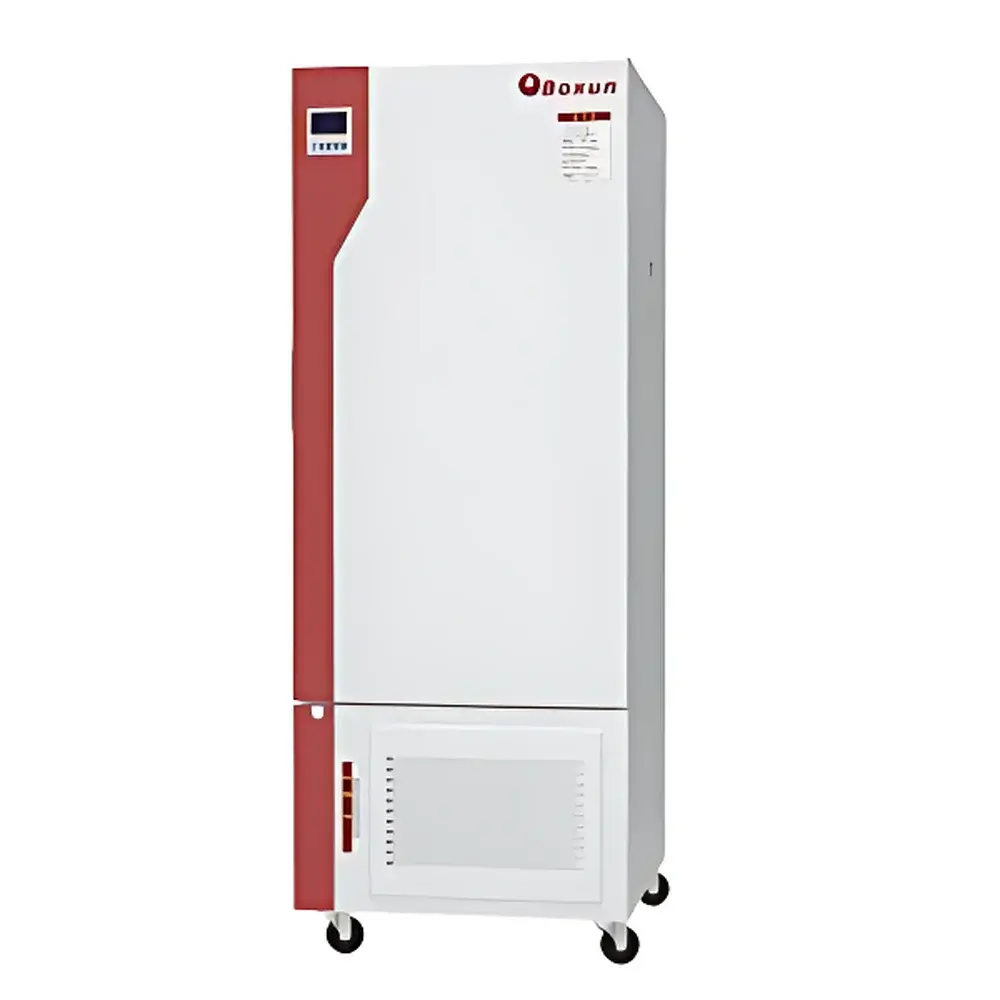
Boxun BSD-250 Orbital Shaking Incubator
| Brand | Boxun |
|---|---|
| Origin | Shanghai, China |
| Manufacturer Type | Direct Manufacturer |
| Product Origin | Domestic (China) |
| Model | BSD-250 |
| Price Range | USD 1,400 – 2,800 |
| Temperature Range | 0–60 °C |
| Temperature Uniformity | ±1 °C (at 37 °C) |
| Humidity Control | Not Available |
| Chamber Capacity | 250 L |
| Temperature Resolution | 0.1 °C |
| Temperature Fluctuation | ±0.5 °C |
| Power Input | 1150 W |
| Timer Range | 0–9999 min |
| Orbital Speed Range | 0–220 rpm (adjustable) |
| Reciprocating Frequency | 0–300 cpm (adjustable) |
| Orbit Diameter | 20 mm (orbital), 30 mm (reciprocating) |
| Shelf Dimensions (W×D×H) | 420×320×200 mm |
| Interior Dimensions (W×D×H) | 510×450×1100 mm |
| Exterior Dimensions (W×D×H) | 650×740×1726 mm |
| Standard Shelf Quantity | 1 |
| Cooling System | Hermetic Compressor with R134a Refrigerant |
| Air Exchange | Adjustable Independent Fresh-Air Intake |
| Interface | RS-485 for PC/Logger Connectivity |
| Data Protection | Power-Failure Parameter Memory & Auto-Restart Functionality |
| Programming | 10-Stage, 99-Cycle Programmable Profile |
| Safety | Mechanical Door Lock, Over-Temperature Alarm, Self-Diagnostic Cooling System, Energy-Efficient Defrosting |
Overview
The Boxun BSD-250 Orbital Shaking Incubator is an integrated environmental control system engineered for precise temperature-regulated cultivation of microbial, cellular, and biochemical samples under dynamic agitation conditions. Designed around a dual-function platform—combining stable thermal management with programmable mechanical oscillation—it supports both orbital shaking (0–220 rpm, 20 mm orbit) and reciprocating motion (0–300 cpm, 30 mm stroke), enabling method flexibility across aerobic fermentation, suspension cell culture, enzyme kinetics, and BOD incubation protocols. Its 250 L stainless-steel chamber (510 × 450 × 1100 mm interior) operates within a 0–60 °C range with ±0.5 °C fluctuation and ±1 °C uniformity at 37 °C—validated per ISO 15189 and ASTM E1545-20 calibration guidelines for laboratory incubators. The unit employs a hermetically sealed R134a refrigeration system with patented non-energy-consuming defrost logic, eliminating thermal disturbance during extended operation—a critical requirement for uninterrupted microbial growth studies.
Key Features
- Microprocessor-based PID temperature control with 0.1 °C resolution and real-time LCD display of setpoint, actual temperature, elapsed time, and alarm status
- Dual-mode agitation system: independently adjustable orbital (0–220 rpm) and reciprocating (0–300 cpm) motion, both with fixed amplitude options (20 mm or 30 mm)
- Optimized air circulation architecture featuring centrifugal blower and proprietary baffle-guided airflow path, ensuring rapid thermal equilibration and spatial uniformity
- Modular stainless-steel interior with removable, height-adjustable shelf (420 × 320 × 200 mm load surface); polished mirror-finish 304 stainless steel walls resist corrosion and simplify decontamination
- Dedicated fresh-air inlet valve (30 mm inner / 60 mm outer diameter ports on left/right side panels) enables controlled atmospheric exchange without compromising chamber integrity
- RS-485 serial interface compliant with Modbus RTU protocol for integration into centralized lab monitoring systems or third-party data loggers
- Comprehensive safety suite: mechanical door lock, over-temperature cutoff, self-diagnostic cooling subsystem, and non-volatile memory preserving all operational parameters after power interruption
Sample Compatibility & Compliance
The BSD-250 accommodates standard microbiological vessels—including Erlenmeyer flasks (up to 2 L), test tubes, multi-well plates, and petri dishes—on its single reinforced shelf. Its absence of humidity control restricts use to applications where ambient RH suffices (e.g., bacterial broth cultures, yeast propagation, algal suspensions). The device conforms to IEC 61010-1:2010 for electrical safety in laboratory equipment and meets CE marking requirements for EMC (EN 61326-1) and low-voltage directive compliance. While not certified for GLP/GMP production environments, its programmable profile logging, parameter retention, and RS-485 audit trail support traceability in QA/QC labs adhering to ISO/IEC 17025 standards.
Software & Data Management
No proprietary software is bundled; however, the RS-485 interface allows connection to industry-standard SCADA platforms (e.g., LabVIEW, WinCC, or custom Python-based acquisition tools) via Modbus register mapping. All user-defined settings—including 10-segment temperature/time ramps, oscillation profiles, and timer configurations—are stored in EEPROM and retained across power cycles. Optional accessories include thermal printer modules (supporting real-time curve output) and GPRS-enabled SMS alert transceivers for remote fault notification (e.g., temperature deviation >±2 °C, door open >60 s). Audit-ready event logs—timestamped entries for alarms, mode changes, and manual overrides—can be exported via serial dump for regulatory review.
Applications
- Biochemical oxygen demand (BOD5) testing per APHA Standard Methods 5210B and ISO 5815-1:2019, using dilution water incubation at 20 °C with continuous shaking
- Microbial culture maintenance for Escherichia coli, Bacillus subtilis, and fungal isolates requiring aeration-dependent growth
- Suspension-based mammalian cell line expansion (e.g., CHO, HEK293) under low-shear orbital agitation
- Enzyme assay optimization involving temperature-dependent reaction kinetics with simultaneous mixing
- Aquatic toxicity screening and phytoplankton growth studies under controlled thermal and agitation regimes
- Seed germination and plant tissue culture pre-incubation where gentle agitation enhances nutrient diffusion
FAQ
Does the BSD-250 support humidity control?
No. This model is a dry-shaking incubator and does not include humidification or condensation management systems.
Can multiple shaking modes operate simultaneously?
No. Orbital and reciprocating motions are mutually exclusive; users must select one mode per operating cycle.
Is the RS-485 interface compatible with FDA 21 CFR Part 11 requirements?
The interface itself is hardware-level compliant; full Part 11 adherence requires implementation of electronic signature, audit trail, and access control layers at the host software level.
What is the maximum flask size supported on the standard shelf?
Two 2 L Erlenmeyer flasks (with baffles) can be accommodated side-by-side while maintaining balanced rotation and clearance from chamber walls.
How often does the auto-defrost cycle activate?
Defrosting occurs only when frost accumulation is detected by the evaporator sensor—typically every 72–120 hours under continuous 37 °C operation—and completes without interrupting chamber temperature stability.




