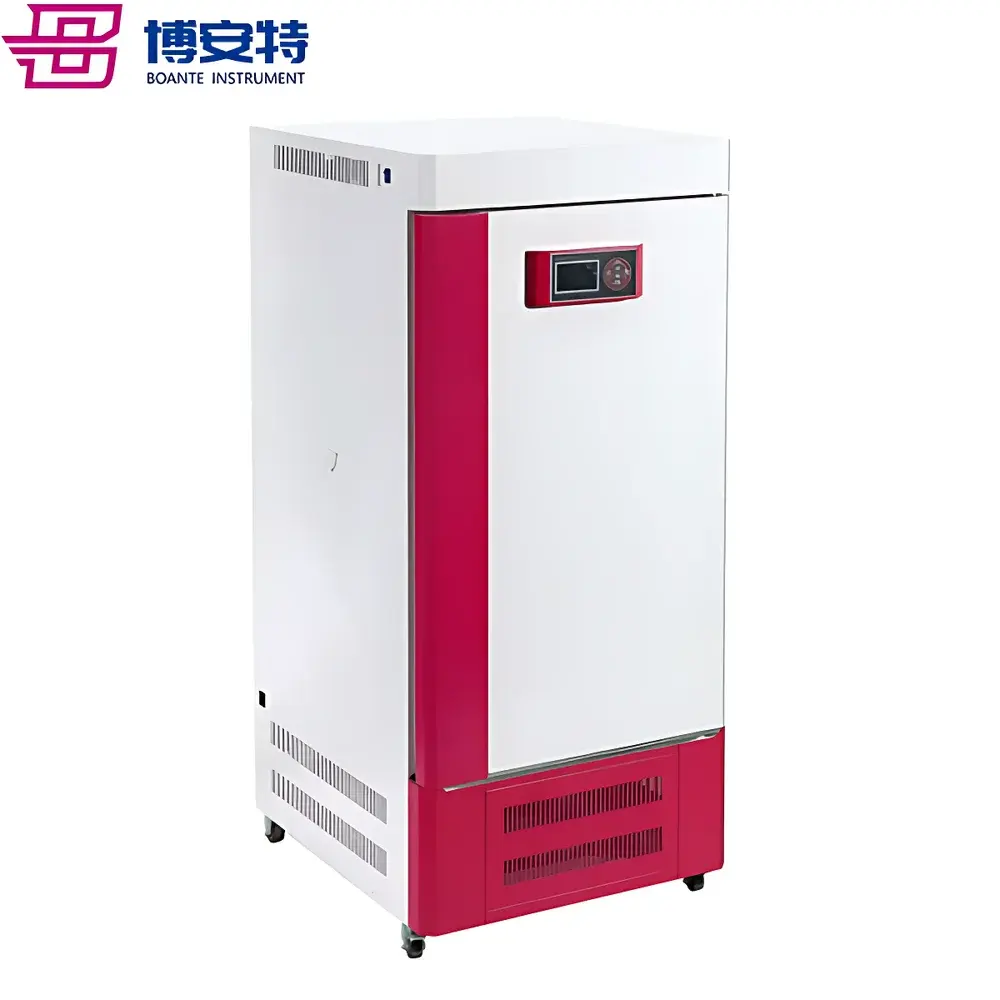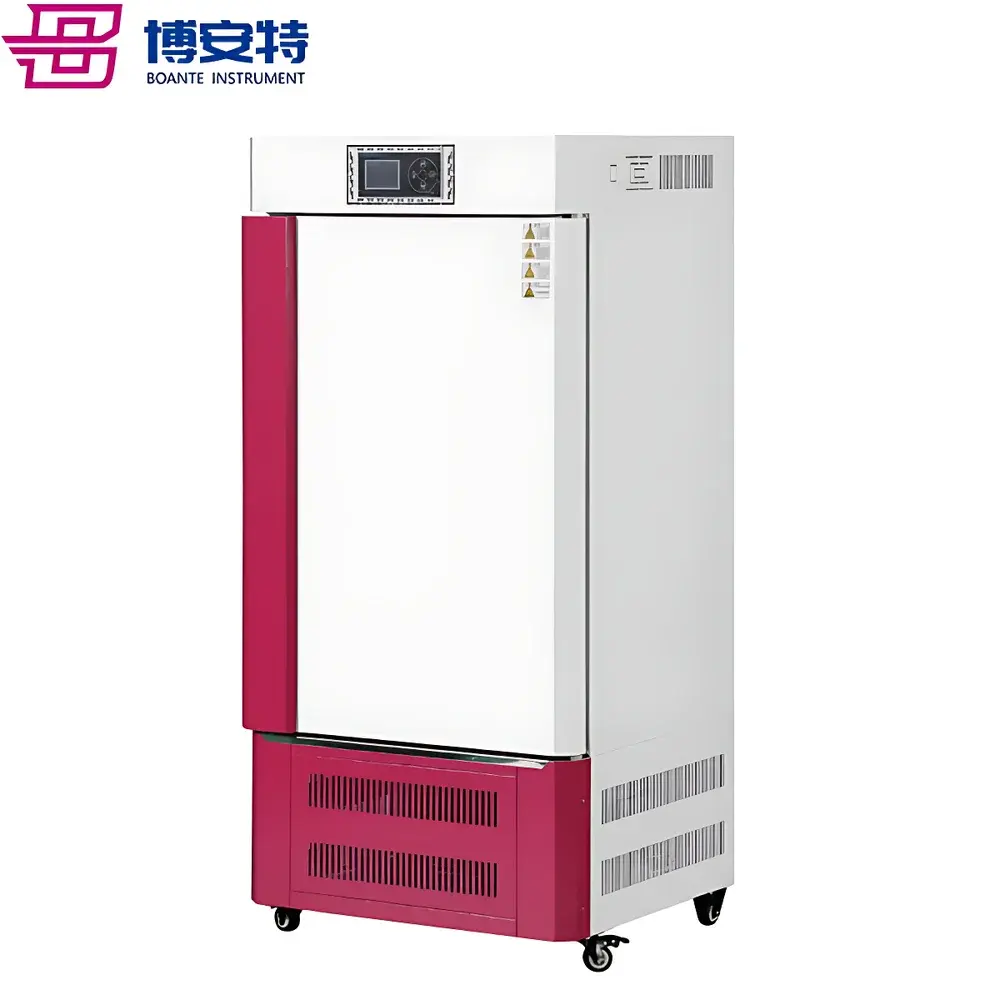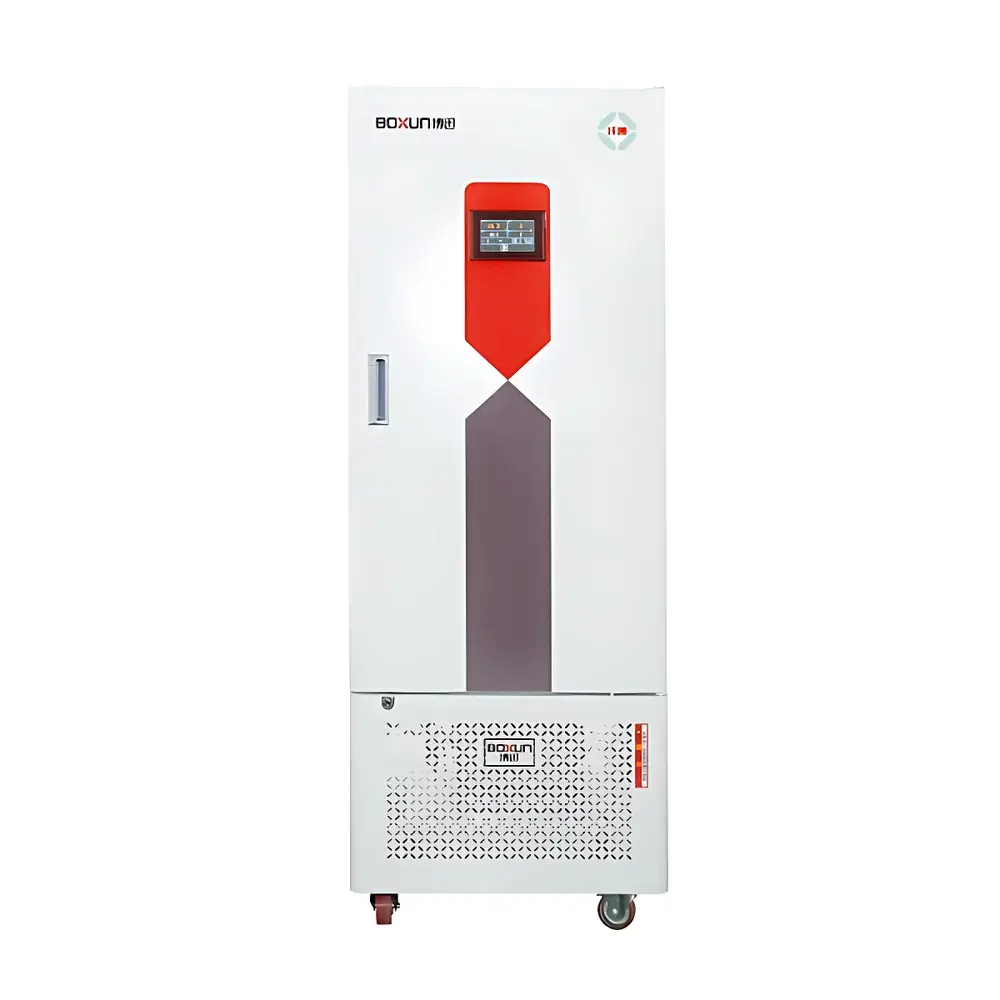
BOXUN BGQ-400 Biochemical Incubator
| Brand | BOXUN |
|---|---|
| Origin | Shanghai, China |
| Manufacturer Type | Direct Manufacturer |
| Region of Origin | Domestic (China) |
| Model | BGQ-400 |
| Heating Method | Air-jacketed |
| Cooling Method | Compressor-based |
| Air Circulation | Forced convection |
| Temperature Range | 0–80 °C |
| Temperature Stability | ±0.3 °C (heating), ±0.5 °C (cooling) |
| Temperature Uniformity | ±0.8 °C at 25 °C |
| Capacity | 400 L |
| External Dimensions | 745 × 930 × 1695 mm |
| Internal Dimensions | 600 × 640 × 1050 mm |
| Power Input | 1350 W |
| Timer Range | 0–9999 min/h (switchable) |
| Calendar-based Scheduling | Yes |
| Programmable Control | 30 segments, 99 cycles |
| Resolution | 0.1 °C |
| Fan Speed Levels | 6 adjustable levels |
| Standard Shelves | 4 (max. 7), load capacity per shelf: 15 kg |
| Illumination | 8 W waterproof LED interior lamp |
| Data Storage | Onboard non-volatile memory (≥5 years), USB export in immutable file format |
| Communication Interfaces | 1 × USB, 2 × RS-485 |
| Safety Features | Independent over-temperature cut-off, door-open alarm, sensor fault detection, compressor overheat protection, overload & earth-leakage protection |
| Compliance Reference | GB/T 28851–2012 |
Overview
The BOXUN BGQ-400 Biochemical Incubator is an engineered environmental control system designed for precise, stable, and traceable temperature management in life science laboratories. It operates on a dual-mode thermal regulation principle—air-jacketed heating combined with a variable-frequency compressor-based cooling system—enabling continuous, frost-free operation across its full 0–80 °C range. Unlike natural convection units, the BGQ-400 employs forced-air circulation with six independently adjustable fan speed levels, ensuring optimal airflow distribution while minimizing evaporative stress on sensitive biological samples such as microbial cultures, enzyme assays, and cell-based reagents. Its structural compliance with GB/T 28851–2012—a national standard governing performance, safety, and metrological requirements for biochemical incubators—confirms its suitability for regulated environments where reproducibility and documentation integrity are essential.
Key Features
- Intelligent BRIGHT I control system with adaptive parameter compensation based on ambient environmental shifts, improving long-term thermal consistency without manual recalibration.
- 5-inch capacitive LCD touchscreen interface with intuitive navigation, multilevel password protection (administrator/operator/user tiers), and real-time graphical display of setpoint, actual temperature, and operational status.
- Onboard non-volatile memory retains ≥5 years of timestamped temperature logs and event records—including parameter modifications, alarm triggers (e.g., over-temperature, door open, sensor failure), and maintenance alerts—without reliance on external storage media.
- Immutable data export via USB: All logged data and event histories are exported in write-protected, tamper-evident file formats compliant with ALCOA+ principles (Attributable, Legible, Contemporaneous, Original, Accurate, Complete, Consistent, Enduring, Available), supporting audit readiness under GLP and GMP frameworks.
- Dual-layer door architecture with full-view tempered glass inner door minimizes thermal disturbance during visual inspection; integrated condensate recovery systems (inner door + chamber base) prevent water accumulation and cross-contamination.
- Service-oriented design includes front-accessible compressor condenser cleaning port, rounded internal corners for CIP-compatible wiping, dual 30-mm calibration ports (left/right sidewalls), and a built-in 220 V IPX4-rated power outlet for auxiliary equipment integration.
Sample Compatibility & Compliance
The BGQ-400 accommodates a broad spectrum of biological and biochemical specimens—including bacterial and fungal cultures, tissue explants, diagnostic reagent stability studies, and enzymatic activity assays—across both sub-ambient and elevated temperature regimes. Its ±0.8 °C uniformity at 25 °C and ±0.3 °C stability under heating conditions meet typical requirements for ISO/IEC 17025-accredited testing laboratories performing method validation or reference material conditioning. The unit’s mechanical lock mechanism, independent over-temperature cutoff (non-software dependent), and comprehensive alarm hierarchy (including door-open, sensor fault, and compressor overheat) align with risk-mitigation expectations outlined in ICH Q5C and USP . While not certified to FDA 21 CFR Part 11 out-of-the-box, its immutable audit trail architecture and electronic signature-ready logging infrastructure provide a validated foundation for subsequent qualification under Part 11 Annex 11 or EU GMP Annex 11.
Software & Data Management
The embedded BRIGHT I operating system supports calendar-based scheduling (public-date programming), multi-stage ramp-soak profiles (30 segments × 99 cycles), and configurable alarm thresholds. All user interactions—including menu navigation, setpoint changes, and manual overrides—are time-stamped and archived in onboard flash memory. Data export via USB generates cryptographically hashed log files (.csv + .log) with digital signatures verifying content integrity and chronological sequence. No cloud connectivity or remote access is implemented, preserving data sovereignty and simplifying cybersecurity validation. RS-485 interfaces enable integration into centralized facility monitoring systems (e.g., Siemens Desigo, Honeywell Experion) using Modbus RTU protocol for real-time telemetry and alarm forwarding.
Applications
- Microbiological quality control in pharmaceutical manufacturing (e.g., growth promotion testing per USP , bioburden enumeration).
- Stability testing of diagnostic kits, vaccines, and therapeutic proteins per ICH Q1A(R2) and Q5C guidelines.
- Enzyme kinetics studies requiring tightly controlled thermal environments between 4 °C and 60 °C.
- Long-term storage and activation of lyophilized cultures and reference strains under defined humidity-adjacent conditions (when used with optional humidity module).
- Environmental simulation for material compatibility assessments—e.g., polymer degradation, packaging permeability, or adhesive curing kinetics.
FAQ
Does the BGQ-400 support 21 CFR Part 11-compliant electronic records?
It provides foundational capabilities—immutable audit trails, user authentication, and exportable tamper-proof logs—but requires site-specific validation and procedural controls (e.g., SOPs, role-based access policies) to achieve full Part 11 compliance.
What is the maximum number of shelves supported, and what is the weight limit per shelf?
Up to seven adjustable stainless-steel shelves can be installed; each supports a static load of 15 kg.
Is the temperature sensor calibrated traceable to NIST or other national standards?
The unit ships with a factory calibration certificate referencing ISO/IEC 17025-accredited reference standards; end-user requalification must follow internal SOPs or third-party metrology service protocols.
Can the incubator operate continuously at 4 °C or 65 °C?
Yes—its compressor-driven refrigeration and air-jacketed heating enable uninterrupted operation across the entire 0–80 °C range, including sustained sub-ambient and high-temperature setpoints.
Are firmware updates available, and how are they deployed?
Firmware upgrades are distributed via secure BOXUN technical support channels and installed locally using USB; version history and change logs are provided with each release to support configuration management.
Related Products