
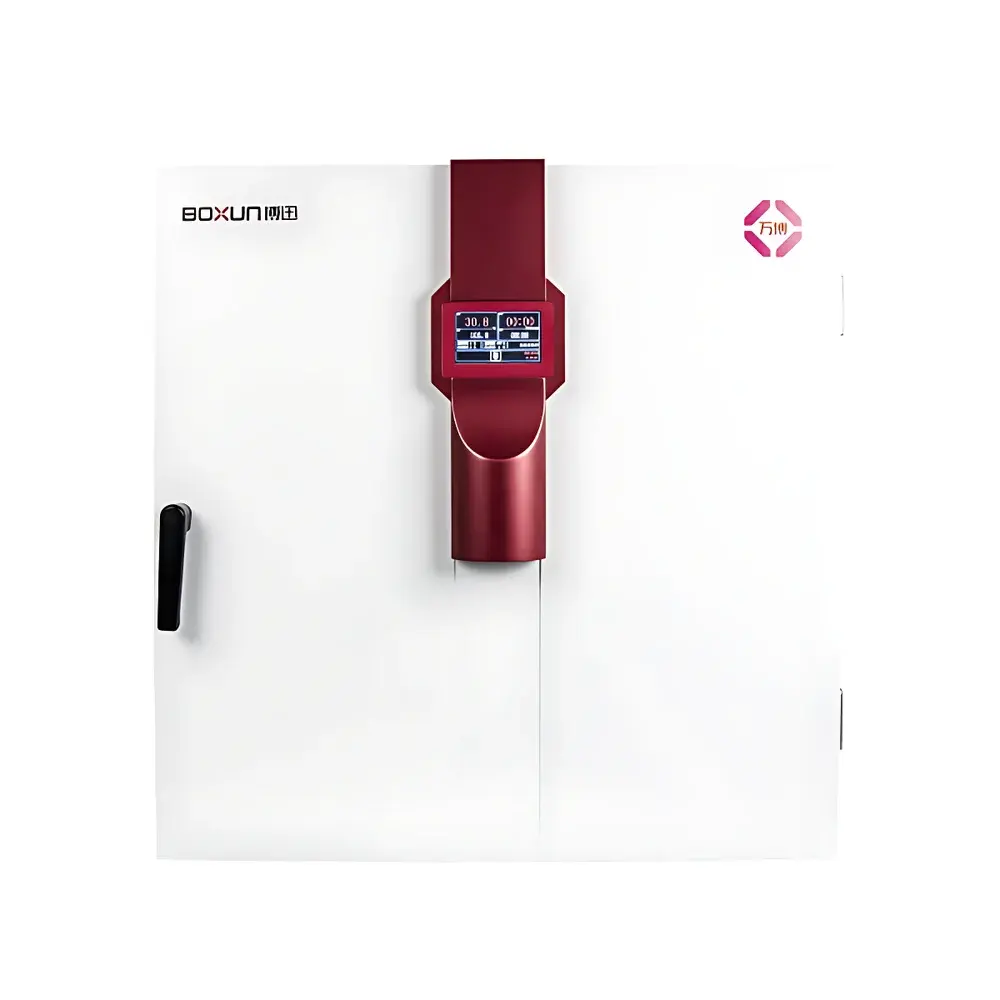
BOXUN BGH-130S Precision Programmable Drying Oven
| Brand | BOXUN |
|---|---|
| Origin | Shanghai, China |
| Manufacturer Type | Direct Manufacturer |
| Product Category | Domestic |
| Model | BGH-130S |
| Instrument Type | Precision Drying Oven |
| Temperature Range | RT+5 to 300 °C |
| Temperature Fluctuation | ±0.3 °C |
| External Dimensions (L×W×H, mm) | 735×658×757 |
| Internal Dimensions (L×W×H, mm) | 570×400×570 |
| Temperature Resolution | 0.1 °C |
| Chamber Material | Stainless Steel (AISI 304) |
| Heating Method | Forced-Air Circulation |
| Temperature Uniformity | ±1.9 °C |
| Chamber Volume | 129 L |
| Power Rating | 1.8 kW |
| Standard Shelves | 2 (max. 7) |
| Shelf Load Capacity | 25 kg per shelf |
| Stacking Support | Yes (up to 2 units) |
| Ramp/Soak Programming | 30 segments × 99 cycles |
| Ventilation Control | Motorized 10-step adjustable exhaust damper |
| Fan Speed Control | 6-step variable-speed blower |
| Data Storage Capacity | 4 million records |
| Interface Ports | Dual RS-485, 1×USB |
| Optional | Inlet/Exhaust HEPA Filters |
Overview
The BOXUN BGH-130S Precision Programmable Drying Oven is an engineered-for-reliability thermal processing system designed for laboratories requiring strict thermal control in drying, curing, annealing, and stabilization applications. Based on forced-air convection thermodynamics, the oven maintains stable temperature profiles through a dual-sensor feedback loop and independent overtemperature protection architecture. Its chamber employs a preheated air mixing cavity upstream of the working zone—ensuring rapid thermal equilibration (<20 min to 150 °C) and minimizing thermal gradients across the load. The stainless steel (AISI 304) interior, combined with 50 mm aluminum-foil-wrapped mineral fiber insulation and zero-glass-fiber leakage construction, meets ISO 14644-1 Class 5 cleanroom compatibility requirements. With a usable volume of 129 L and optimized airflow distribution, the BGH-130S supports reproducible thermal treatment of pharmaceutical intermediates, polymer samples, ceramic precursors, and moisture-sensitive analytical standards.
Key Features
- 5-inch high-resolution capacitive touchscreen running BRIGHT II intelligent OS — enabling real-time parameter adjustment, environmental compensation algorithms, and intuitive multi-level navigation
- Programmable ramp/soak functionality: up to 30 temperature/time segments per cycle, repeatable over 99 cycles — suitable for ASTM E2251-compliant thermal profiling
- Dual overtemperature protection: primary control via Pt100 sensor array + secondary independent mechanical thermal cutoff switch — certified for unattended operation under GLP conditions
- Motorized 10-step exhaust damper and 6-step variable-speed centrifugal blower — enabling precise control of air exchange rate (ACH) and cross-flow velocity to suppress dust dispersion during powder drying
- Preheated air mixing chamber and radial airflow design — achieving ±1.9 °C uniformity at 150 °C (measured per ISO 17025-accredited mapping protocol)
- Rotary two-point door locking mechanism with high-compression silicone gasket — ensuring >99.9% sealing efficiency and minimal heat loss during extended dwell periods
- Drawer-type adjustable shelves with tool-free removal — supporting ergonomic loading/unloading and full chamber accessibility for cleaning validation (e.g., residue swab testing)
Sample Compatibility & Compliance
The BGH-130S accommodates diverse sample formats including Petri dishes, crucibles, glass vials, metal trays, and porous ceramic substrates. Its smooth-radius internal corners and seamless welds prevent particle entrapment, facilitating compliance with FDA 21 CFR Part 11 data integrity requirements when paired with audit-trail-enabled software. The optional HEPA-filtered inlet/exhaust configuration allows integration into ISO Class 5–7 controlled environments. All thermal performance specifications—including temperature fluctuation (±0.3 °C), recovery time (8 s after 30 s perturbation at 150 °C), and uniformity—are verified per IEC 60068-3-5 and validated using NIST-traceable Class A PT100 probes. The unit conforms to CE marking directives (2014/30/EU EMC, 2014/35/EU LVD) and RoHS 2011/65/EU material restrictions.
Software & Data Management
Data logging operates continuously at user-selectable intervals (1–600 s), storing up to 4 million timestamped records internally. Logged parameters include chamber temperature, setpoint, fan speed, damper position, alarm status, and event timestamps. Export is supported via USB mass storage in immutable .CSV format — preserving file integrity for regulatory review. The dual RS-485 interfaces enable Modbus RTU integration with centralized laboratory information management systems (LIMS) or SCADA platforms. Optional PC-based software provides graphical trend analysis, deviation reporting, and electronic signature support aligned with ALCOA+ principles (Attributable, Legible, Contemporaneous, Original, Accurate, Complete, Consistent, Enduring, Available).
Applications
- Moisture content determination per USP and ASTM D2298
- Thermal stability assessment of APIs and excipients under ICH Q1A(R2) guidelines
- Curing of epoxy-coated substrates and printed circuit board laminates
- Pre-drying of gravimetric filters prior to particulate matter analysis (EPA Method 201A)
- Conditioning of reference standards for calibration traceability (ISO/IEC 17025 Clause 7.7)
- Accelerated aging studies for packaging materials per ASTM F1980
FAQ
Does the BGH-130S support 21 CFR Part 11-compliant electronic records?
Yes — when used with the optional validated software package, it provides role-based access control, audit trails, and electronic signatures meeting FDA 21 CFR Part 11 Subpart B requirements.
Can multiple ovens be networked for centralized monitoring?
Yes — via RS-485 Modbus RTU daisy-chaining, up to 32 units can be integrated into a single supervisory interface.
What is the maximum allowable ambient temperature for continuous operation?
The unit is rated for ambient temperatures up to 35 °C and relative humidity ≤80% non-condensing, as specified in IEC 60068-2-1.
Is IQ/OQ documentation available for GMP environments?
Standard factory-issued IQ/OQ protocols are provided; PQ execution templates and witness logs are included for user-specific validation.
How is temperature uniformity verified during installation qualification?
A 9-point sensor mapping protocol (per ISO 17025 Annex A.4) is recommended, using calibrated Class A PT100 probes positioned at defined geometric locations within the loaded chamber.



