
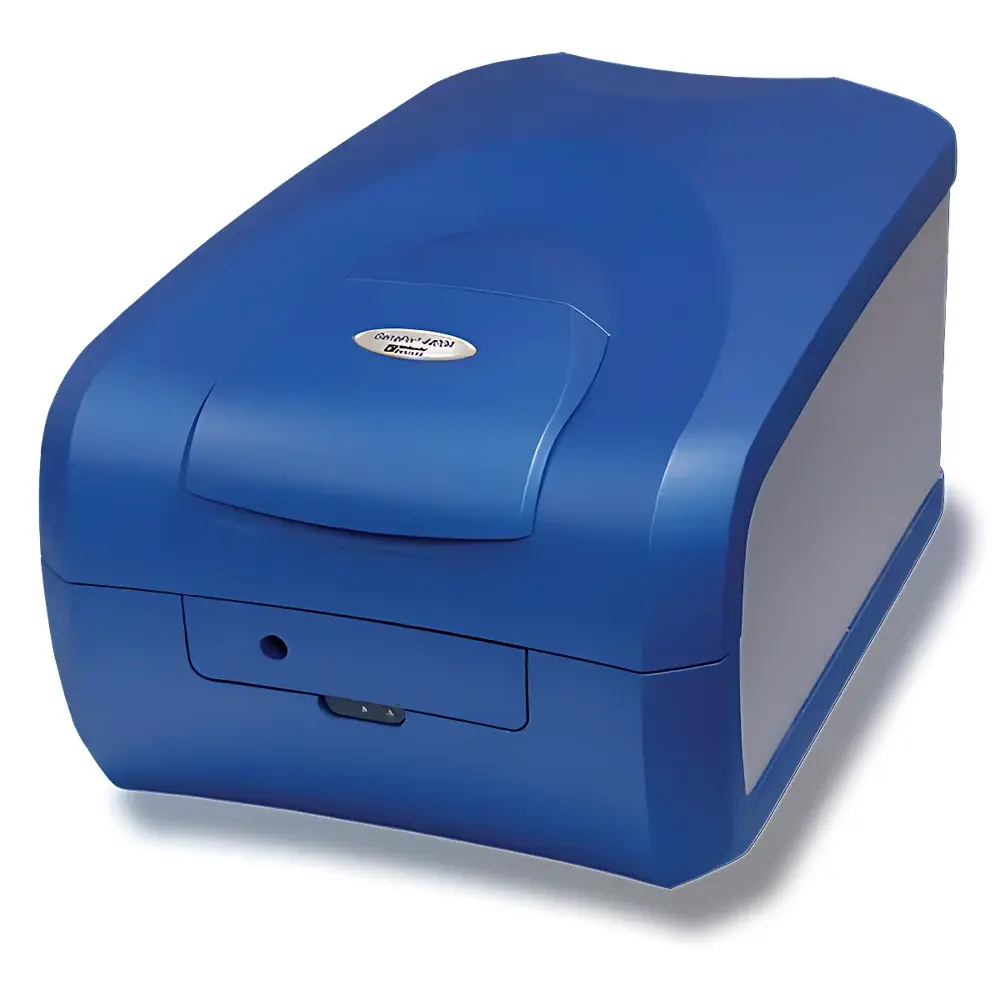
Molecular Devices GenePix 4300A & 4400A Microarray Scanner
| Brand | Molecular Devices |
|---|---|
| Origin | USA |
| Manufacturer Type | Original Equipment Manufacturer (OEM) |
| Product Category | Imported Instrument |
| Model | GenePix 4300A & GenePix 4400A |
| Instrument Type | Microarray Scanning System |
| Optical Resolution | 2.5–100 µm/pixel (selectable, 4300A base: 5 µm/pixel, upgradable to 2.5 µm/pixel) |
| Laser Sources | Up to 4 solid-state and gas lasers |
| Emission Filter Wheel | 16-bit, 12-position |
| Detection Technology | Non-confocal epifluorescence scanning with PMT detection |
| Bit Depth | 16-bit per channel |
| Software Suite | GenePix Pro (image acquisition & primary analysis), Acuity (advanced bioinformatics & statistical analysis) |
Overview
The Molecular Devices GenePix 4300A and GenePix 4400A are high-performance microarray scanners engineered for precision fluorescence imaging of DNA, RNA, protein, tissue, and cell-based microarrays. These instruments employ a non-confocal epifluorescence scanning architecture—optimized specifically for planar, surface-bound biomolecular assays—where uniform illumination and high signal collection efficiency are critical. Unlike confocal systems designed for thick-section 3D reconstruction, the GenePix platform prioritizes wide-field optical throughput, minimal photobleaching, and robust signal linearity across heterogeneous substrate topographies (e.g., membrane-bound, embedded, or unevenly coated slides). The system captures quantitative fluorescence intensity data at pixel-level resolution, supporting downstream quantification of hybridization efficiency, expression levels, binding affinities, and spatial biomarker distribution. Its optical design integrates low-noise photomultiplier tube (PMT) detectors, high-transmission bandpass filters, and digitally stabilized laser diodes to deliver reproducible, calibrated intensity values compliant with quantitative microarray standards.
Key Features
- Adjustable optical resolution from 2.5 µm/pixel to 100 µm/pixel (GenePix 4400A); GenePix 4300A supports 5 µm/pixel out-of-box with field-upgrade path to 2.5 µm/pixel
- Four independently controllable laser sources (solid-state and gas), enabling simultaneous or sequential excitation of diverse fluorophores including Cy3®, Cy5®, FITC, GFP, Texas Red®, Alexa Fluor® dyes, and quantum dots
- 16-bit, 12-position emission filter wheel with automated indexing—facilitating rapid method switching and future expansion without manual alignment
- Auto-PMT gain balancing across all channels ensures consistent dynamic range and inter-channel signal normalization within a single scan
- 6-point precision slide holder with kinematic mounting minimizes mechanical drift and eliminates focus instability during auto-focusing—critical for fragile or warped substrates
- Laser power adjustable in 1% increments; real-time laser output monitoring and automatic compensation correct for thermal drift and aging effects
- High-duty-cycle voice-coil actuators and optimized thermal management extend motor service life and reduce positional jitter during high-speed raster scanning
Sample Compatibility & Compliance
The GenePix 4300A/4400A accommodates standard microscope slides (25 × 75 mm), custom-format arrays, membrane-based blots (nitrocellulose, PVDF), and non-transparent substrates—including glass, silicon, polymer, and metal-coated chips—without requiring transmissive optics. Focusing is fully programmable and adaptable to variable substrate thicknesses and surface topography, supporting applications such as comparative genomic hybridization (aCGH), NimbleGen® high-density arrays, antibody microarrays, glycan arrays, and tissue microarrays (TMAs). The system meets essential requirements for GLP- and GMP-aligned workflows: raw image metadata (including laser power, PMT voltage, filter position, exposure time, and calibration timestamp) is embedded in TIFF headers and preserved through export. When paired with GenePix Pro software configured for audit trail logging, the platform supports compliance with FDA 21 CFR Part 11 for electronic records and signatures in regulated environments.
Software & Data Management
Acquisition and analysis are unified via GenePix Pro software—a validated, instrument-integrated application that controls hardware parameters in real time, performs on-the-fly gridding, spot finding, background subtraction, and ratio-based quantification. All scan logs, ROI definitions, and QC metrics (e.g., signal-to-background ratio, coefficient of variation per feature, grid registration error) are stored in structured .gpr files compatible with MIAME-compliant repositories. Optional Acuity software extends analytical capability with hierarchical clustering, principal component analysis (PCA), ANOVA, false discovery rate (FDR) correction, pathway enrichment mapping, and relational database integration (ODBC/JDBC). Both applications support batch processing, script automation (via JavaScript API), and export to common formats (CSV, TXT, MAGE-TAB, BED) for interoperability with R/Bioconductor, Python (Scanpy, scikit-learn), and commercial LIMS platforms.
Applications
- DNA microarray analysis: gene expression profiling, SNP genotyping, methylation screening, and exon-level splicing detection
- Protein microarrays: antibody validation, autoantibody profiling, cytokine multiplexing, and post-translational modification mapping
- Tissue microarrays (TMAs): digital pathology quantification of immunohistochemical (IHC) staining intensity and spatial heterogeneity
- Glycomics and metabolomics arrays: lectin-binding assays, carbohydrate-protein interaction studies, and small-molecule target engagement screens
- Quality control of array manufacturing: spot morphology assessment, printing uniformity evaluation, and lot-to-lot reproducibility verification per ISO/IEC 17025 guidelines
FAQ
What distinguishes the GenePix 4300A from the 4400A model?
The GenePix 4400A offers expanded resolution flexibility (2.5–100 µm/pixel) and enhanced motor control firmware for higher throughput scanning of ultra-dense arrays; the 4300A provides fixed 5 µm/pixel resolution with an upgrade path to 2.5 µm/pixel.
Can the scanner handle non-glass substrates such as membranes or polymer slides?
Yes—the non-confocal epifluorescence design enables direct surface imaging of opaque and semi-transparent substrates without transmission optics or index-matching fluids.
Is laser recalibration required between experiments?
No—integrated laser power sensors and closed-loop feedback continuously adjust output to maintain stability; factory calibration is retained over >10,000 hours of operation.
How does the system ensure quantitative comparability across multiple scans or instruments?
Each scan embeds NIST-traceable calibration metadata; optional reference slide kits (e.g., GenePix Calibration Slides) enable cross-instrument normalization and longitudinal study consistency.
Does GenePix Pro support automated QC flagging based on user-defined thresholds?
Yes—customizable QC rules (e.g., spot saturation %, foreground/background CV, grid shift tolerance) trigger automatic annotation and exclusion of substandard features during acquisition.




