
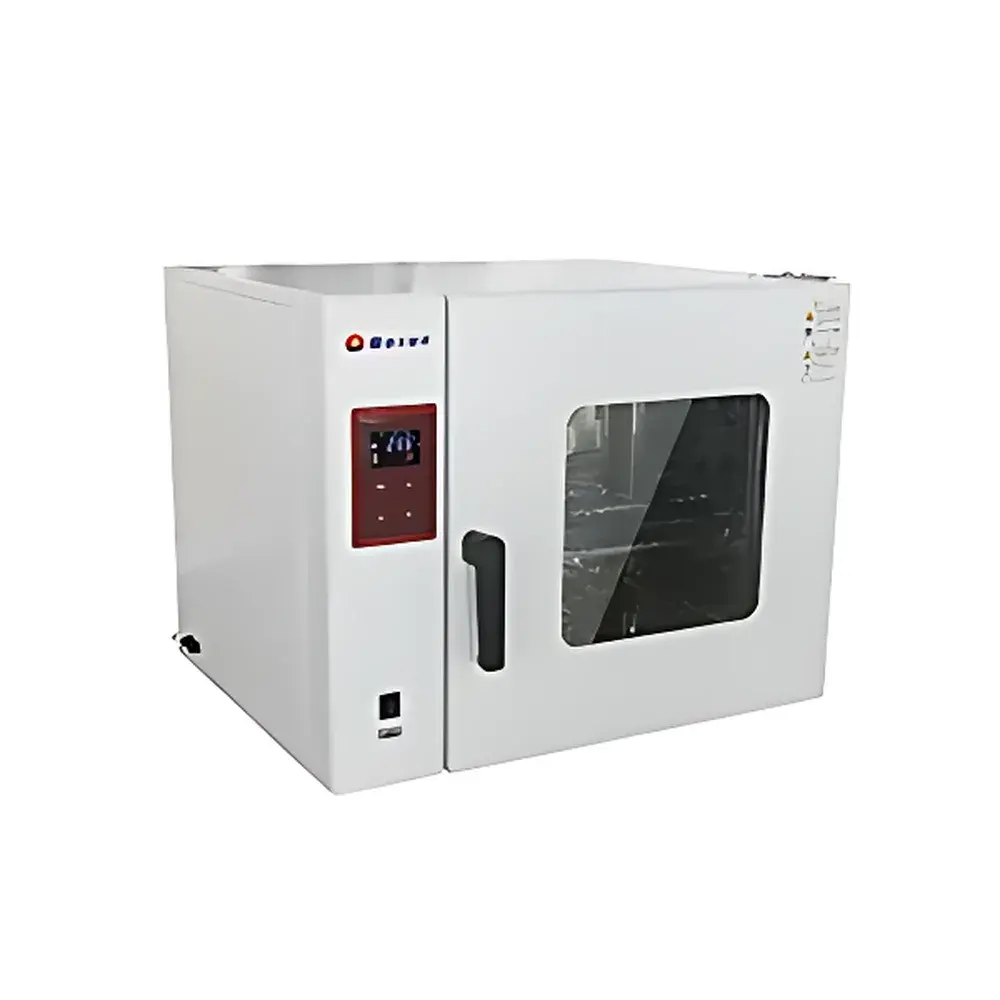
BOXUN BGZ-30 Forced-Air Laboratory Drying Oven
| Brand | BOXUN |
|---|---|
| Origin | Shanghai, China |
| Manufacturer Type | Direct Manufacturer |
| Region of Origin | Domestic (China) |
| Model | BGZ-30 |
| Instrument Type | General-Purpose Forced-Air Oven |
| Temperature Range | Ambient +5°C to 250°C |
| Temperature Uniformity | ±1°C (at setpoint) |
| Temperature Resolution | 0.1°C |
| Temperature Fluctuation | ±0.5°C (at 100°C) |
| External Dimensions | 640 × 485 × 525 mm |
| Internal Chamber Dimensions | 350 × 350 × 350 mm |
| Chamber Material | Mirror-Finish Stainless Steel (SUS304) |
| Heating Method | Forced-Air Convection with Adjustable Fan Speed |
| Power Supply | AC 220 V ±10%, 50 Hz ±2% |
| Rated Power | 550 W |
| Shelf Capacity | 2 Adjustable Stainless Steel Shelves |
| Timer Range | 0–99 h 60 min |
| Programmable Profile | 10 segments × 100 cycles |
| Communication Interface | RS-485 (Modbus RTU protocol) |
| Data Retention | Power-Fail Recovery with Non-Volatile Parameter Memory |
| Optional Accessories | Thermal Printer (curve logging), GPRS Remote Alert Module, PC-Based Supervisory Software |
Overview
The BOXUN BGZ-30 Forced-Air Laboratory Drying Oven is an engineered solution for precise thermal processing in routine laboratory environments. Designed around the principle of forced convection heating—where a calibrated axial fan circulates heated air uniformly across the chamber—it delivers consistent temperature distribution and rapid thermal recovery after door opening. Its operational envelope spans from ambient +5°C to 250°C, making it suitable for applications including moisture removal, thermal stabilization of samples, pre-weighing desiccation, polymer curing, and low-temperature sterilization of glassware and tools. The oven complies with fundamental design expectations outlined in ISO 17025:2017 for equipment used in testing laboratories, and its thermal performance aligns with common validation requirements for Class II dry heat processes per USP . The microprocessor-based controller ensures traceable operation through real-time parameter display, programmable ramp/soak profiles, and configurable alarm thresholds.
Key Features
- Mirror-finish SUS304 stainless steel interior chamber—resistant to corrosion, easy to clean, and compliant with GLP cleaning validation protocols
- Adjustable airflow system featuring a brushless DC motor and aerodynamically optimized impeller, enabling automatic fan speed modulation based on thermal load and setpoint deviation
- High-efficiency insulation using nano-porous ceramic fiber board (density ≥128 kg/m³), reducing surface temperature rise and improving energy efficiency
- Intelligent temperature control architecture with PID algorithm, 0.1°C resolution, and ±0.5°C stability at 100°C (per IEC 61000-4-3 immunity testing conditions)
- Large-view double-glazed observation window with silicone-sealed frame—enabling visual monitoring without compromising thermal integrity
- RS-485 serial interface supporting Modbus RTU protocol for integration into centralized lab management systems or SCADA platforms
- Non-volatile memory retention for all user-defined parameters—including program sequences, alarm settings, and timer values—ensuring continuity after unexpected power interruption
Sample Compatibility & Compliance
The BGZ-30 accommodates standard laboratory vessels including Petri dishes, weighing boats, crucibles, and glass sample jars up to 350 mm in height or width. Its uniform airflow design minimizes localized hot spots, ensuring reproducible drying kinetics across heterogeneous sample loads. The unit meets CE marking requirements for electromagnetic compatibility (EN 61326-1) and low-voltage safety (EN 61010-1). While not certified for explosion-proof or sterile barrier applications, it is routinely deployed in QC labs operating under ISO/IEC 17025-accredited quality systems. Documentation packages include factory calibration reports (traceable to NIM, China), electrical safety test records, and thermal mapping data (available upon request for IQ/OQ support).
Software & Data Management
The embedded controller supports direct connection to Windows-based PCs via RS-485-to-USB adapters. Optional supervisory software provides real-time graphing of chamber temperature, event logging (door open/close, alarm triggers, program completion), and export of CSV-formatted time-series data compatible with LIMS or statistical process control (SPC) tools. When equipped with the thermal printer option, the system generates hard-copy output of temperature profiles—including start/end timestamps, peak deviation, and dwell time compliance—meeting documentation requirements for FDA 21 CFR Part 11 when paired with appropriate electronic signature controls. Audit trails are maintained for all configuration changes, with timestamped entries stored in non-erasable memory.
Applications
- Moisture content determination per ASTM D2298 and ISO 712 for food, pharmaceutical excipients, and soil samples
- Drying of filter papers and gravimetric analysis substrates prior to ashing or titration
- Curing of epoxy-coated substrates and adhesive-bonded assemblies in materials R&D
- Conditioning of hygroscopic reference standards (e.g., potassium hydrogen phthalate) before primary calibration
- Pre-sterilization drying of reusable pipette tips, forceps, and stainless steel components in biosafety level 1/2 labs
- Accelerated aging studies of packaging materials under controlled thermal stress (ISO 11607-1 Annex C)
FAQ
What is the maximum recommended load volume for optimal temperature uniformity?
For guaranteed ±1°C uniformity across the entire chamber, the total sample volume should not exceed 40% of internal chamber volume (i.e., ≤17.2 L). Overloading may impair airflow and increase recovery time.
Does the BGZ-30 support validation-ready documentation for GxP environments?
Yes—factory calibration certificates, thermal mapping summaries, and IQ/OQ templates are available. Full 21 CFR Part 11 compliance requires integration with validated third-party software and administrative controls.
Can the oven operate continuously at 250°C for extended periods?
Yes—the heating elements and insulation are rated for continuous duty at maximum temperature; however, prolonged operation above 200°C may accelerate seal aging and requires quarterly verification of door compression integrity.
Is the RS-485 interface compatible with LabVIEW or Python-based automation frameworks?
Yes—Modbus RTU implementation allows native integration via standard VISA or pymodbus libraries; register maps and communication examples are provided in the technical manual.
What maintenance intervals are recommended for routine operation?
Fan filter inspection every 3 months; chamber cleaning with neutral detergent after each use involving volatile organics; annual verification of temperature sensor drift against a NIST-traceable reference thermometer.



