
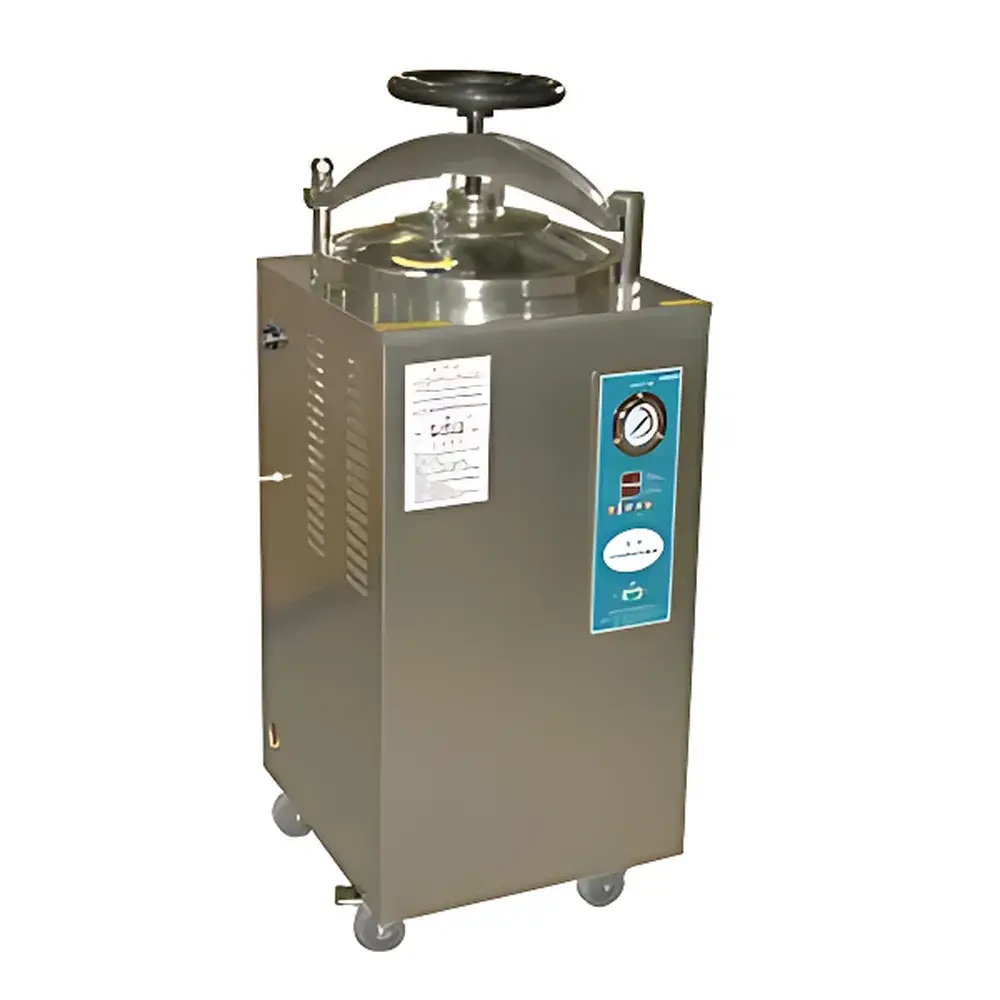
BOXUN YXQ-LB-50SII Vertical Steam Sterilizer
| Brand | BOXUN |
|---|---|
| Origin | Shanghai, China |
| Manufacturer Type | Direct Manufacturer |
| Product Category | Domestic |
| Model | YXQ-LB-50SII |
| Instrument Type | Vertical |
| Max Temperature | 135 °C |
| Max Pressure | 0.22 MPa |
| Chamber Dimensions | Φ400 × 630 mm |
| External Dimensions | 485 × 485 × 1120 mm |
| Chamber Volume | 50 L |
| Power | 3.1 kW |
| Voltage/Frequency | 220 V ±10%, 50 Hz ±2% |
| Temperature Range (Operating/Design) | 135 °C / 138 °C |
| Pressure Range (Operating/Design) | 0.22 MPa / 0.25 MPa |
| Timer Range | 0–120 min |
| Basket Dimensions | Φ360 × 240 mm × 2 units |
| Material | SUS304 stainless steel chamber, door, and baskets |
Overview
The BOXUN YXQ-LB-50SII Vertical Steam Sterilizer is a fully self-contained, microprocessor-controlled autoclave engineered for reliable saturated steam sterilization in laboratory, clinical, and research environments. It operates on the fundamental principle of moist heat sterilization—utilizing pressurized saturated steam at elevated temperatures to irreversibly denature microbial proteins and nucleic acids. With a validated operating range up to 135 °C and 0.22 MPa, the unit meets core requirements for sterilization cycles defined in ISO 17665-1 (Sterilization of health care products — Moist heat — Part 1: Requirements for the development, validation and routine control of a sterilization process for medical devices) and supports standard gravity-displacement and pre-vacuum-compatible protocols. Its 50-liter chamber volume accommodates common laboratory loads including wrapped instruments, glassware, culture media, textiles, and liquid preparations—making it suitable for routine decontamination in biomedical labs, veterinary clinics, agricultural research stations, and teaching facilities.
Key Features
- Self-locking handwheel-type fast-opening door with integrated safety interlock: prevents door opening under pressure and ensures mechanical and electronic dual verification before operation.
- SUS304 stainless steel construction throughout the chamber, door, and dual removable baskets—resistant to corrosion from repeated exposure to steam, condensate, and cleaning agents.
- Intelligent microcomputer control system with digital PID temperature regulation, real-time pressure monitoring, and automatic cycle sequencing (pre-heat, exhaust, sterilize, drying, cooling).
- Auto-cold-air purge function via self-expanding silicone gasket design—ensures complete air removal prior to sterilization for uniform heat distribution and cycle repeatability.
- Dual redundant safety systems: overtemperature protection (cut-off at 138 °C), overpressure relief valve (set at 0.25 MPa design limit), low-water-level alarm with automatic power cutoff, and pressure-dependent door lock enforcement.
- Acoustic end-of-cycle alert and LED status indicators provide unambiguous operational feedback; built-in test port enables thermocouple or biological indicator validation without compromising chamber integrity.
Sample Compatibility & Compliance
The YXQ-LB-50SII accommodates heterogeneous loads typical in academic and applied life science settings—including stainless steel surgical tools, borosilicate glass flasks and pipettes, cotton gauze and linen packs, agar-based culture media (in vented containers), and aqueous buffer solutions. Load configuration follows standard guidelines per EN 285 (Sterilization—Steam sterilizers—Large sterilizers) for load density and placement. The sterilizer supports documentation-ready operation when paired with optional thermal printer (RS232 interface); all cycle parameters—including time, temperature, pressure, and phase duration—are logged internally with timestamping. While not inherently 21 CFR Part 11 compliant out-of-the-box, audit-trail-capable data export (via USB or serial output) facilitates integration into GLP/GMP-aligned quality management systems where traceability and operator accountability are required.
Software & Data Management
The embedded controller provides non-volatile memory storage for ≥100 completed cycle records, each containing start/end timestamps, peak temperature/pressure values, and user-assigned batch identifiers. Cycle programming allows customization of sterilization duration (0–120 minutes), dwell temperature (up to 135 °C), and optional post-sterilization drying phases. Data export is supported via RS232 serial connection for external logging or LIMS integration. Optional thermal printer module delivers hard-copy cycle reports meeting basic record retention standards per ISO 13485 and local health authority requirements. Firmware updates are performed locally using supplied utility software—no cloud dependency or remote access functionality is implemented, preserving network security and regulatory boundary integrity.
Applications
- Routine sterilization of reusable surgical and diagnostic instruments in university teaching hospitals and outpatient clinics.
- Preparation of sterile microbiological growth media and reagents for bacteriology, mycology, and cell culture laboratories.
- Decontamination of biohazardous waste (e.g., used Petri dishes, pipette tips, contaminated PPE) prior to disposal or recycling.
- Validation support for sterilization process development—leveraging the standard test port for thermocouple insertion during IQ/OQ/PQ activities.
- Agricultural research applications requiring pathogen-free substrates, such as seed germination assays or soil microcosm studies.
FAQ
What is the maximum validated sterilization temperature and pressure?
Maximum operating temperature is 135 °C at 0.22 MPa; design limits are 138 °C and 0.25 MPa per ASME BPVC Section VIII compliance.
Does the unit support liquid cycle programming?
Yes—microprocessor logic includes dedicated liquid sterilization mode with controlled heating/cooling ramps to prevent boil-over and container rupture.
Is the chamber geometry compatible with standard ISO/EN-compliant load configurations?
Chamber dimensions (Φ400 × 630 mm) and dual-basket layout (Φ360 × 240 mm each) conform to Class B load capacity definitions under EN 13060.
Can cycle data be exported for regulatory review?
Yes—via RS232 interface or optional thermal printer; raw logs include full parameter traces and operator IDs for audit readiness.
What maintenance intervals are recommended for long-term reliability?
Weekly chamber seal inspection, monthly safety valve functional test, and annual calibration of temperature/pressure sensors by accredited service provider.



