
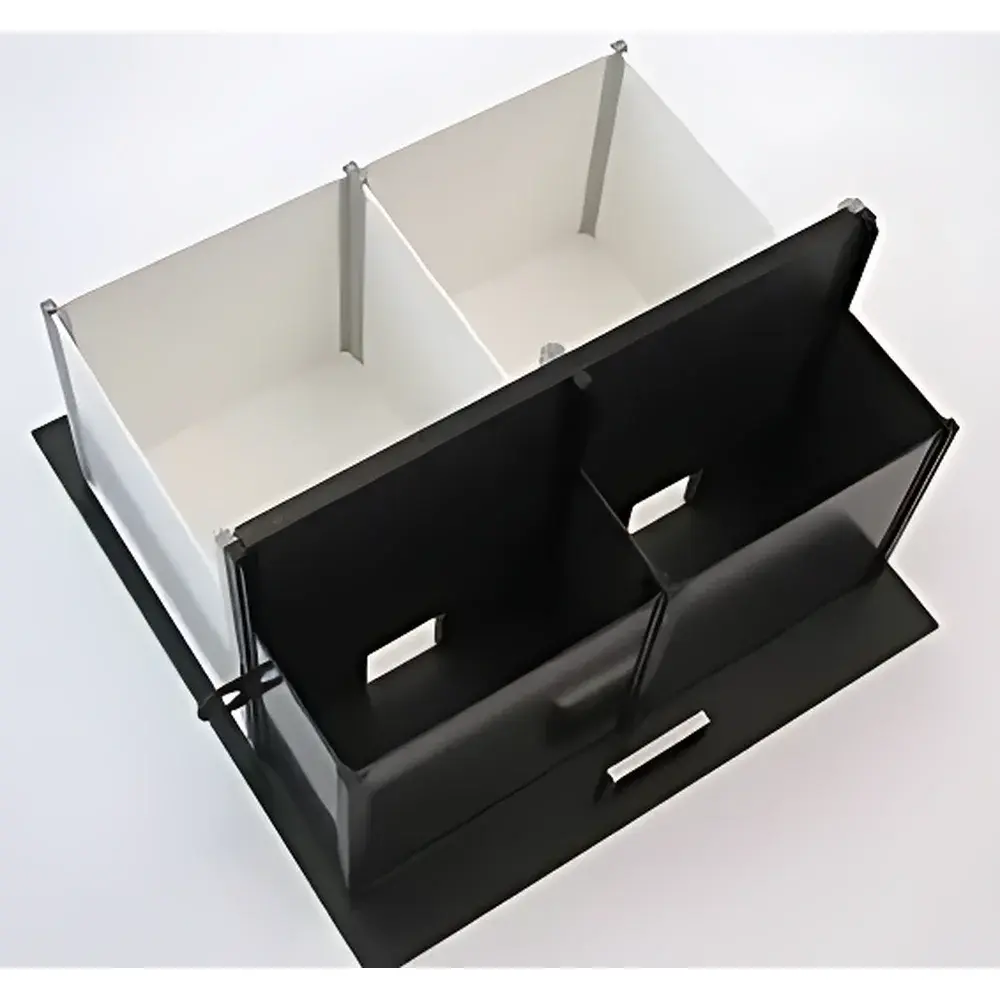
Light-Dark Test System by TSE Systems
| Brand | TSE Systems |
|---|---|
| Origin | Germany |
| Model | Light-Dark Test |
| Configuration Options | Two- or Three-Compartment Chamber (Single- or Dual-Animal Setup) |
| Integration | Compatible with TSE PhenoMaster®, VideoMot2® video tracking, ActiMot2® infrared beam frame, TSE Conditioning Systems & Multi-Conditioning Systems |
| Species | Mice and Rats |
| Regulatory Context | Designed for GLP-compliant behavioral phenotyping workflows |
Overview
The Light-Dark Test System by TSE Systems is a standardized, ethologically grounded apparatus engineered for the quantitative assessment of unconditioned anxiety-like behavior in rodents. It leverages the natural conflict between thigmotaxis-driven aversion to brightly illuminated open spaces and innate exploratory drive toward novel environments. This paradigm operates on well-established neurobehavioral principles: the light compartment induces mild stress through heightened sensory exposure, while the dark compartment provides refuge, enabling objective measurement of approach-avoidance dynamics. Unlike operant or learned fear assays, the Light-Dark Test requires no pre-training, food/water restriction, or reinforcement history—making it ideal for high-throughput pharmacological screening, genetic phenotyping, and longitudinal behavioral monitoring. The system is fully compatible with TSE’s modular phenotyping infrastructure, including PhenoMaster® metabolic cages and multi-parameter conditioning platforms, ensuring seamless integration into comprehensive preclinical study designs.
Key Features
- Modular chamber architecture supporting two-compartment (light/dark) or three-compartment (light–neutral–dark) configurations, with scalable dimensions for mice (standard: 25 × 25 × 30 cm) and rats (standard: 45 × 45 × 45 cm)
- Dual-animal testing capability via synchronized parallel chambers, enabling within-session control-treatment comparisons without inter-trial confounds
- Optimized illumination profile: light compartment maintained at 300–400 lux (measured at floor level), dark compartment <5 lux, with spectrally neutral white LED sources to avoid phototactic bias
- Opaque acrylic construction with non-reflective interior surfaces to minimize visual artifacts and ensure consistent contrast perception across strains
- Interchangeable floor inserts (perforated vs. solid) and wall textures to accommodate strain-specific locomotor profiles and tactile preference variables
- Standardized entry portal geometry (7 × 7 cm aperture) positioned at chamber midline to enforce unambiguous transition scoring
Sample Compatibility & Compliance
The system supports C57BL/6, BALB/c, CD-1, Sprague-Dawley, and Wistar strains under standard housing conditions (12-h light/dark cycle, ambient temperature 22 ± 2°C, humidity 50–60%). All hardware complies with ISO 17025-accredited calibration traceability for dimensional tolerances and photometric output. Behavioral protocols align with OECD Test Guideline 425 (Acute Oral Toxicity) and ICH S7A (Safety Pharmacology Studies), with built-in metadata tagging for audit-ready data lineage. When deployed in conjunction with TSE PhenoMaster® or VideoMot2®, the platform satisfies FDA 21 CFR Part 11 requirements for electronic records and signatures—including time-stamped, user-authenticated event logs, immutable raw video archiving, and version-controlled analysis scripts.
Software & Data Management
Behavioral parameters are extracted via TSE VideoMot2® software using adaptive background subtraction and sub-pixel centroid tracking (spatial resolution: 0.1 mm; temporal resolution: 30 fps). Primary endpoints include latency to first light-compartment entry, total time spent in light zone, number of transitions, rearing counts (via synchronized ActiMot2® infrared beam breaks), and distance traveled per zone. All metrics are exported in CSV/TSV format with ISO 8601 timestamps and animal ID cross-referencing. Integrated with TSE’s Phenotype Data Warehouse (PDW), datasets support automated statistical pipelines (ANOVA, mixed-effects modeling) and visualization dashboards compliant with MIAME and MINIMAR reporting standards.
Applications
- Preclinical evaluation of anxiolytic and anxiogenic compounds (e.g., benzodiazepines, SSRIs, CRF antagonists)
- Genetic validation of anxiety-related loci (e.g., knockout/knockin models of BDNF, 5-HT1A, GABAA receptor subunits)
- Neurodevelopmental disorder modeling (e.g., maternal immune activation, early-life stress paradigms)
- Chronic disease comorbidity studies (e.g., anxiety phenotypes in diabetic or hypertensive rodent models)
- Validation of non-pharmacological interventions (e.g., environmental enrichment, vagus nerve stimulation)
FAQ
What is the recommended acclimation period prior to testing?
Animals should be habituated to the testing room for ≥60 minutes under ambient lighting before placement in the apparatus.
Can the system be used for repeated measures design?
Yes—chamber surfaces are autoclavable and chemically resistant; validated protocols support up to three weekly sessions with ≥72-hour inter-test intervals.
Is illumination intensity adjustable?
Yes—TSE’s programmable LED controller allows fine-tuning from 50 to 1000 lux in 10-lux increments, with factory calibration certificates provided.
How does the system handle data synchronization across multiple modalities?
All TSE hardware modules (VideoMot2®, ActiMot2®, PhenoMaster®) share a common NTP-synchronized clock domain and exchange timestamped events via deterministic CAN bus protocol.
Are validation reports available for regulatory submissions?
TSE provides IQ/OQ documentation packages, including chamber dimensional verification, photometric uniformity maps, and software validation summaries aligned with GAMP5 Category 3/4 criteria.





